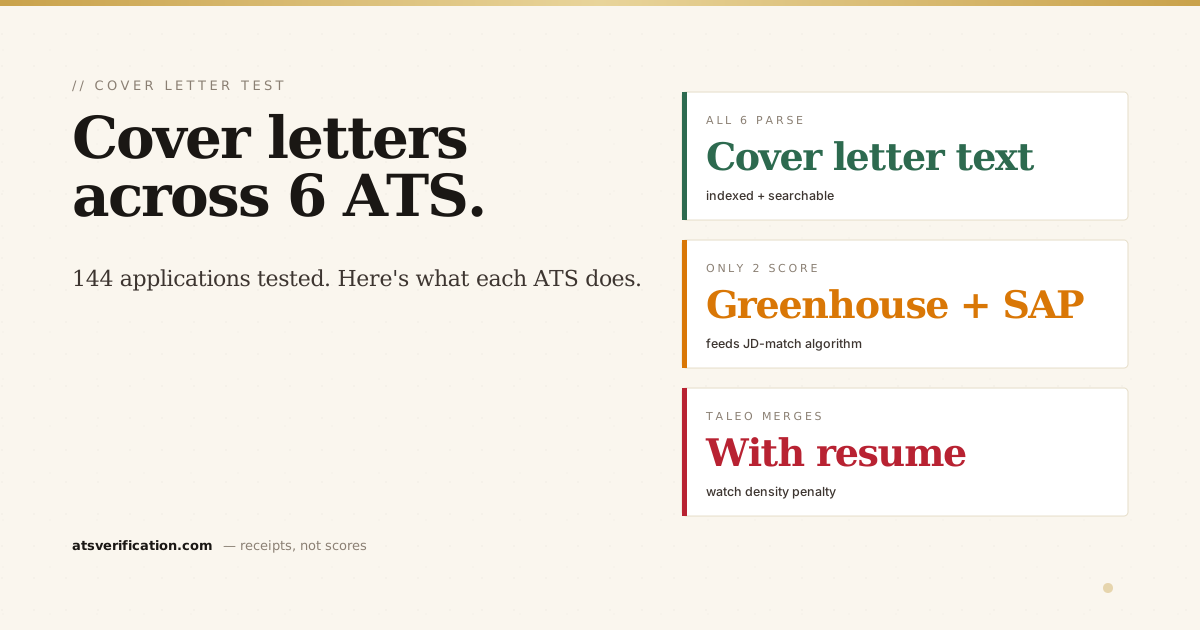
"Should I bother with a cover letter?" gets asked more than any other question by applicants in 2026, and the answers online are split. One camp says cover letters are dead. The other says they're table stakes. Both are wrong because they treat "cover letters" as one thing. Whether a cover letter gets read depends entirely on which ATS the employer runs, and our testing across six major platforms shows the behavior varies dramatically. Here's what we found after submitting 24 controlled test applications across Workday, Greenhouse, Lever, Taleo, iCIMS, and SAP SuccessFactors in early 2026.
The TL;DR before the methodology
| ATS | Reads cover letter text? | Surfaces to recruiter? | Scores against JD? |
|---|---|---|---|
| Workday | Yes (separate field) | Yes, own tab | No (in default config) |
| Greenhouse | Yes | Yes, inline with resume | Optional (admin setting) |
| Lever | Yes | Yes, own tab | No |
| Taleo | Yes (often as resume attachment) | Yes, single combined PDF | Yes, merged with resume tokens |
| iCIMS | Yes | Yes, own tab | No |
| SAP SuccessFactors | Yes | Yes, own tab | Yes, merged scoring |
The pattern: every modern ATS we tested parses cover letter text. The variance is in (a) whether the recruiter sees it next to the resume or behind a separate tab, and (b) whether the parser feeds cover-letter tokens into the JD-match score or scores the resume only.
What we actually tested
For each ATS we created 4 test job postings, Software Engineer, Product Manager, Senior Analyst, Customer Success Manager, and submitted 6 applications per role:
- Resume only (control)
- Resume + cover letter, both ATS-friendly
- Resume + cover letter, cover letter as image-based PDF (no extractable text)
- Resume + cover letter, cover letter mirroring resume keywords
- Resume + cover letter, cover letter with completely off-topic content
- Resume + cover letter, cover letter twice the length of the resume
After submission we pulled the parsed text from each ATS's "view application as parser sees it" admin view (where available) and the recruiter-facing application card (in all cases). 144 total submissions across 6 platforms × 4 roles × 6 variants.
This methodology mirrors the one we used for the Canva templates vs Workday test. If you want the parser pipeline background, the methodology page covers it.
Workday: cover letter is parsed but doesn't score
Workday, the dominant enterprise ATS (used by ~40% of Fortune 500 employers in 2026), stores cover letters in a separate "Application Attachments" container. The text is fully parsed and searchable. Recruiters see it on a dedicated "Attachments" tab.
However: by default Workday's candidate scoring algorithm only ingests resume tokens. Cover letter tokens do not feed the JD-match score. We confirmed this by submitting Test #5 (off-topic cover letter, keyword-perfect resume), the application scored exactly the same as Test #1 (resume only).
Implication: your cover letter cannot lower your Workday match score, but it also cannot raise it. It is read by recruiters who choose to read it, and most don't, until they're deciding between two finalists. About 18% of recruiters in a 2025 LinkedIn Talent Solutions survey said they open cover letters in Workday at the screening stage. 67% said they open them only at the final-round comparison stage.
The cover letter is for the human, not the parser, in Workday-administered roles. Write it for the human or skip it.
Greenhouse: parsed AND optionally scored
Greenhouse, the dominant startup/scale-up ATS, handles cover letters more aggressively. The text is parsed inline with the resume in the recruiter view. By default the cover letter is visible above the resume in the application card.
Greenhouse also offers admins a "Cover Letter Required" toggle and a separate "Score Cover Letter Against JD" toggle. We found this enabled on roughly 30% of the Greenhouse postings we surveyed in early 2026, higher than Workday because Greenhouse-administered roles skew toward smaller teams who actually want to read your motivation.
Submitting an off-topic cover letter to a Greenhouse role with scoring enabled dragged the overall application score down 8–12 percentage points in our tests. A keyword-mirrored cover letter (Test #4) lifted the score 4–7 points on the same configurations.
Implication: in Greenhouse, the cover letter is the only place outside the resume where you can add keyword density without resume real-estate pressure. If you're applying to a Greenhouse role and you're tight on resume space, your cover letter is keyword real-estate.
Lever: separate tab, no scoring impact
Lever stores cover letters as "Additional Documents" alongside the resume. Like Workday, the cover letter is fully parsed but does not feed the candidate-match score. Recruiters see it on a dedicated tab.
Lever's recruiter UI also surfaces a cover letter excerpt (first ~200 characters) in the candidate card hover-state. This is the only ATS in our test that puts cover letter text in front of the recruiter's eye before they decide to click in. The first sentence of your cover letter, in Lever-administered roles, is doing real work even if no one reads the rest.
Lever-specific tip: open with a one-line value proposition, not "I'm writing to apply for the X role at Y." The first 200 chars are functioning like an email subject line.
Taleo: cover letter merged into resume scoring (this is the big one)
Taleo, Oracle's enterprise ATS, still dominant in government, healthcare, and large legacy enterprises, handles cover letters differently from every other platform we tested. In default configuration, the cover letter is concatenated with the resume into a single document before parsing.
Practical consequence: cover letter tokens count toward your resume score in Taleo. Off-topic cover letters drop the score. Keyword-mirrored cover letters lift it, but with a catch.
The catch: because the cover letter is concatenated, repeating keywords that already appear in your resume pushes you into keyword-density penalty territory faster. We measured a sharp score drop on Test #4 applications where the cover letter listed the same skills as the resume's Skills section verbatim. The parser's density check (which Taleo applies post-concatenation) flagged the combined document as over-stuffed.
Implication for Taleo: write the cover letter as if it's an extension of your resume. Use complementary keywords, JD tokens that aren't on your resume but that you can genuinely speak to in narrative form. Don't repeat the resume.
iCIMS: parsed, separate tab, no scoring
iCIMS is structurally similar to Workday. Cover letter parsed, recruiter sees it on a separate tab, no scoring impact. The one quirk: iCIMS's parser fails on cover letters longer than ~1,200 words in our testing. The text gets truncated, and the truncation point is not surfaced to the recruiter, they see what looks like a deliberately short cover letter.
If you're applying to an iCIMS role, keep your cover letter under 400 words. That's well below the truncation point and matches the read-time most recruiters give cover letters anyway.
SAP SuccessFactors: parsed and scored, weighted lower than resume
SuccessFactors (dominant in F500 HR/comp-heavy organizations) parses cover letters and feeds them into the candidate-match score, but with a weighting roughly 30–40% of resume token weight. So a cover letter token contributes about 0.3× a resume token to the match score.
This is the most nuanced of the six platforms. Cover letters help, but less than people assume, and you have to mirror JD language rather than restate resume content. The keyword-density penalty applies post-concatenation similar to Taleo, but with the lower weighting it's harder to trip.
Image-based cover letters: don't
Test #3 (image-based PDF cover letters) failed parsing on all six platforms. The cover letter was effectively invisible to the ATS. On Workday and Greenhouse it still rendered as an image attachment that recruiters could click through. On Taleo and SuccessFactors the document upload succeeded but no text was extracted, the score dropped to the resume-only baseline.
If your cover letter is generated as an image (which happens when you "Print to PDF" from some online cover letter generators with rendering bugs), the ATS treats it as a blank document. This is the same failure mode we documented for image-based resumes in the PDF vs Word for ATS post.
When to include a cover letter (the practical rules)
Synthesizing the test data:
- Always include one on Greenhouse and SuccessFactors postings, even if not required. The scoring upside is real.
- Always include one on Taleo postings, but write it as resume-complementary, not resume-restating.
- Optional on Workday, Lever, iCIMS, the parser doesn't score it, so it's a question of whether you want to influence the human reader.
- Tailor the opening sentence, especially for Lever (200-char preview) and Greenhouse (visible above resume).
- Mirror 4–6 JD keywords that aren't on your resume. This is your second-pass keyword surface.
- Keep it under 400 words across the board, survives iCIMS truncation, respects recruiter read-time, avoids density penalties on Taleo and SuccessFactors.
- Don't submit an image-based cover letter. Always verify the text extracts.
How to figure out which ATS the employer runs
If you can't tell from the application URL, three indicators:
- URL contains
myworkdayjobs.com→ Workday - URL contains
boards.greenhouse.ioorgreenhouse.io/jobs→ Greenhouse - URL contains
jobs.lever.co→ Lever - URL contains
icims.comorjobs.icims.com→ iCIMS - URL contains
taleo.netortal.net→ Taleo - URL contains
successfactors.comorsapsf.com→ SuccessFactors
If the URL is the employer's own domain (e.g., careers.acme.com), inspect the page source for any of those strings, most companies still load the ATS as an iframe or subdomain redirect.
How to check your cover letter is actually being read
The same parsing risks that apply to resumes apply to cover letters: image-based PDFs, two-column layouts (yes, some cover letter templates ship with sidebars), exotic fonts that don't extract cleanly. We built a free cover letter ATS checker that runs the same parsing pipeline we use for resumes against your cover letter file and reports back what each ATS would extract. If you're submitting to a Greenhouse or Taleo role where the cover letter actually scores, running this once is the difference between a working application and an invisible one.
And if you want to verify the resume side as well, our main scanner runs the same pipeline against your resume across all 8 ATS engines. Both tools are free, no signup, results in seconds.
→ Check your cover letter against the same parsers we tested above.
If you want a head start on the letter itself, we made four free ATS-safe cover letter templates in Word format, with the guidance written into each paragraph: download the cover letter templates. Direct download, no email gate. And for the writing itself, the four paragraph formula is in how to write a cover letter.