Correction, 17 October 2026. Earlier versions of this article said the advice was "tested against 14 UAE graduate-hiring ATS configurations", listed which applicant tracking system named employers use, claimed those systems filter on Tawjihi scores, GPA thresholds and Nafis status, and gave graduate statistics and salary ranges. We have no records of that test, and those figures had no source, so we have removed them. We also removed programme names we could not verify, including Saudi programmes that do not apply in the UAE. The article now rests on UAE graduate CV conventions and on how resume parsers extract text, which you can check against our methodology.
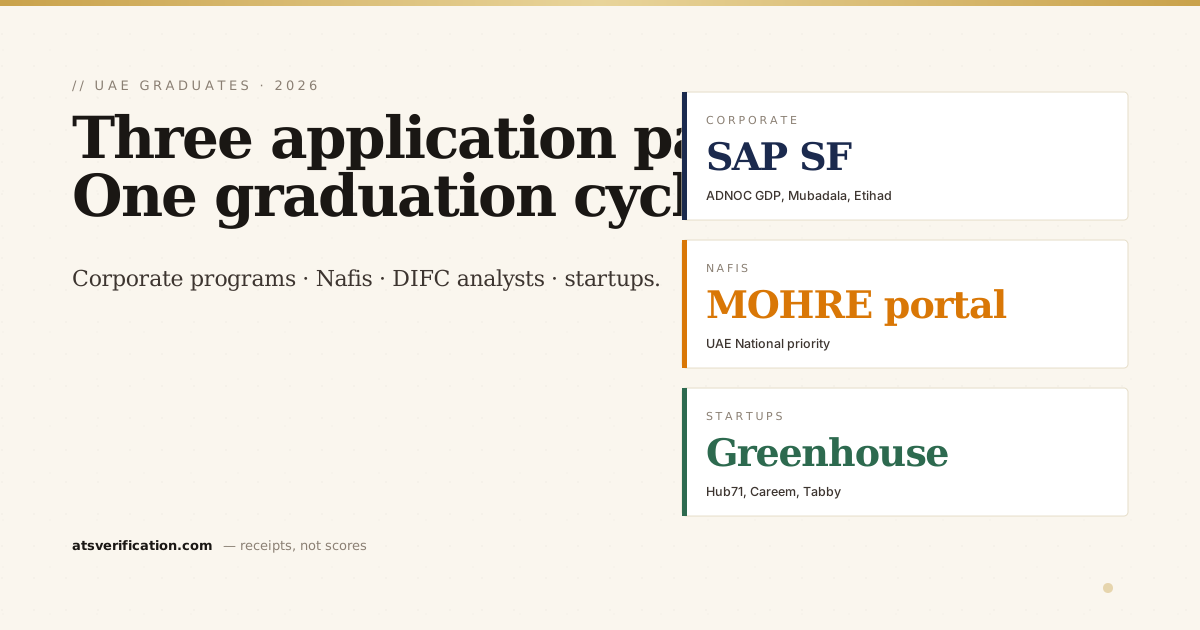
Fresh graduates in the UAE usually take one of three routes into a first job. Structured graduate programmes at large employers such as ADNOC, Emirates Group, Mubadala, Emirates NBD and Etihad, with formal application windows and assessments. Emiratisation routes for UAE Nationals, including the Nafis programme. And direct entry-level applications to multinationals, startups and smaller firms. Each route values slightly different things on a CV, but all of them run applications through software that has to read your file before anyone searches it. This guide is for graduates from AUS, AUD, Khalifa University, UAEU, Zayed University, NYU Abu Dhabi, Heriot-Watt Dubai, Middlesex Dubai, Murdoch Dubai, Birmingham Dubai, Sorbonne Abu Dhabi and similar universities.
Why UAE fresh-graduate CVs have their own conventions
UAE graduates come from local universities (UAEU, Khalifa University, Zayed University, Higher Colleges of Technology, AUS, AUD) and international branch campuses (NYU Abu Dhabi, Sorbonne Abu Dhabi, Heriot-Watt, Middlesex, Murdoch, Birmingham and others). Some are UAE Nationals, and many are expat graduates who grew up in the UAE.
The routes differ accordingly. UAE Nationals can access Emiratisation programmes, including Nafis, and many government and government-related graduate programmes prioritise Emirati candidates. Expat graduates compete for graduate-programme places at multinationals and UAE companies, internship-to-full-time conversions, and direct entry-level roles.
The CV conventions differ too. A government-related programme may expect a full personal details block; a startup won't want one. Keep a version per route.
Corporate graduate programmes (ADNOC, Mubadala, Emirates Group, Etihad, DP World, Emirates NBD)
Large UAE employers run graduate and trainee programmes with fixed application windows, online assessments and interviews. Names, eligibility and timing change from year to year, so check each employer's careers page for the current intake.
Personal details (when the application asks)
- Photo in the body of the page, date of birth written out, nationality, and UAE National status stated clearly if it applies
- Visa status for expats, as one line: "Family visa" / "Student visa" / "UAE Resident"
- Languages with proficiency: Arabic and English (Native / Fluent / Conversational / Basic), plus any others
- School results (Tawjihi, 12th grade, A-levels or IB), if the programme asks for them
Education, full academic history
- University name (full name and abbreviation), degree, major, graduation date (or expected date)
- Cumulative GPA on the scale your university uses (often 4.0 in the UAE). Include it if it's strong or if the programme asks for it
- Relevant coursework, the 4 to 6 courses most relevant to the role
- Capstone or final-year project, title, one-line description, methods used and outcome
- Academic awards, Dean's List, scholarships, exchange programmes, competitions
- For foreign degrees: attestation status, "Degree attested" or "Attestation in progress"
Internships and projects, the differentiator
For most graduates, internships are the only professional experience on the CV. Give them the same treatment as a full-time job:
- Employer, dates and duration, for example "Summer Intern, EnergyCo, Jun–Aug 2025 (12 weeks)"
- Team or department, for example "Reservoir Engineering"
- A number for what you did, even if it's small: "Built a dashboard tracking daily production for 12 wells"
- If the internship was part of a university or government programme, name it
Bank and multinational graduate programmes
Local banks and global firms in DIFC and ADGM run graduate, analyst and summer programmes. Conventions differ by employer:
Resume conventions
- For global firms: international format, no photo, no date of birth, LinkedIn URL, university and GPA prominent
- For local banks: a photo and personal details are acceptable if the application asks for them
- If you interned at the same firm, say so prominently. A successful internship is one of the clearest routes into a graduate offer
- Strong, quantified bullets on coursework projects, for example "Built a DCF valuation model for a USD 200M target company in a final-year project; presented to an industry panel"
The Nafis route (UAE Nationals)
Nafis is the federal programme, launched in 2021, that supports UAE Nationals into private-sector jobs through training, salary support and job matching. For UAE National graduates it's a major entry route. Check the official Nafis platform for current benefits and eligibility.
Resume conventions for UAE Nationals
- "UAE National" stated clearly in the contact line, so a recruiter sees it immediately
- Nafis participation, if it applies: "Enrolled in Nafis [programme name]"
- National Service, for male UAE Nationals: "Completed UAE National Service, [dates]" or "Currently completing UAE National Service"
- Arabic proficiency stated clearly; many Emiratisation-focused roles value it
- School results (Tawjihi or equivalent), if the programme asks for them
- Government-backed training programmes you've completed, by their official names
Startups and tech (Hub71 companies, fintech, product companies)
UAE startups and tech companies follow international conventions for entry-level hiring.
Resume conventions
- Single column, no photo, no date of birth, no marital status
- LinkedIn URL, plus GitHub and portfolio URLs for technical roles
- University and GPA in compact form ("BSc Computer Science, NYU Abu Dhabi, GPA 3.7/4.0")
- Capstone and side projects with deployed URLs or GitHub repositories
- Hackathons, programming contests, Kaggle or CTF results for technical roles
- Internships (paid or unpaid) with quantified outcomes
- For non-technical entry-level roles (marketing, operations, customer success): case competitions, business-plan competitions, Model UN, student leadership
The 5 most common UAE fresh-graduate resume mistakes
1. Burying internships under "Other Experience"
For fresh graduates, internships are professional experience. List them under "Experience", exactly as you'd list a full-time role. A heading like "Experience" is one a parser recognises, and recruiters read that section first.
2. Leaving out UAE-specific details the programme asked for
If you're a UAE National, say so in the header. If you're an expat with a foreign degree, give attestation status. If the programme's eligibility criteria ask for school results or GPA, include them. International graduates often miss these, and a recruiter then has to chase you or move on.
3. Listing every course you took
Some graduate templates list every course from university. Recruiters find it unhelpful, and it buries the courses that matter. List the 4 to 6 most relevant under "Relevant Coursework".
4. Generic "looking for opportunities" objective
Most graduate CVs open with this. Replace it with a short summary naming the target role, your academic preparation and one or two key projects. "Recent BSc Computer Science graduate (NYU Abu Dhabi, GPA 3.7) seeking a software engineering role in distributed systems. Capstone: event-driven payments prototype on AWS. ICPC regional bronze medal." Specific and searchable.
5. Getting GPA wrong
Many graduate programmes publish minimum GPA or grade requirements, and some ask for GPA on the application form whatever you put on the CV. Check the eligibility criteria before you apply. If your GPA is modest and the programme doesn't ask for it on the CV, lead with what's stronger: relevant coursework, capstone outcomes, internships and projects. Never round a GPA up.
Which applicant tracking system will read your CV?
We don't publish a list of which UAE employer uses which system. Employers change vendors, run different systems in different divisions, and often hire through agencies, so any such list goes stale. You can check a specific employer yourself: open one of their job postings and look at the address of the apply page. Common patterns include myworkdayjobs.com (Workday), successfactors.com or successfactors.eu (SAP SuccessFactors), taleo.net (Oracle Taleo), greenhouse.io (Greenhouse) and lever.co (Lever). Whatever the system, the safe format is the same: one column, standard headings, real text rather than images, and contact details in the body of the page.
Notes for popular UAE graduate routes
ADNOC
- UAE National status stated clearly; Emirati candidates are a priority for many ADNOC programmes
- Attestation status for foreign degrees, GPA, internships in energy, and student memberships such as SPE
- English and Arabic proficiency
Mubadala
- UAE National status stated clearly if it applies
- Strong academic record, capstone, and internships in investment, consulting or related fields
Emirates Group
- Strong English, and any additional languages you speak
- Customer-facing experience (retail, hospitality, tourism) is relevant for many roles
- Cadet pilot and cabin crew routes have their own requirements; follow them exactly
Emirates NBD and UAE banks
- ACCA or CFA student status if you've started, and any banking internship
- Arabic is an advantage for branch and relationship roles
Hub71 companies and fintech
- GitHub URL for technical roles, side projects with deployed URLs, hackathons and open-source contributions
- English CV; Arabic is an advantage for Emiratisation-focused roles
How to check your graduate resume before you apply
Before submitting to any UAE graduate programme, run your resume through our free ATS scanner. It reads your file with our own parser and will:
- Check that your name and contact details are found, and that they aren't only in the page header or footer
- Check for recognisable Education, Experience and Skills headings
- Flag two-column layouts and sidebars that scramble the reading order
- Catch table cells that come out glued together, a common problem with grades and skills tables
- List personal details a recruiter may not want, such as date of birth, marital status and ID numbers. On a traditional Gulf version you may keep some of these on purpose; on an international version, remove them.
It can't tell you how a particular employer's system is configured; our methodology page explains what it checks. The scan is free, with no signup. Our $5 Verbatim Rebuild turns your existing wording into a clean single-column .docx and PDF.
Related guides for UAE fresh graduates
- UAE ATS landing page, pricing in AED + quick-start scan
- Dubai UAE Resume Format 2026, companion general post
- UAE Finance Resume Format 2026, for graduates targeting banking, DIFC or investment roles
- UAE Engineer Resume Format 2026, for engineering graduates
- UAE Sales Resume Format 2026, for graduates targeting SDR/BDR or property sales roles
- ATS Resume for Fresh Graduates (global), broader US/UK conventions
- How to tailor a resume to a job description, applicable to graduate-programme applications
→ Run a free ATS scan on your graduate-application resume, check that your education and internships read cleanly before submitting to ADNOC, Mubadala, ENBD, Etihad, or any UAE graduate programme.