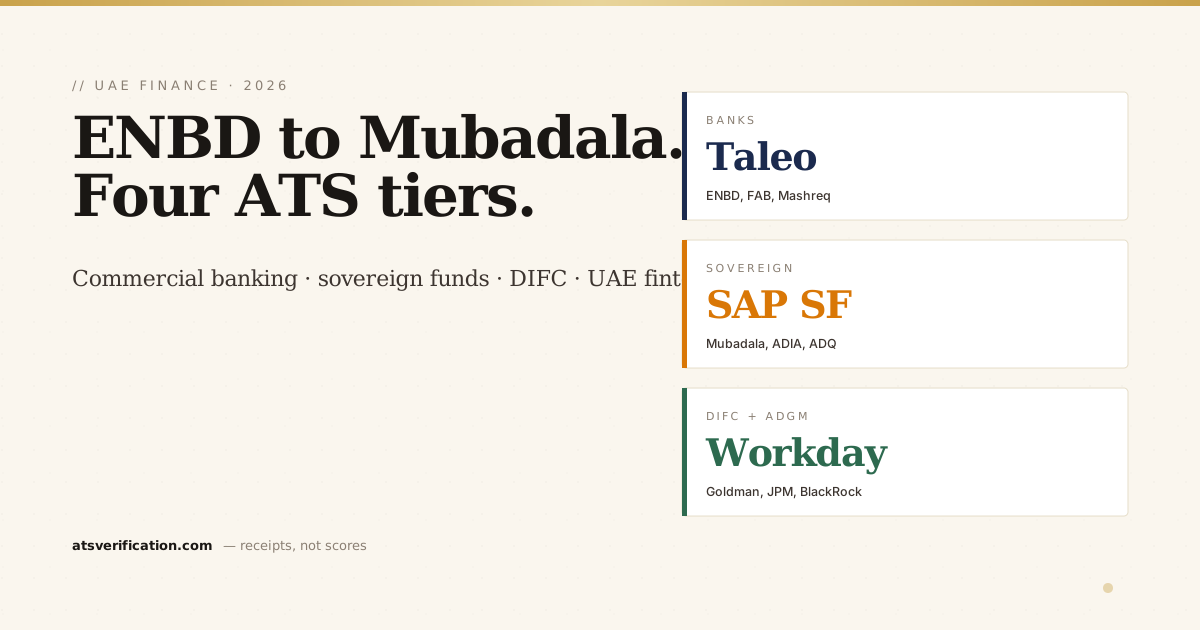
Correction, 17 October 2026. Earlier versions of this article stated which applicant tracking system named UAE banks, funds and firms use (with migration dates), referred to "UAE finance cohort scans", and gave market-size figures and salary ranges. We have no records of those scans, and those figures had no source, so we have removed them. The article now rests on the credentials and conventions UAE finance employers expect and on how resume parsers extract text, which you can check against our methodology.
Finance hiring in the UAE spans four different kinds of employer. Local commercial and Islamic banks (Emirates NBD, FAB, Mashreq, ADCB, DIB, ADIB). Sovereign and government-related investors (Mubadala, ADIA, ADQ, ICD). Global financial firms in DIFC and ADGM. And a growing fintech sector (Tabby, Tamara and others). Each expects different things on a CV, from a personal details block to regulatory registrations to unit economics. The layout rules are the same for all of them, because every applicant tracking system (ATS) has to read your text before a recruiter can search it. Here's the playbook, written from inside the UAE finance market.
Why UAE finance hiring is different
The UAE has one of the deepest concentrations of financial-services employers in the region: local banks, Islamic banks, sovereign and government-related investors, family offices, the global firms in DIFC and ADGM, and fintech. A finance professional might apply to a credit-risk role at a local bank, a treasury role at a sovereign investor, an associate role at a DIFC firm and a product-finance role at a fintech in the same month.
Those four employers want four different things. A traditional Gulf CV with a photo and a personal details block reads as normal at many local banks and looks out of place at a DIFC firm. A lean international CV without attestation status or language proficiency can look incomplete to a government-related investor. One CV everywhere means uneven results. Keep a version per type of employer.
Commercial and Islamic banks (ENBD, FAB, Mashreq, ADCB, CBD)
Many UAE banks are used to the traditional Gulf CV, and some application portals ask for personal details. Follow the form. If it asks, include:
Personal details (when asked)
- Photo: professional headshot in the body of the page, not the page header
- Date of birth: written out, for example "15 Mar 1990"
- Nationality: relevant to Emiratisation reporting
- Visa status: one line such as "Employment visa" / "Family visa" / "UAE National", with no ID numbers
- Languages with proficiency: Arabic and English (Native / Fluent / Conversational / Basic), plus Hindi or Urdu for client-facing roles where relevant
Certifications, surface prominently
Bank recruiters search for specific certifications. Put them in a Certifications section near the top, one per line, not buried at the bottom:
- ACCA, very common in UAE banking and finance; write "ACCA Member" or "ACCA Affiliate" with the year
- CFA Level 1/2/3, for investment, asset management and research roles
- CISI (Chartered Institute for Securities & Investment), often required for regulated client-facing investment roles
- SCA registration, if you hold or held a role registered with the UAE Securities and Commodities Authority, state the function
- FRM (Financial Risk Manager), for credit, market and operational risk
- CAMS, for anti-money-laundering and compliance roles
- CPA (US), valued at US-linked multinationals
Islamic finance for Islamic banks
Dubai Islamic Bank, Abu Dhabi Islamic Bank, Emirates Islamic, Sharjah Islamic Bank and the Islamic windows of conventional banks look for explicit Islamic finance experience. Surface:
- Islamic products you've worked on (Murabaha, Ijara, Sukuk, Takaful, Mudaraba, Musharaka)
- AAOIFI standards
- IFSB standards, if relevant
- Work with a Sharia Supervisory Board, for senior roles
Sovereign and government-related investors (Mubadala, ADIA, ADQ, ICD)
Government-related investors are often comfortable with the traditional Gulf CV, and their portals may ask for personal details. The content that matters most is your investment record.
Personal details, GCC convention (when asked)
- Photo, date of birth, nationality, visa status, languages with proficiency
- UAE National status, stated clearly if it applies
- Degree attestation for foreign degrees: "Degree attested; MoE equivalency certificate available on request", if true
Deal experience in USD
Investment teams care about deal sizes and outcomes. Quantify in USD:
- Transaction value (acquisitions, divestments, IPOs, debt issuance)
- Portfolio AUM and asset-class mix
- Capital deployed or committed
- Returns (IRR, MOIC, TVPI for private equity; Sharpe or alpha for public markets)
Credentials and background
- MBA from a well-known business school, if you have one, near the top
- CFA charter, for investment roles
- CAIA, for private equity, real estate and infrastructure roles
- Prior employers in banking, consulting or asset management, named clearly so a recruiter can search for them
DIFC and ADGM global firms
DIFC (Dubai International Financial Centre) and ADGM (Abu Dhabi Global Market) host the regional offices of many global banks, asset managers and hedge funds. They usually follow their head-office CV conventions.
What to remove from a traditional Gulf CV
- Photo, date of birth, marital status
- Detailed visa information (a single "UAE Resident" line at most)
- 12th-grade or Tawjihi percentages
- Driving licence
What to add or emphasise
- LinkedIn URL in the header
- Regulatory frameworks you've worked with: IFRS 9, IFRS 16, Basel III, MiFID II, EMIR, AML/CFT, FATCA, CRS
- DFSA / FSRA registration history, DIFC's Dubai Financial Services Authority and ADGM's Financial Services Regulatory Authority register individuals in certain functions. State it if it applies, for example "Previously DFSA Authorised Individual"
- Prior employers, named clearly
- Deal or portfolio experience in USD
UAE fintech (Tabby, Tamara and peers)
UAE fintech companies follow international startup conventions:
- Single column, experience first, quantified bullets
- GitHub URL for engineering-adjacent finance roles, if relevant
- Unit economics for product-finance roles: CAC payback, LTV/CAC, contribution margin, gross margin trend
- Payments-domain experience named explicitly (acquiring, issuing, processing, BNPL, embedded finance)
- English CV is standard; an Arabic version only if the advert asks
The 5 most common UAE finance resume mistakes
1. One resume submitted everywhere
The most common mistake: one CV built for one type of employer, sent to all four. A traditional CV with photo, date of birth, marital status and driving licence looks dated at a DIFC firm. A lean international CV can look incomplete at a government-related investor that expects attestation status and language proficiency. Keep a version per employer type and switch between them.
2. Burying ACCA / CFA credentials at the bottom
Finance recruiters search for credentials first. If "ACCA" sits at the bottom under "Other", or inside a long sentence, it's easy to miss. Put certifications in a section near the top, or in your headline ("Senior Credit Analyst | ACCA | 8 years UAE wholesale banking").
3. AED and USD mixed inconsistently
Pick one currency per CV version. AED for local bank applications. USD for DIFC firms and sovereign investors, which often report in dollars. Mixing them within one CV reads as careless.
4. Emirates ID or passport number listed
Older UAE templates from job boards still include ID numbers. No recruiter needs them to shortlist you, and they create unnecessary exposure when your CV is forwarded. State only "UAE Resident · Employment visa" or "UAE National". HR collects ID documents after an offer.
5. Generic "Open to opportunities in Dubai" opener
Recruiters see this line constantly. Replace it with a 2-line professional summary that names the role and sector. "Senior credit-risk analyst, 8 years in UAE wholesale banking and IFRS 9 modelling" is specific and searchable, and it uses the most-read lines on the page well.
Which applicant tracking system will read your CV?
We don't publish a list of which UAE employer uses which system. Employers change vendors, run different systems in different divisions, and often hire through agencies, so any such list goes stale. You can check a specific employer yourself: open one of their job postings and look at the address of the apply page. Common patterns include myworkdayjobs.com (Workday), successfactors.com or successfactors.eu (SAP SuccessFactors), taleo.net (Oracle Taleo), greenhouse.io (Greenhouse) and lever.co (Lever). Some family offices and smaller firms have no ATS at all and take CVs by email. Whatever the route, the safe format is the same: one column, standard headings, real text rather than images, and contact details in the body of the page.
Employer notes for UAE finance professionals
Emirates NBD (ENBD)
- Surface ACCA, CFA, CISI and FRM prominently, plus any SCA registration for regulated roles
- For Emirates Islamic roles, name Islamic finance products you've worked on
First Abu Dhabi Bank (FAB)
- For commercial banking roles, the same credentials as above
- For investment-banking roles, a deal sheet (transactions, sizes, your role) matters most
Mubadala Investment Company
- Deal experience in USD, CFA and MBA credentials near the top
- State UAE National status clearly if it applies; bilingual Arabic and English is an advantage
ADIA (Abu Dhabi Investment Authority)
- Investment roles look for buy-side experience and strong professional credentials such as the CFA charter
- Hiring processes for senior roles can be long; alumni networks and referrals help
DIFC firms
- International format: no photo, no date of birth, LinkedIn URL
- Regulatory experience (Basel III, MiFID II, IFRS 9) and any DFSA or FSRA registration
Tabby / Tamara (UAE fintech)
- Payments-domain experience named explicitly
- Unit economics and cohort metrics for product-finance roles
How to check your finance resume before you apply
Before submitting to any UAE finance employer, run your resume through our free ATS scanner. It reads your file with our own parser and will:
- Check that your name and contact details are found, and that they aren't only in the page header or footer
- Flag two-column layouts and sidebars that scramble the reading order
- Catch table cells that come out glued together, a common problem with certification and skills tables
- Flag year-only or unusual date formats
- List personal details a recruiter may not want, such as date of birth, marital status and ID numbers. On a traditional Gulf version you may keep some of these on purpose; on an international version, remove them.
It can't tell you how a particular employer's system is configured; our methodology page explains what it checks. The scan is free, with no signup. If you want a rebuilt version, our $5 Verbatim Rebuild turns your existing wording into a clean single-column .docx and PDF.
UAE finance roles are also shifting from recording to business partnering. If you want the bigger picture on where finance careers are heading, read the future of finance jobs.
Related guides for UAE finance professionals
- UAE ATS landing page, pricing in AED + quick-start scan
- Dubai UAE Resume Format 2026, companion general-purpose post covering all roles
- ATS resume guide for finance professionals (global), broader US/UK/EU finance-resume conventions
- UAE ATS resume guide (general), covers all sectors at a higher level
- Saudi Arabia Resume Format 2026, for UAE-based finance professionals applying across the GCC
- How to tailor a resume to a job description, targeted edits without keyword stuffing
- Workday ATS guide, how Workday applications work
- SAP SuccessFactors guide, how SuccessFactors applications work
→ Run a free ATS scan on your finance resume, confirm it reads cleanly before submitting to ENBD, FAB, Mubadala, DIFC firms, or any UAE finance employer.