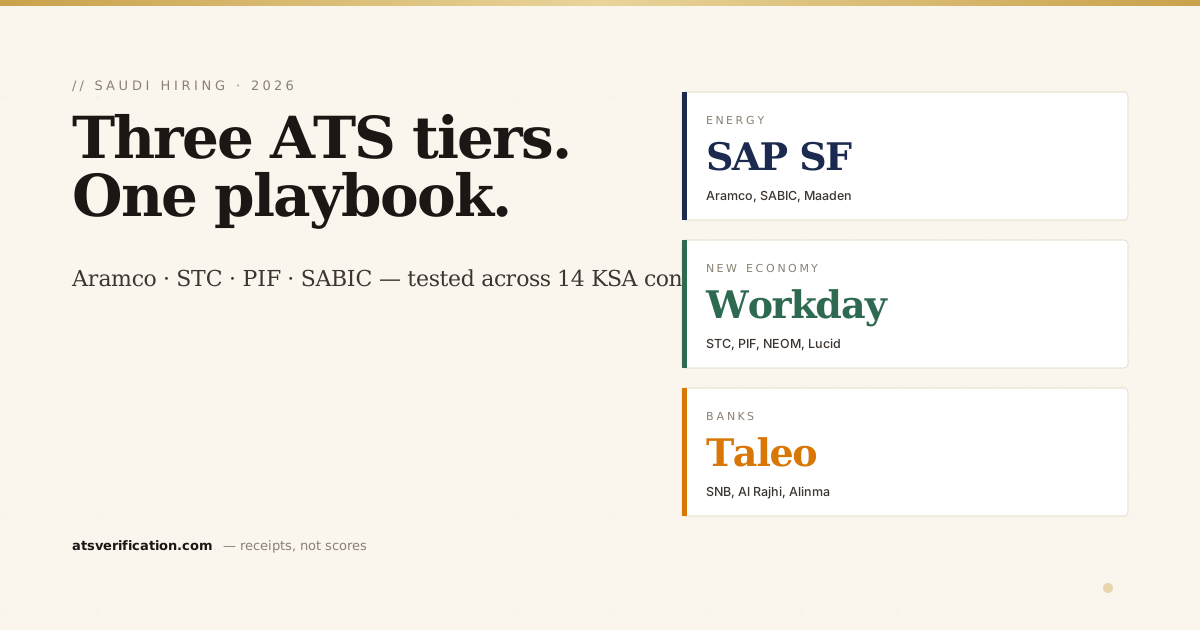
Correction, 17 October 2026. Earlier versions of this article said the advice was "tested against 14 Saudi ATS configurations", referred to "Saudi cohort scans", stated which applicant tracking system named Saudi employers use (with rollout dates), and gave hiring volumes, market-share figures, school-score thresholds and salary ranges. We have no records of that test or those scans, and those figures had no source, so we have removed them. The article now rests on Saudi CV conventions and on how resume parsers extract text, which you can check against our methodology.
Saudi hiring has changed fast since Vision 2030. Aramco, STC, PIF, SABIC, NEOM, Red Sea Global, Lucid and a long list of PIF portfolio companies are recruiting for roles that barely existed a few years ago. Saudization, formalised in the Nitaqat programme, pushes employers to hire Saudi nationals into roles that were often held by expats, so many Saudi candidates are entering corporate hiring for the first time. Expats who built long Gulf careers face the opposite pressure: their residency is tied to their job. Whichever side you're on, most large Saudi employers run applications through an applicant tracking system (ATS) that has to read your CV before a recruiter can search it. Here's how to build a CV that reads cleanly and meets Saudi expectations.
The Vision 2030 hiring shift
Vision 2030 (vision2030.gov.sa) is the blueprint behind the change: reducing oil dependency, building tourism (Red Sea Global, AlUla, Diriyah), launching giga-projects (NEOM, Qiddiya, ROSHN), and growing financial services. Each of these means new corporate hiring, and most of that hiring runs through recruitment software.
For job seekers, two things follow. The volume of applications per role is high, so recruiters search and filter rather than read everything. And employers differ: established energy and petrochemical companies are often used to the traditional Gulf CV, while PIF portfolio companies, multinationals and startups usually follow international conventions. (Before the resume itself, the wider search strategy, Vision 2030 sectors, job sites, Saudization and the government platforms, is in how to find a job in Saudi Arabia.)
The traditional Gulf CV (common at energy and petrochemical employers)
Aramco, SABIC, Maaden, Sipchem, Saudi Kayan and other established employers recruit at scale, and many candidates applying to them use the traditional Arab-world CV. If the application form asks for personal details, include them. Keep them short:
Personal details (when the employer expects them)
- Photo: professional, passport-style, in the body of the page next to your name, not in the page header
- Date of birth: written out, for example "15 Mar 1990", so it can't be misread as a US-style date
- Nationality: relevant to Saudization reporting
- Iqama status (for expats): one line such as "Transferable Iqama", with no Iqama number
- Languages with proficiency: Arabic and English (Native / Fluent / Conversational / Basic), plus others if relevant
- Driving licence: a Saudi licence, if the role involves field work or travel
Marital status still appears on some Gulf CVs. It isn't needed for any role; leave it out unless a form asks.
Education section, full history
Traditional applications often ask for complete academic history. Include:
- Highest degree, university, year, GPA or grade
- Previous degrees with the same detail
- Secondary-school results, if requested: the Saudi secondary certificate for Saudi candidates, or the equivalent (12th grade for Indian or Pakistani candidates, A-levels for the British system)
- Saudi equivalency (Mu'adalah) status for foreign degrees, if you have it
Experience section
List roles in reverse chronological order, including:
- Employer name and location (city and country)
- Role title in English (with Arabic in parentheses if useful for Saudization-focused roles)
- Dates as "Mar 2020 – Aug 2024"; avoid all-numeric dates, which can be read as day/month or month/day
- 4 to 6 bullets per role, quantified in SAR or USD where relevant
The international CV (PIF companies, multinationals, startups)
STC, PIF and its portfolio companies (NEOM, Red Sea Global, ROSHN, Qiddiya and others), multinationals and startups usually follow international conventions: no personal details, experience first.
What to remove from the traditional version
- Photo, not expected, and an image carries no text a parser can use
- Date of birth, not needed to assess you
- Marital status, same reason
- Iqama details, handled by HR after an offer; one short line at most
- School percentages, irrelevant once you have several years of experience
- Driving licence, only if the job requires field travel
What to add or emphasise
- LinkedIn URL in the header
- Quantified bullets in one currency; USD is common for roles that report to global or investor audiences, SAR for Saudi-only roles
- Vision 2030 alignment, if your work touches a Vision 2030 theme (sustainability, tourism, digital transformation, manufacturing, healthcare, financial services), name it in your summary
- Saudization-relevant experience, frame experience around the skills employers are building locally
Banks (SNB, Al Rajhi, Alinma, Riyad Bank)
Saudi banks are often comfortable with the traditional CV, and some application forms ask for personal details. Sector content matters most:
- Follow the form on photo and date of birth
- Professional certifications, CFA, CPA, ACCA, FRM, CISI and any local regulatory qualifications, in a Certifications section near the top
- An Arabic version is worth having ready; many banks work in both languages
- Islamic finance experience, named explicitly for Al Rajhi and Alinma (both Islamic banks) and Islamic-banking roles elsewhere
The 5 most common Saudi resume mistakes
1. Sending one resume to every employer
The most common mistake: one CV built for one kind of employer, sent to all of them. A traditional CV with photo, date of birth and marital status can look dated at a PIF company or multinational. A lean international CV can look incomplete to an employer whose form asks for full academic history. Keep two versions and switch between them.
2. Arabic-only or English-only when both are expected
Some Saudization-focused and government-related roles ask for, or prefer, both an Arabic and an English CV. If the advert is in Arabic, or the role is customer-facing in Arabic, have an Arabic version ready.
3. Ambiguous date formats
Saudi convention often uses DD/MM/YYYY, and Hijri dates appear on some documents. All-numeric dates can be read as day/month or month/day by any parser, and Hijri dates may not be recognised at all. The safest format is "Mar 2020 – Aug 2024" in Gregorian months.
4. Listing Iqama details nobody asked for
Older Saudi templates include Iqama number, sponsor name, transfer status and expiry date. No recruiter needs the number to shortlist you, and your CV gets forwarded and stored. State only "Transferable Iqama" or "On family visa" if relevant. Never list the Iqama number.
5. A generic objective instead of a real summary
"Seeking a challenging opportunity in the growing Saudi market" reads as boilerplate. Replace it with a 2-line professional summary that names your role and, if it fits, one Vision 2030 theme your work has touched. "Senior data engineer building real-time supply-chain analytics for tourism developments" is specific and searchable.
Which applicant tracking system will read your CV?
We don't publish a list of which Saudi employer uses which system. Employers change vendors, run different systems in different divisions, and often hire through agencies, so any such list goes stale. You can check a specific employer yourself: open one of their job postings and look at the address of the apply page. Common patterns include myworkdayjobs.com (Workday), successfactors.com or successfactors.eu (SAP SuccessFactors), taleo.net (Oracle Taleo), greenhouse.io (Greenhouse) and lever.co (Lever). Government entities often use their own portals; submit in the format they request. Whatever the system, the safe format is the same: one column, standard headings, real text rather than images, and contact details in the body of the page.
Employer notes for popular Saudi employers
Saudi Aramco
- Complete academic history if requested; follow the application form on photo and personal details
- For engineering roles, surface SPE, API or ASME credentials prominently
- English CV, with an Arabic version ready if useful
STC
- Single column, LinkedIn URL, international format
- Telecoms skills listed clearly (5G, RAN, OSS/BSS, network analytics)
NEOM
- Name the Vision 2030 themes your work has touched: sustainability, smart cities, tourism, clean energy
- International format; giga-project or greenfield experience, if you have it
PIF (Public Investment Fund)
- Deal experience in USD near the top; strong professional credentials (CFA, MBA)
- Arabic and English both an advantage
SNB (Saudi National Bank)
- Professional certifications near the top; an Arabic version ready
- For Islamic-banking roles, name Islamic finance experience explicitly
Saudization
If you're a Saudi national applying to private-sector roles, Nitaqat means many employers are actively looking for Saudi candidates. Adjust the CV:
- Write "Saudi National" in your contact line so a recruiter sees it immediately
- Secondary-school and university results, include them if the employer or programme asks
- Arabic as mother tongue, stated explicitly, especially for banking, government-related and customer-facing roles
- HRDF-supported training, if you've completed programmes through HRDF (Hadaf) or its Doroob platform, list them under Certifications
- Saudi work history, with locations on every role, so local experience is easy to see
How to check your resume before you apply
Before submitting to any Saudi employer, run your resume through our free ATS scanner. It reads your file with our own parser and will:
- Check that your name and contact details are found, and that they aren't only in the page header or footer
- Check for recognisable Education, Experience and Skills headings
- Flag two-column layouts and tables whose cells come out glued together
- Flag year-only or unusual date formats
- List personal details a recruiter may not want, such as date of birth, marital status and Iqama or passport numbers. On a traditional version you may keep some of these on purpose; on an international version, remove them.
It can't tell you how a particular employer's system is configured; our methodology page explains exactly what it checks. The scan is free, with no signup. If you want a rebuilt version, our $5 Verbatim Rebuild turns your existing wording into a clean single-column .docx and PDF.
Related guides
- Saudi Arabia ATS landing page, pricing in SAR + quick-start scan
- UAE ATS resume guide, the neighbouring GCC market
- Indian tech jobs resume format, for Saudi-based Indian professionals applying back home
- Software engineer ATS resume guide, applies to most Saudi tech roles
- Tailoring resume to job description, targeted edits without keyword stuffing
- Workday ATS guide, how Workday applications work
→ Run a free ATS scan on your current resume, see your baseline before submitting to Aramco, STC, PIF, or any Saudi employer.