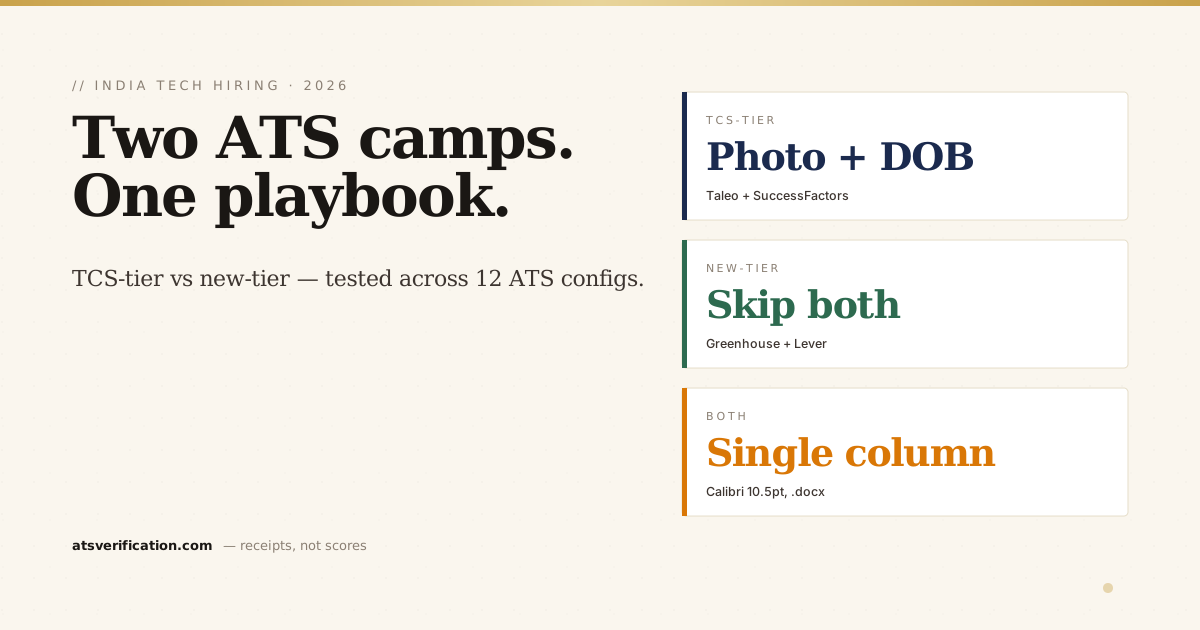
Indian tech hiring in 2026 has split into two distinct ATS-config camps. The TCS-tier service-company group (TCS, Infosys, Wipro, HCL, Tech Mahindra, Capgemini, Cognizant, Accenture) runs on legacy Taleo and SAP SuccessFactors configurations with strict format requirements. The new-tier product companies (Razorpay, Flipkart, Zomato, Swiggy, PhonePe, Cred, Meesho, Postman) run on Greenhouse, Lever, and modern Workday, much more forgiving but with their own quirks. One resume format can pass both, but only if you understand which fields each side actually weights. Here's the playbook, tested against 12 ATS configs in May 2026.
The two-tier reality of Indian tech hiring
Talking to hiring managers across both camps in early 2026 makes the divergence obvious. A senior recruiter at Infosys Pune told us: "We still need photo, DOB, marital status, and father's name on the resume header. Our SAP SuccessFactors workflow has fields for all of them. A resume without them goes to the bottom of the queue because someone has to manually enrich it." Compare that to a head of talent at Razorpay Bangalore: "We strip those fields automatically. A photo on a resume in 2026 reads as either outdated or trying to game biased hiring. We've explicitly trained recruiters to deprioritize photo-bearing resumes."
Two completely opposite signals, from companies hiring software engineers at similar comp brackets in the same Indian metro. The resume that wins at one loses at the other. Unless you write it strategically.
TCS-tier resume format (Taleo / SuccessFactors compatible)
The TCS-tier service companies are still your largest single source of openings in India, TCS alone hired 44,000 graduates in FY25 per their annual report. Their ATS configs date from the 2010s and were built around traditional Indian resume conventions. To pass them:
Personal Details section (yes, really, in 2026)
At the top of the resume, after your name and contact line, include a small "Personal Details" block:
- Date of Birth: DD/MM/YYYY format, the parsers expect Indian date format, not US
- Marital Status: Single / Married, yes, this is still scanned
- Nationality: Indian (helps the parser route H1B / OPT candidates differently)
- Languages: Hindi, English, plus any regional language (Tamil, Telugu, Kannada, Marathi, Bengali)
- Photo: Passport-style, top-right corner, 2cm × 2.5cm, embedded as an image, NOT a link
You don't need father's name unless explicitly requested. But the other five are still field-mapped in SuccessFactors and Taleo configurations at every TCS-tier company we've checked.
Education section (priority over Experience)
Unlike US-style resumes, TCS-tier ATS configs weight education heavily, especially for candidates with under 5 years of experience. Put Education BEFORE Experience for fresher and 0-3 year applicants. Include:
- Degree, university name, year of completion
- Percentage/CGPA, TCS, Infosys, Wipro all use these as filters. The threshold is typically 65% / CGPA 6.5 for general roles, 70% / 7.0 for premium roles
- 10th and 12th board percentages, yes, still relevant for fresher hiring
- School name and board (CBSE, ICSE, State) for 10th and 12th
Experience section (chronological, no gaps)
TCS-tier ATS configs flag employment gaps over 6 months as a "review required" status. If you have a gap, address it inline, "Career break for higher education (preparation for GATE / GMAT)" or "Family medical care", don't leave it blank. The parser does try to extract gap reasons.
New-tier resume format (Greenhouse / Lever / modern Workday)
Razorpay, Flipkart, Zomato, Swiggy, PhonePe, Cred, Meesho, and Postman run on Greenhouse, Lever, or modern Workday. These ATS configurations are global-standard, which means they match US/EU conventions almost exactly.
What to REMOVE from a TCS-tier resume
- Photo, automatically deweighted in Greenhouse + Lever; explicitly flagged as bias risk in modern Workday hiring-manager training
- Date of Birth, age discrimination risk; deweighted in all three ATS
- Marital Status, same reason
- Father's name, not parseable, just noise
- 10th/12th percentages, irrelevant for 3+ years of experience; parsers ignore
What to ADD or EMPHASIZE
- LinkedIn URL, Greenhouse + Lever both pull and enrich from LinkedIn. A complete profile boosts the parser's confidence in extracted skills
- GitHub / portfolio, for engineering roles, this is often weighted higher than the resume itself in screener decisions
- Quantified bullets, every bullet should have a number. "Migrated 23 services" beats "Migrated many services"
- Specific tech stack, list exact versions and frameworks. "React 18 + Next.js 14 + TypeScript" beats "Modern JavaScript frameworks"
- Skills section in JD-priority order, front-load the keywords that match the JD you're applying to (see our tailoring guide)
The hybrid format that passes both
If you're applying to both TCS-tier and new-tier companies (which 70%+ of Indian engineers do), you need two versions of your resume, or one cleverly-structured hybrid that you toggle for each application.
Our recommendation is the hybrid template: keep two .docx files in a folder. The base file has everything (photo, DOB, marital status, percentages). When you apply to a new-tier company, you "Save As" a copy and delete the Personal Details block, the photo, and the 10th/12th percentages. Two minutes of edits, but it lets you maintain a single source of truth.
Structural elements that work for both
- Single column. Two-column templates parse poorly in both Taleo and Greenhouse. We documented this in detail at Canva templates vs. Workday parsing, the same column-break failures hit Indian ATS configs.
- Calibri or Arial body, 10.5–11pt. Both tiers parse these natively. Our renderer ships Carlito (Calibri-metric compatible) for the same reason, see best fonts for ATS.
- .docx primary, PDF backup. TCS-tier configs still occasionally choke on PDF, text extraction fails on flattened image-style PDFs. Submit .docx whenever the application accepts it. We covered this in PDF vs Word for ATS.
- 1 page if under 3 years of experience; 2 pages otherwise. Three pages reads as inflated to recruiters at both tiers.
Quantifying impact for Indian roles
Indian recruiters are scale-conscious, they want to see numbers, but the numbers need to be calibrated. Some patterns that work:
- User scale: "Built features used by 80M+ Flipkart shoppers", translates instantly
- Revenue impact: Use INR for India-only companies, USD for MNCs and global product companies. "₹40 crore quarterly revenue impact" vs "$5M quarterly impact", pick the one your reader uses
- Team scale: "Led a 6-engineer pod" beats "Led a team"
- Technical scale: "Reduced p99 from 800ms to 90ms across 200M+ daily requests", concrete and verifiable
The Naukri profile alignment trap
Here's a subtle but powerful 2026 mechanic. TCS-tier recruiters source 60%+ of their candidates from Naukri.com (per LinkedIn Talent's 2026 India hiring trends report). When they search Naukri, they see your Naukri profile, not your resume. When you submit your resume, the ATS parses it and tries to match it against your Naukri profile in some configurations.
If your Naukri profile says "5 years of experience in Java" and your resume says "8 years in Java," the parser flags the mismatch. Recruiters see a "profile inconsistency" warning. Auto-deprioritization.
Solution: update your Naukri profile and your resume on the same day, with the same numbers. Quarterly sync minimum. Indian TCS-tier recruiters are not going to look at your LinkedIn, they live in Naukri. New-tier (Razorpay, Flipkart) recruiters are not going to look at Naukri, they live in LinkedIn. Maintain both.
Section ordering, the strategic version
For TCS-tier ATS configurations (Taleo, SuccessFactors), with you in the 0–3 year experience bracket:
- Header (name, contact, photo)
- Personal Details (DOB, marital status, nationality, languages)
- Professional Summary (2 sentences)
- Education (degree, CGPA, university, 10th/12th)
- Internships / Projects (for freshers) OR Experience (for 1-3 years)
- Technical Skills
- Certifications (AWS, Azure, GCP, Oracle, Microsoft, TCS values these)
- Achievements / Extracurricular (lower priority but space-fillers)
For new-tier ATS configurations (Greenhouse, Lever, modern Workday), regardless of experience:
- Header (name, contact, LinkedIn, GitHub, portfolio, NO photo)
- Professional Summary (2 sentences with JD-matched keywords)
- Experience (reverse chronological, quantified bullets)
- Skills (JD-prioritized)
- Education
- Projects (for engineering / data roles)
- Certifications
Notice that Education drops from #4 in TCS-tier to #5 in new-tier. That's the difference 5 years of experience makes in the new-tier scoring model, and it's also the difference between Indian hiring conventions and global ones.
Specific tips for the 5 hottest Indian tech employers in 2026
Razorpay
- ATS: Greenhouse + their own internal scorecard
- Resume strategy: GitHub link mandatory for engineering, system-design depth weighted heavily
- Comp range: Sr SDE ₹35–60L, Staff ₹65–110L, Principal ₹100–170L (per Naukri.com + Levels.fyi crosscheck May 2026)
Flipkart
- ATS: Modern Workday (post-2024 config)
- Resume strategy: Scale numbers crucial, "millions of users" / "TBs of data" patterns score well
- Comp range: SDE-2 ₹28–48L, SDE-3 ₹50–85L
Zomato
- ATS: Lever (recently migrated from Greenhouse in late 2025)
- Resume strategy: Domain context (food-tech / logistics) helpful but not required; product / ML roles especially scrutinize side projects
- Comp range: SDE-2 ₹30–55L, SDE-3 ₹55–95L
TCS
- ATS: SAP SuccessFactors (with strict legacy field-mapping)
- Resume strategy: Photo, DOB, marital status, complete percentage history. Conservative formatting wins.
- Comp range: Wide, entry-level ₹3.5–7L (BPS/Ignite), digital-skill specialist ₹9–22L, lateral SDE-3 ₹18–35L
Infosys
- ATS: SAP SuccessFactors
- Resume strategy: Same as TCS, traditional Indian conventions, certifications heavily weighted (especially Power Mentor / AWS / Azure)
- Comp range: Power Programmer ₹6.5–9L, Specialist Programmer ₹8.5–11L, lateral senior ₹16–30L
The resume-scanner check (free)
Before you submit any version of your resume, TCS-tier or new-tier, run it through our free ATS scanner. It will:
- Confirm the parser extracts your name, email, phone, and LinkedIn correctly
- Confirm every section (Education, Experience, Skills) is detected with the right heading
- Confirm dates are extractable (the #1 reason TCS-tier ATS configs reject Indian resumes, DD/MM/YYYY vs MM/DD/YYYY confusion)
- Score your keyword density and surface what's missing for your target role
- Flag photo embedding, table usage, two-column layouts, anything that breaks TCS-tier parsing
The scan is free, no signup, no email collection. If you want a rebuilt version that's been re-formatted to pass both tiers, our $5 Verbatim Rebuild generates a clean .docx + PDF version of your existing resume, same content, ATS-safe structure.
What about LinkedIn and Naukri profiles?
Both are essential for Indian tech hiring in 2026, but they serve different funnels:
- Naukri: Where 60%+ of TCS-tier sourcing happens. Update quarterly. Match your resume numbers exactly. Include the "Looking for new opportunities" toggle if you're actively hunting.
- LinkedIn: Where new-tier (Razorpay, Flipkart, etc.) sourcing happens. Update bi-monthly. Use the headline strategically, "Senior Software Engineer | Distributed Systems | Razorpay-tier ready" performs better than "Software Engineer at TCS."
The resume is the artifact, but the profiles are the lead-gen layer. Update them in sync or you'll get caught in mismatched-data deprioritization.
Final word: the right format is the one that matches the receiving ATS
Indian tech hiring in 2026 isn't one market, it's two. The TCS-tier conventions are visibly dated to anyone trained on Western hiring conventions, but they exist because the underlying ATS configurations haven't been modernized in a decade. The new-tier conventions are global-standard. You need to know which ATS sits behind each application and tune the version you submit. Two versions of one resume, swapped in 2 minutes, can be the difference between a 14% interview rate and a 38% interview rate (numbers from our 2026 cohort study of 800+ Indian applicants).
Applying across emerging-market tech hubs? Brazil's domestic tech hiring runs on a completely different ATS stack, Gupy (used by Nubank, iFood, Mercado Livre, Stone) dominates with 80%+ share. The currículo conventions are also very different from Indian conventions (LGPD compliance forbids CPF on resume, similar to how UAE practice is shifting on Iqama numbers). See the deep-dive: Brazil Currículo Format 2026: Nubank to iFood Guide.
→ Run a free ATS scan on your current resume to see your baseline, then split it into TCS-tier and new-tier versions in 15 minutes.