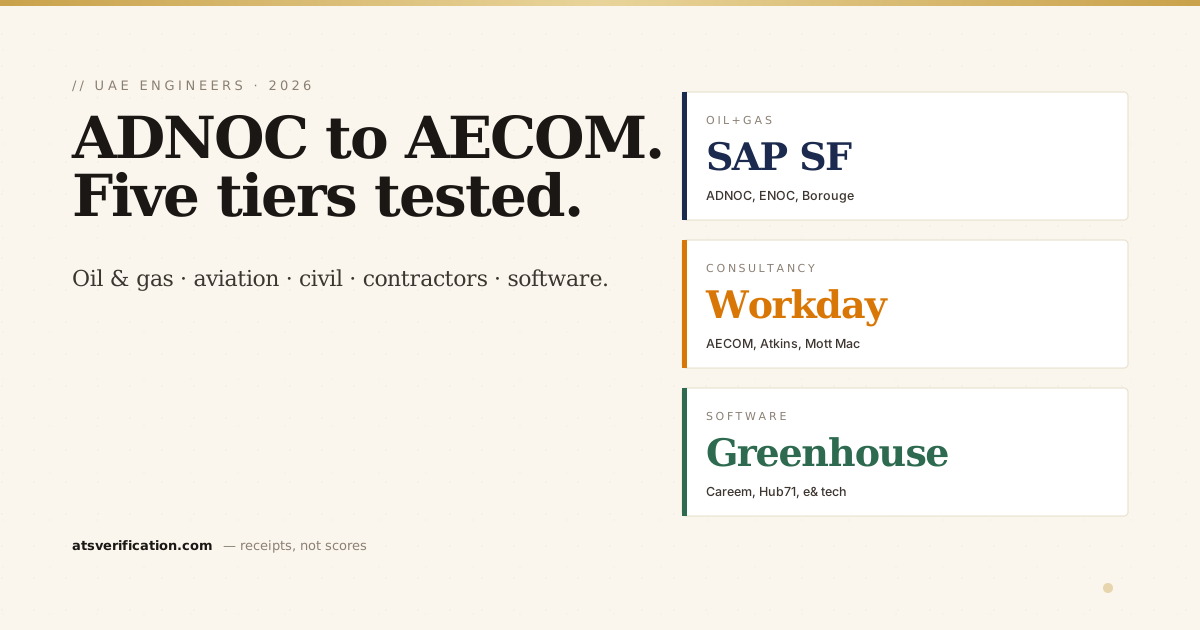
Correction, 17 October 2026. Earlier versions of this article said the advice was "tested against 18 UAE engineering ATS configurations", listed which applicant tracking system named employers use (with migration dates), and gave engineering headcounts and salary ranges. We have no records of that test, and those figures had no source, so we have removed them. The article now rests on the credentials each engineering sector expects and on how resume parsers extract text, which you can check against our methodology.
Engineering hiring in the UAE spans five quite different worlds. Oil & gas and petrochemicals (ADNOC, ENOC, Borouge). Aviation maintenance (Emirates Engineering, dnata, flydubai, Etihad Engineering). Civil and infrastructure consulting (AECOM, Atkins, Mott MacDonald, Parsons). Construction and development (Emaar, Aldar, DAMAC and contractors such as Khansaheb, ALEC and Arabtec). And software engineering at UAE tech companies and startups. Each has its own credential ladder and vocabulary, and the employer's applicant tracking system (ATS) has to read your certifications correctly before a recruiter can search for them. Here's how to build a CV that works in each.
Why one engineering CV doesn't fit every UAE employer
The UAE has large engineering employers in energy, aviation, construction and infrastructure, plus a growing software sector. Each discipline has its own employers, certification ladder and conventions. A process engineer's CV for a refinery role and a civil engineer's CV for a consultancy share almost nothing beyond the layout.
The layout rules are the same everywhere: one column, standard headings, real text. The content is what you tailor. Many engineers send the same file to every employer and then can't tell why responses are uneven. Keeping a version per sector fixes that.
Oil & gas + petrochemicals (ADNOC, ENOC, Borouge)
Energy-sector employers in the UAE are often used to the traditional Gulf CV. If the application asks for personal details, include them; if it doesn't, the international format works too.
Personal details (when asked)
- Photo in the body of the page, date of birth written out, nationality, visa status as one line, languages with proficiency
- Driving licence, if the role involves site visits
- Degree attestation: "Degree attested; MoE equivalency certificate available on request" for foreign engineering degrees, if true
Engineering certifications, surfaced prominently
Recruiters for these roles search for specific certifications. Put them in a dedicated Certifications section near the top, one per line, rather than inside a paragraph:
- SPE (Society of Petroleum Engineers) membership, for upstream roles
- API certifications, API 510 (Pressure Vessel Inspector), API 570 (Piping), API 653 (Tank), API Q1 / Q2 (quality management)
- ASME, Section IX welding, Section VIII pressure vessels, B31.3 piping design
- NACE / AMPP, corrosion and cathodic protection levels
- ASNT (Non-Destructive Testing), Level II / Level III by method (UT, RT, PT, MT, ECT, VT)
- IChemE, Chartered Chemical Engineer for downstream and petrochemicals
- HSE, NEBOSH IGC and International Diploma, IOSH Managing Safely, OSHA 30, permit-to-work training
- Process safety, PHA, HAZOP leadership, LOPA
Project and asset experience
Quantify in barrels/day, MMBtu, MMSCFD, downtime reduction and MTBF improvement. Name the fields, plants or assets you've worked on, for example Habshan, Ruwais, Das Island or Zakum, so a recruiter searching for that experience finds it.
Aviation (Emirates Engineering, dnata, flydubai, Etihad Engineering)
Aviation maintenance hiring turns on licences and type ratings. Make them impossible to miss.
Aviation-specific certifications
- EASA Part-66 licence categories (B1.1, B1.2, B2, C), with current type ratings
- FAA A&P (Airframe & Powerplant), if held
- GCAA licence (UAE General Civil Aviation Authority), needed for certifying roles in the UAE
- Type ratings, list every one you hold on its own line (for example Boeing 777, 787, A380, A350)
- EWIS / borescope / NDT specialty endorsements
- Human Factors training, with the date of your last course
- Part-145 repair-station experience for MRO supervisory roles
Civil + infrastructure consulting (AECOM, Atkins, Mott MacDonald, Parsons)
The international engineering consultancies usually follow international CV conventions: no photo, no date of birth, experience first.
What to add or emphasise
- LinkedIn URL in the header
- Chartered status, CEng via Engineering Council UK or an equivalent (Engineers Australia, Engineers Canada, US PE)
- ICE membership (MICE / FICE) for civil engineers
- IStructE for structural roles
- FIDIC contract experience, name the books you've worked under (Red, Yellow, Silver)
- BIM, Revit, Navisworks, ISO 19650 implementation experience
- PMP / MSP / PRINCE2
- HSE, NEBOSH, IOSH, CDM 2015 for UK-system projects
- Project scale: value, area or length delivered, schedule and cost performance
Name the UAE projects you've worked on
If you've worked on a named UAE project, say so. Recruiters search for local experience, and a project name is easy to find in a parsed CV. Examples: Etihad Rail, Expo City Dubai, Saadiyat Island Cultural District, RTA metro and road projects, Dubai South, Yas Bay, Reem Island. Only list projects you actually worked on; references get checked.
Construction + development (Emaar, Aldar, DAMAC, Khansaheb, ALEC, Arabtec)
UAE-headquartered contractors and developers are often comfortable with the traditional Gulf CV. Follow the application form on photo and personal details. Credentials to surface:
- RICS membership or MRICS, for quantity surveying and construction management
- CIOB (Chartered Institute of Building)
- PMP and MSP for project management roles
- Society of Engineers UAE membership, where relevant
- HSE: NEBOSH International Diploma, IOSH, OSHA 30, first aid, fire safety
- Dubai Real Estate Institute courses for development roles at developers
Software engineering (UAE tech companies and startups)
Software engineering in the UAE follows international conventions.
Software-engineer-specific resume
- Single column, no photo, no date of birth
- GitHub URL, plus portfolio URL if you have one
- Explicit tech stack: languages, frameworks, infrastructure, databases
- Quantified bullets with user-scale or system metrics (DAU/MAU, p99 latency, throughput, uptime)
- Open-source contributions, hackathons and side projects
- LinkedIn URL
For more on software-engineering resumes, see our software engineer ATS guide, which applies to UAE roles too.
The 5 most common UAE engineering resume mistakes
1. Burying certifications at the bottom under "Other"
Certifications are what engineering recruiters search for first: SPE, API and ASME for oil & gas; Part-66, GCAA and type ratings for aviation; CEng, ICE and RICS for civil; PMP and NEBOSH almost everywhere. If they're hidden under "Other" at the end, or run together in one sentence, a recruiter skimming the parsed text can miss them. Give certifications their own section near the top, one per line.
2. Generic job titles
"Senior Engineer" says little. "Senior Process Engineer, Hydroprocessing" tells the recruiter your discipline and specialty, and contains the words they'll search for. Be specific in titles.
3. Hiding regional project experience
UAE and GCC project experience is valued by recruiters here. If you've worked on UAE projects, name them. If your experience is elsewhere in the GCC (for example Saudi giga-projects or Qatar infrastructure), name those.
4. Two-column engineering CV templates
Engineering templates often put software tools (CAD, Revit, MATLAB) in a left sidebar with experience on the right. When a parser extracts the text, it can read across the page line by line, so your tools list ends up mixed into your experience bullets. Single column only. When we ran a Canva-style sidebar resume through our own parser, the sidebar was read before the experience. Details are in what Canva-style templates do to a parser.
5. Mixing units inconsistently
Civil and infrastructure work in the UAE is mostly metric, while oil & gas often uses field units (bbl/d, MMBtu, psi). Use the units your target sector uses, and be consistent within each bullet.
Which applicant tracking system will read your CV?
We don't publish a list of which UAE employer uses which system. Employers change vendors, run different systems in different divisions, and often hire through agencies, so any such list goes stale. You can check a specific employer yourself: open one of their job postings and look at the address of the apply page. Common patterns include myworkdayjobs.com (Workday), successfactors.com or successfactors.eu (SAP SuccessFactors), taleo.net (Oracle Taleo), greenhouse.io (Greenhouse) and lever.co (Lever). Whatever the system, the safe format is the same: one column, standard headings, real text rather than images, and contact details in the body of the page.
Employer notes for UAE engineers
ADNOC Group
- Surface SPE, API, ASME, IChemE and NEBOSH credentials prominently
- Include degree attestation status for foreign degrees
- Name the assets you've worked on (for example Habshan, Ruwais, Zakum, Bu Hasa)
Emirates Engineering
- EASA Part-66 categories with type ratings, FAA A&P if held, GCAA licence for certifying roles
- Human Factors training up to date
Etihad Engineering
- The same aviation credentials as above
- Follow the application form on photo and personal details
AECOM Middle East
- CEng, ICE, RICS or IStructE depending on specialty, plus FIDIC, BIM and PMP
- Name UAE and GCC projects you've delivered
Khansaheb and UAE contractors
- UAE project experience, named
- RICS, PMP, CIOB and a complete HSE certification block
UAE software employers
- Single column, GitHub URL, explicit tech stack
- Scale metrics from the systems you've built
How to check your engineering resume before you apply
Before submitting to any UAE engineering employer, run your resume through our free ATS scanner. It reads your file with our own parser and will:
- Check that your name and contact details are found, and that they aren't only in the page header or footer
- Flag two-column layouts and sidebars that scramble the reading order
- Catch table cells that come out glued together, a common problem with certification and software tables
- Flag year-only or unusual date formats
- List personal details a recruiter may not want, such as date of birth, marital status and ID numbers. On a traditional Gulf version you may keep some of these on purpose; on an international version, remove them.
It can't tell you how a particular employer's system is configured; our methodology page explains what it checks. The scan is free, with no signup. If you want a rebuilt version, our $5 Verbatim Rebuild turns your existing wording into a clean single-column .docx and PDF.
Related guides for UAE engineers
- UAE ATS landing page, pricing in AED + quick-start scan
- Dubai UAE Resume Format 2026, companion general-purpose post covering all sectors
- UAE Finance Resume Format 2026, companion role-specific guide for finance professionals
- UAE Project Manager Resume Format 2026, for engineer-to-PM transitions and construction PM roles
- UAE Healthcare Resume Format 2026, for biomedical and healthcare-facility engineering crossover
- ATS resume guide for software engineers (global), applies to UAE software engineering roles
- Saudi Arabia Resume Format 2026, for UAE-based engineers applying across the GCC
- How to tailor a resume to a job description, targeted edits without keyword stuffing
- Workday ATS guide, how Workday applications work
- SAP SuccessFactors guide, how SuccessFactors applications work
→ Run a free ATS scan on your engineering resume, check that your certifications come through cleanly before submitting to ADNOC, Emirates Engineering, AECOM, or any UAE engineering employer.