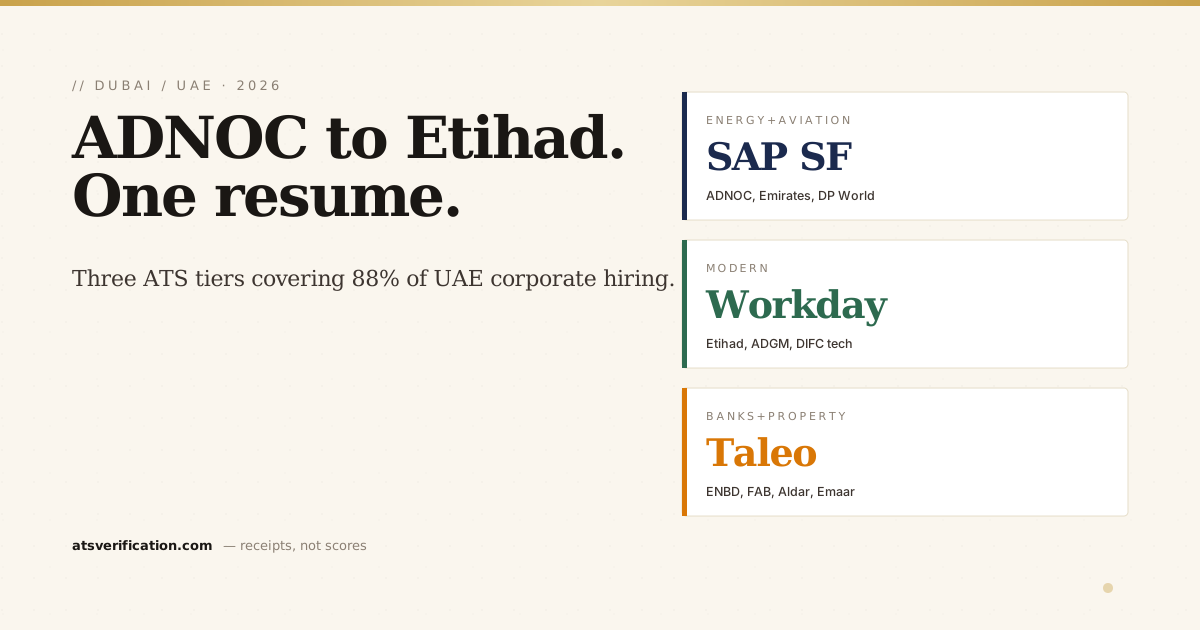
Correction, 17 October 2026. Earlier versions of this article said the advice was "tested against 18 UAE ATS configurations", listed which applicant tracking system named UAE employers use (with migration dates), and gave application volumes, filter rates, a LinkedIn penetration figure and salary ranges. We have no records of that test, and those figures had no source, so we have removed them. The article now rests on UAE CV conventions and on how resume parsers extract text, which you can check against our methodology.
Job hunting in the UAE runs through LinkedIn, Bayt, GulfTalent, Naukrigulf and employers' own careers portals, and most large employers store and search applications in an applicant tracking system (ATS). Two things decide whether your CV works there. First, the system has to read it: the text must come out in the right order, with your name, contact details, dates and headings intact. Second, the recruiter who opens it has to see what a UAE employer expects, from your visa status to your degree attestation. This guide covers both. It's written from Dubai, where atsverification.com is built.
Why the CV matters more for UAE expats
The UAE job market has a pressure that most countries don't: your residence visa is usually tied to your job. When employment ends, a grace period starts, and its length depends on your visa category, so check the current rules with the authorities rather than relying on a figure you read online. That pressure makes a resume that works first time worth more here than in most markets. (Once your resume is in shape, channel and networking strategy matter just as much, covered in how to find a job in the UAE.)
Large UAE employers receive far more applications than any recruiter reads in full. Applications go into an ATS, recruiters search and filter them, and they open the ones that match. If a parser can't read your job titles, dates or skills, a keyword search won't surface you, however well qualified you are. That is a structural problem, and it's fixable before you apply.
The traditional Gulf CV
Many UAE-headquartered, family-owned and government-related employers are used to the traditional Gulf CV, and some application forms ask for the same details. If you're applying to one of them, a personal details block is normal. Keep it short and factual:
Personal details (when the employer expects them)
- Photo: a professional, passport-style headshot, placed in the body of the page next to your name, not in the page header
- Date of birth: written out, for example "15 Mar 1990", so it can't be misread as a US-style date
- Nationality: relevant to Emiratisation reporting, so many employers ask for it
- Visa status (for expats): one line such as "Employment visa (current employer)" / "Spouse visa" / "Family visa", with no numbers
- Driving licence: include a UAE licence if the role involves driving or site visits
- Languages with proficiency: Arabic and English (Native / Fluent / Conversational / Basic), plus any others you use at work
Marital status still appears on some Gulf CVs. It isn't needed for any role, and we'd leave it out unless a form asks for it.
Education, include degree attestation status
UAE employers care about whether a foreign degree has been attested and, for some roles, recognised through the Ministry of Education equivalency process, because it's needed for the work permit and for some licensed professions. For degrees from outside the UAE, include:
- Highest degree, university name, country, year of completion, grade or GPA
- Attestation status: for example "Degree attested; MoE equivalency certificate available on request", if that's true. It answers a question the recruiter would otherwise have to ask.
- Previous degrees with similar detail
- For early-career candidates: secondary-school results (12th grade, A-levels, Tawjihi or equivalent)
Experience, include employer location
Recruiters in the UAE look for local and regional experience, so make the location of every role easy to see:
- Role title in English
- Employer name, city, country, for example "EnergyCo, Dubai, UAE"
- Dates as "Jul 2025 – Present"
- 4 to 6 bullets per role, with numbers where you have them
The international CV
Multinationals with UAE offices, firms in DIFC and ADGM, and most startups usually follow their head-office conventions. For them, remove the personal details block and lead with experience.
What to remove
- Photo, many international employers ask candidates not to send one, and an image carries no text a parser can use (the full machine-vs-culture breakdown is in should you put a photo on your resume)
- Date of birth and marital status, not needed to assess you
- Detailed visa information, keep one short line at most; HR collects the rest after an offer
- Driving licence, only if the role requires it
- 12th-grade percentages, no longer relevant once you have several years of experience
What to add or emphasise
- LinkedIn URL in the header
- Quantified bullets in one currency. Use USD if the role reports into a global office, AED if it doesn't
- Relevant certifications: ACCA, CPA or CFA for finance, CISI for banking and wealth, PMP for project roles, and so on
- A short location line such as "Dubai, UAE · UAE Resident"
Banking, property and telecoms
Local banks, developers and telecoms operators sit between the two styles. Many accept the traditional Gulf CV, and some application portals ask for personal details. Check the advert and the form. Sector content matters more than the template:
- Banking: surface regulatory and professional credentials (SCA registration where you hold one, CFA, FRM, CISI, CAMS) in a Certifications section near the top
- Property: RICS membership or MRICS, Dubai Real Estate Institute courses, and RERA broker registration for brokerage roles
- Islamic finance: name the products you've worked on (Murabaha, Ijara, Sukuk, Takaful) for Islamic banks and Islamic windows
The 5 most common UAE resume mistakes
1. Listing Emirates ID, passport or visa file numbers
Older UAE resume templates include Emirates ID number, visa file number, sponsor name and visa expiry. No employer needs them to shortlist you, and your CV gets emailed around, attached to spreadsheets and sent to agencies. Never list the numbers. State only:
- "UAE Resident · Employment visa" (for expats changing employer)
- "UAE Resident · Spouse visa" (for candidates on family sponsorship)
- "UAE National" (for Emirati candidates)
2. Generic "Open to opportunities in Dubai" opener
Recruiters read this line constantly and it tells them nothing. Replace it with a 2-line professional summary that names the role and sector you're targeting. "Senior credit-risk analyst, 8 years in UAE wholesale banking and IFRS 9 modelling" is specific and searchable.
3. Mixing AED and USD inconsistently
Pick one currency and use it throughout. AED for UAE-only roles, USD for global or regional roles that report in dollars. Mixing them makes your numbers hard to compare and reads as careless.
4. Two-column "modern" templates
Free CV builders and many Canva "modern professional" designs use two columns with a sidebar. When a parser extracts the text, it can read across the page line by line, so a sidebar's skills land between your job titles, or dates separate from the jobs they belong to. Single column only. When we ran a Canva-style sidebar resume through our own parser, the sidebar was read before the experience and a languages table came out glued together. The details are in what Canva-style templates do to a parser.
5. LinkedIn profile that doesn't match the CV
UAE recruiters commonly check LinkedIn. If your CV shows 8 years of experience and LinkedIn shows 5, or the titles differ, it raises questions you'd rather not answer in a screening call. Keep dates, titles and employer names consistent.
Which applicant tracking system will read your CV?
We don't publish a list of which UAE employer uses which system. Employers change vendors, run different systems in different divisions, and often hire through agencies, so any such list goes stale. You can check a specific employer yourself: open one of their job postings and look at the address of the apply page. Common patterns include myworkdayjobs.com (Workday), successfactors.com or successfactors.eu (SAP SuccessFactors), taleo.net (Oracle Taleo), greenhouse.io (Greenhouse) and lever.co (Lever). Whatever the system, the safe format is the same: one column, standard headings, real text rather than images, and contact details in the body of the page.
Sector notes for major UAE employers
ADNOC and the energy sector
- Surface engineering credentials prominently: SPE membership, API inspector certifications, ASME, IChemE, NEBOSH
- Include degree attestation status for foreign degrees
- Name the assets, fields or plants you've worked on, and quantify in the units the industry uses (bbl/d, MMSCFD, uptime)
Emirates Group and aviation
- For technical roles, list licences and type ratings explicitly: EASA Part-66 categories, GCAA licence, aircraft types
- Cabin crew and pilot applications have their own requirements; follow the application form exactly
Etihad
- Same aviation credentials as above for technical roles
- If you've worked on sustainability or fuel-efficiency programmes, say so in the summary; Etihad publicises its Greenliner programme
Emirates NBD and UAE banks
- Surface CFA, FRM, CISI and any SCA registration prominently for banking and wealth roles
- For Islamic-window roles, name the Islamic finance products you've worked on
Mubadala and investment roles
- Lead with deal experience in USD: transaction values, assets managed, capital deployed
- Professional credentials (CFA, an MBA) and buy-side experience belong near the top
Aldar, Emaar and property developers
- Real estate credentials (RICS, MRICS, Dubai Real Estate Institute courses) and project-management certifications (PMP, MSP, PRINCE2)
- For senior roles, quantify project value and delivery record in AED
Emiratisation
If you're a UAE National, Emiratisation targets and the Nafis programme mean many private-sector employers are actively looking for Emirati candidates. Adjust the resume accordingly:
- Write "UAE National" in your contact line so a recruiter sees it immediately
- List Nafis participation and any government-backed training programmes you've completed
- State Arabic and English proficiency in the languages section
- Make UAE-based work history easy to see, with locations on every role
How to check your resume before you apply
Before submitting to any UAE employer, run your resume through our free ATS scanner (and since a Gulf CV holds extra personal data, it's worth knowing whether resume checkers are safe to use in the UAE first). It reads your file with our own parser and will:
- Check that your name and contact details are found, and that they aren't only in the page header or footer
- Flag two-column layouts and sidebars that scramble the reading order
- Catch table cells that come out glued together
- Flag year-only or unusual date formats
- List personal details a recruiter may not want, such as date of birth, marital status and ID numbers. On a traditional Gulf version you may keep some of these on purpose; on an international version, remove them.
It can't tell you how a particular employer's system is configured, and our methodology page explains what it does and doesn't check. The scan is free, with no signup. If you want a rebuilt version, our $5 Verbatim Rebuild turns your existing wording into a clean single-column .docx and PDF.
Related guides for UAE job seekers
- UAE ATS landing page, pricing in AED + quick-start scan
- UAE Finance Resume Format 2026, role-specific guide for banking, investment, DIFC and fintech roles
- UAE Engineer Resume Format 2026, oil & gas, aviation, construction and software engineering
- UAE Sales Resume Format 2026, SaaS, property, banking and hospitality sales
- UAE Fresh Graduate Resume Format 2026, graduate programmes, Nafis and entry-level roles
- UAE Healthcare Resume Format 2026, DHA, DoH and MOH licensing for doctors and nurses
- UAE Project Manager Resume Format 2026, PMP, FIDIC, Agile and SAFe
- UAE HR Resume Format 2026, SHRM, CIPD and Emiratisation
- UAE Marketing Resume Format 2026, brand, performance and growth marketing
- UAE ATS resume guide (general), companion post with broader sector coverage
- Saudi Arabia resume format, the neighbouring GCC market
- ATS resume guide for finance professionals, applies to UAE banking and DIFC roles
- Tailoring resume to job description, targeted edits without keyword stuffing
- Workday ATS guide, how Workday applications work
- SAP SuccessFactors guide, how SuccessFactors applications work
Applying from outside the UAE? The overseas-specific rules, availability lines, visa expectations, WhatsApp numbers and the scams to refuse, are in how to apply for Dubai jobs from abroad.
→ Run a free ATS scan on your current resume, see your baseline before submitting to ADNOC, Emirates, ENBD, Etihad, Mubadala, or any UAE employer.