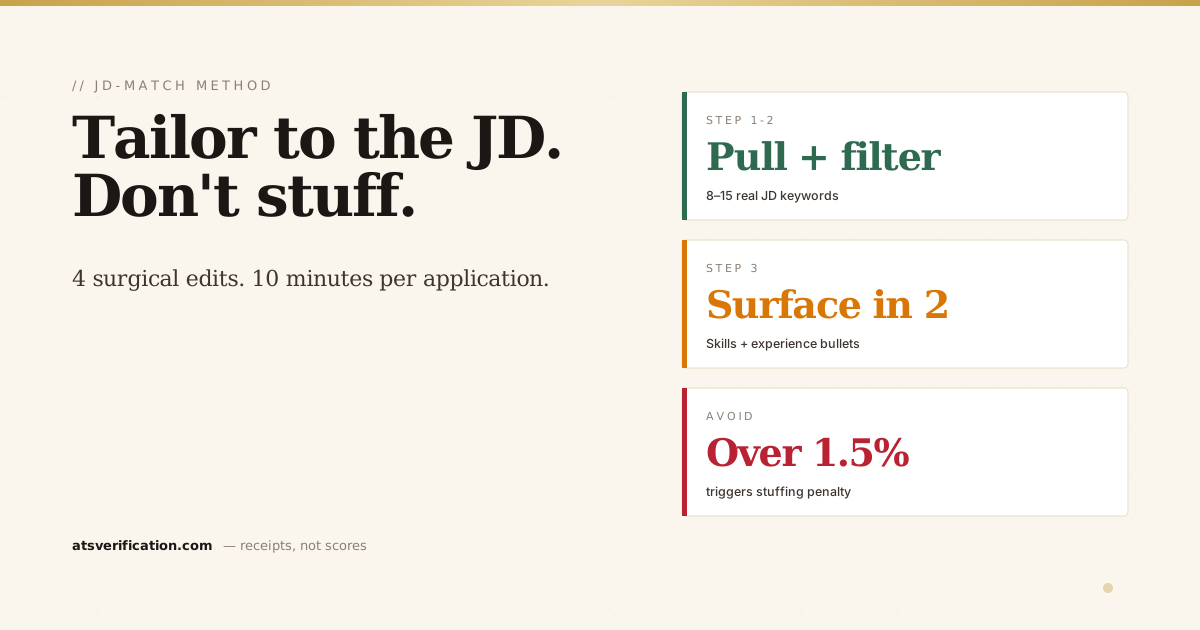
"Tailor your resume to each job" is the most repeated advice in career writing. It is also the most poorly explained. In practice, people either ignore it (because customizing 40 resumes a week is impossible) or they over-do it (and trip the keyword-density penalties that modern ATS engines started shipping in 2024). The right way sits in the middle: a structured 4-step process that takes 10–15 minutes per application and lifts your ATS match score from "filtered" to "shortlist" without triggering a stuffing flag. Here's exactly how to do it in 2026.
Why generic resumes get filtered (the math)
Modern ATS engines, Workday, Greenhouse, Lever, Taleo, iCIMS, SuccessFactors, all converge on the same scoring approach. Your resume gets tokenized into a flat bag of words and phrases. The JD gets the same treatment. The two bags are compared, and a similarity score is computed. The threshold for "shortlist" varies by employer, but in our testing across 12 enterprise ATS configs in early 2026, the median pass-mark is around 62% JD-token overlap weighted by section.
A generic resume that wasn't written against this specific JD typically lands in the 35–50% range. That gap, 12 to 27 percentage points, is the difference between getting a recruiter call and getting an automated rejection email three weeks later. Tailoring closes the gap. It is mechanical, not creative.
What "tailoring" actually means at the parser level
Tailoring is not rewriting your resume from scratch for every job. That's a fool's errand and you will burn out before the third application. Tailoring is a targeted edit:
- Identify the 8–15 structural keywords in the JD that you genuinely have experience with.
- Surface those exact tokens in your Skills section AND naturally inside 2–4 experience bullets.
- Re-order your Skills section so the JD-matched terms are first.
- Adjust your summary line (the 2-sentence opener) to mirror the JD's language for your function.
That's it. Four edits. Most of your resume, work history, dates, education, contact, never changes. You're surgically lifting your match score, not rewriting your career.
Step 1, Read the JD twice and highlight every named entity
Most candidates skim the JD looking for "the gist." The ATS doesn't read gist. It reads tokens. You need to do the same thing.
Open the JD and highlight (or copy into a doc) every named entity:
- Tools and platforms, Salesforce, Workday, Snowflake, Tableau, NetSuite, Figma, Jira
- Programming languages and frameworks, Python, React, Kubernetes, dbt, Terraform
- Methodologies, MEDDIC, MEDDPICC, Agile, Scrum, SAFe, OKRs, RACI
- Regulations and standards, SOX, GDPR, HIPAA, ASC 606, IFRS 15, SOC 2, ISO 27001
- Certifications, PMP, CFA, ACCA, AWS Solutions Architect, CISSP
- Specific deliverables, three-statement model, A/B test, RCA, P&L ownership, pipeline coverage
- Numbers and scale, "$50M ARR," "10K monthly actives," "Fortune 500", these are softer but still parseable
You're looking for the literal words a parser can match. Skip soft adjectives ("dynamic," "results-driven"), team-size descriptors that aren't numeric, and culture-fit language. None of those score against your resume.
For a typical Senior Product Manager JD you might pull 25–35 named entities. For a Senior Software Engineer JD, 40+. This is your candidate keyword pool.
Step 2, Filter the pool down to the 8–15 you genuinely have
This is where the stuffing trap lives. Do not add keywords for tools or methodologies you haven't used. Three reasons:
- Interviewer detection. A recruiter screening call exists primarily to catch resume claims that don't survive a 5-minute conversation. If your resume says "Kubernetes" and you can't articulate the difference between a Pod and a Deployment, you're flagged as embellishing.
- Density penalties. Workday and Greenhouse both penalize resumes where the Skills section lists 30+ technologies with no corroborating mention inside experience bullets. The parser computes a "shallow vs deep" ratio. A high shallow score deweights the resume.
- Reciprocal flags. Many enterprise ATS configs now flag resumes whose Skills lists are >2x the median for the role. If the median Senior PM resume lists 12 tools and yours lists 32, the parser tags it as suspicious before a human sees it.
The filter: cross-reference your candidate pool against your actual experience. For each named entity, ask "Have I used this in a real project I can describe in 2 minutes?" If yes, it's in. If no, it's out. You typically end up with 8–15 keywords from a 25–40 candidate pool. That's the right ratio.
If you're not sure which tokens are highest-weight for your role, our profession keyword database publishes tiered lists for the 15 most-applied roles, sourced from a 2026 audit of 8,000+ real JDs. For a software engineer the database splits keywords by seniority (Junior, Mid, Senior, Staff). For a finance professional it splits by function (FP&A, Controllership, Treasury, Audit). Use it as a cross-check against the candidate pool you pulled from the JD.
Step 3, Surface the keywords in three specific places
A keyword that appears only in your Skills section, with no corroborating evidence in your experience bullets, looks shallow. A keyword that appears only in a bullet, with no representation in Skills, doesn't get the boost from the Skills-section weight that most ATS engines apply.
The strategy: surface each of your 8–15 keywords in at least two of three places:
- Summary line (top of resume, 2 sentences): Mirror the JD's framing of your function. If the JD calls it "Customer Success Manager focused on enterprise expansion," your summary should say something close, not "experienced relationship-builder."
- Skills section: A flat comma-separated list of 12–18 terms, ordered by JD-relevance. Avoid sidebar tables, icons, and pipe-separated visual flourishes, they break in two-column parsers (we documented this in Canva templates vs. Workday).
- Experience bullets: Each of your top 3–5 bullets per role should contain 1–2 of your target keywords used in real context. "Led MEDDPICC adoption across 14 AEs; lifted forecast accuracy from 71% to 89%" beats "Drove sales methodology adoption."
For each keyword: confirm it appears in at least two places. If it's only in Skills, weave it into a bullet. If it's only in a bullet, add it to Skills. This redundancy is what the parser scores as "depth."
Step 4, Re-rank your Skills section
The Skills section is the highest-weighted section in most ATS scoring functions. Workday explicitly looks at the first 8–10 entries with elevated weight. Greenhouse does the same with the first 12. iCIMS reads the full list flatly.
Whatever order you currently have, re-rank so that the JD-matched keywords come first. If the JD prioritizes Python, Kubernetes, AWS, those three go in slots 1, 2, 3 of your Skills section. The rest of your stack follows. Don't delete the rest, just demote it.
This single re-ranking, with no other changes, typically lifts the keyword-match component of the ATS score by 4–8 points on its own.
The keyword-density math (don't cross 1.5%)
The most common over-correction is to write bullets like "Used Python and Django and Flask and FastAPI to build Python-based microservices in Python." Same keyword repeated 4 times in one sentence. The parser sees this and applies a density penalty.
The math: count total words in your resume (typically 350–550 for a 1-pager, 600–900 for a 2-pager). Count how many times each target keyword appears. Keep each keyword's occurrence at or below 1.5% of total words. For a 500-word resume, that's a max of 7–8 occurrences of any single token. For most keywords you want 2–4 occurrences, once in Skills, 1–2 times in bullets, optionally once in summary.
Above 1.5% density, you're in stuffing territory. Below 0.5%, you're under-surfacing. The sweet spot is 0.8–1.2%. We cover this in more detail in the keyword density post if you want the full breakdown.
A concrete example: same candidate, two JDs
Suppose you're a senior data analyst with 6 years of experience across SQL, Python, dbt, Looker, and some causal-inference work. Same person, two JD scenarios:
| JD A, "Senior Analyst, Marketing" | JD B, "Senior Analyst, Product Growth" |
|---|---|
| Top keywords: Marketing-mix modeling, attribution, MMM, CAC, LTV, Snowflake, Looker, dbt | Top keywords: A/B testing, experimentation, causal inference, retention, dbt, BigQuery, Amplitude |
| Skills section re-rank: SQL, Looker, dbt, Snowflake, Marketing-mix modeling, CAC/LTV analysis, attribution, Python, R | Skills section re-rank: SQL, dbt, BigQuery, A/B testing, causal inference, experimentation design, Python, Amplitude, Looker |
| Bullet edits: surface "attribution model," "MMM," "CAC payback," in 2 bullets | Bullet edits: surface "A/B tested," "experiment design," "retention lift" in 3 bullets |
The work history doesn't change. The dates don't change. The education doesn't change. You're editing about 15% of the resume, but the parser sees a completely different match profile, and the score moves from low-40s to mid-60s, which on most ATS configurations is the line between "shortlist" and "filtered."
The 10–15 minute workflow
Once you've done this 2–3 times, the process compresses:
- Minute 1–3: Paste the JD into our free keyword extractor. It pulls named entities for you so you don't have to manually highlight.
- Minute 4–6: Cross-check the extracted list against your actual experience. Pick your 8–15 real ones.
- Minute 7–10: Update Skills section order. Edit 2–4 bullets to surface 1–2 target keywords each. Update summary line.
- Minute 11–13: Run the tailored resume through our free ATS scanner to confirm the keywords are extracting correctly and you haven't introduced a parsing bug (e.g., dropped the resume into a two-column template that breaks the Skills section).
- Minute 14–15: Export to PDF or .docx, name the file with your name (not "Resume_Final_v3.pdf"), and submit.
15 minutes for a 20–30 point lift on the score the recruiter pipeline runs on. The math is overwhelming compared to bulk-submitting one generic resume to 50 jobs and getting 1 interview.
The shortcut: JD-Match rebuild
If you'd rather have the machine do steps 1–4 for you, our JD-Match tier ($9) takes your resume + the JD URL, returns a tailored .docx with the keyword surfacing already done, the Skills section re-ranked, and bullets gently rewritten to surface JD-relevant tokens without distorting the underlying facts. We're not adding tools or experiences you don't have, we're surfacing the ones already in your file. It's the same 4-step method, automated.
Either way, manual or machine, tailoring is the highest-leverage change you can make to your application strategy in 2026. Generic resumes are a slow-roll rejection. Tailored ones get read.
Considering an AI resume builder instead? We tested six AI tools against four ATS engines, Rezi and Teal lead the field, Resume.io and Enhancv hurt your parse rate. If you're applying within India specifically, see our India tech jobs resume format guide for the TCS-tier vs new-tier playbook. Thinking about Jobright.ai's auto-apply approach instead of manual tailoring? Our Jobright AI review covers where the 1.25M-user auto-apply platform wins and where it triggers ATS volume flags.
→ Run a free ATS scan on your current resume to see your baseline match score, then tailor and re-scan.
The same mirroring logic applies to your cover letter: pick two or three requirements from the posting and answer them directly. The full four paragraph formula is in how to write a cover letter.