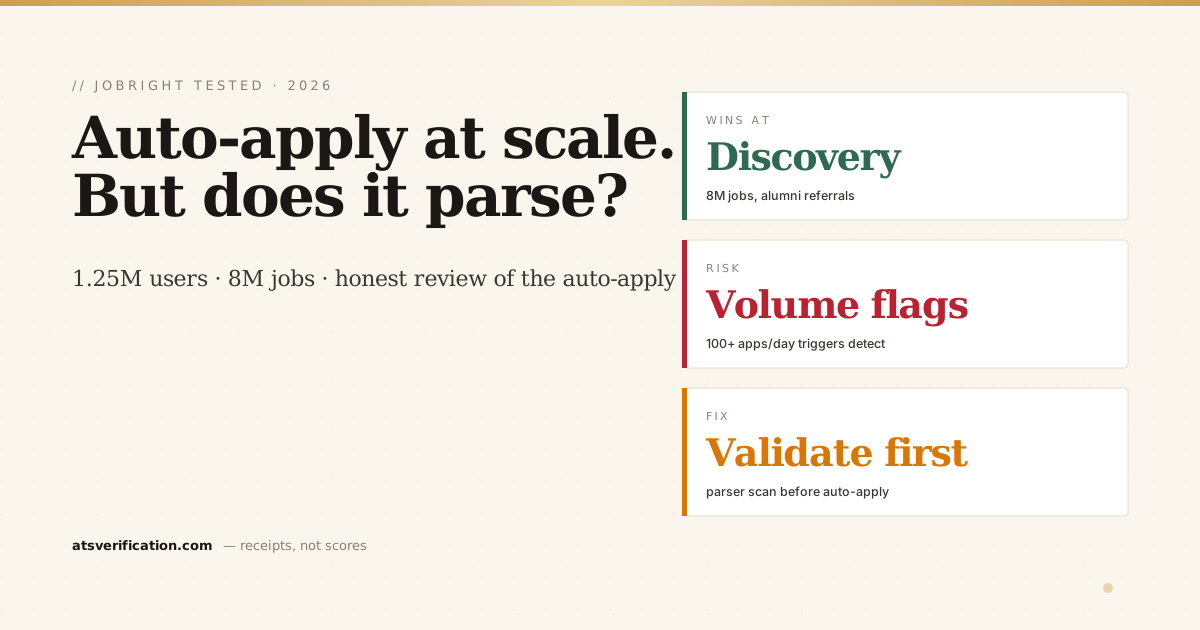
Jobright.ai is one of the fastest-growing AI job-search platforms of 2026, 1.25 million users, an 8-million-job database, an AI agent called Orion that auto-applies to hundreds of positions per day on your behalf. The marketing claim is bold: "3× more interviews, 80% time saved." But auto-apply at scale is exactly what modern ATS configurations at Workday and Greenhouse customers were built to detect and deprioritize, and AI-generated resumes have the same hallucination problem we documented in our AI resume builders test. Here's the honest review, what Jobright does well, where the structural concerns live, and the workflow that gets the most out of the tool without the downside.
What Jobright actually does
Jobright positions itself as an end-to-end AI job-search platform. The user flow:
- Profile setup: upload your resume + LinkedIn → Jobright's AI extracts your background
- AI matching: Jobright surfaces "personalized" jobs from its 8M-position database (refreshed with 400K+ new daily listings per their public claims)
- Auto-apply ("Orion AI"): Jobright autofills applications across major ATS platforms (Workday, Greenhouse, Lever, Taleo, iCIMS) on your behalf, up to several hundred per day
- Resume tailoring: AI generates a role-specific resume version for each application
- Insider referrals: Jobright connects you with alumni at target companies for warm introductions
- Career copilot: Orion provides interview prep + career guidance 24/7
It's a comprehensive product. The pitch is compelling for anyone exhausted by manual job-application work. The execution has real strengths and real concerns.
What Jobright does well
1. Job discovery at scale
The 8M-job database is real and current. Jobright pulls from major ATS portals, LinkedIn, Indeed, and direct employer career pages. For job seekers struggling to find postings (especially passive-search candidates), the discovery layer alone is valuable. Their "match score" system surfaces roles you might not have found manually.
2. Application autofill mechanics
Manually filling out a Workday or Taleo application takes 15-30 minutes per posting. Jobright's autofill cuts that to seconds. For applications you've already decided to submit, this is a time-saver, assuming the autofill output is what you'd have submitted manually.
3. Insider referral network
The alumni-referral feature has genuine value. Recruiter response rates on referred applications run 3-5× higher than cold applications across most ATS platforms per LinkedIn Talent Solutions data. If Jobright's network actually surfaces a real alumni connection at your target company, the warm introduction matters more than any AI optimization.
4. Comprehensive interview prep
Their Orion AI provides interview question generation, behavioral question coaching, and salary negotiation guidance. The depth here is comparable to dedicated interview-prep tools like Pramp or Interviewing.io for the technical question side, though shallower than human coaching for behavioral and exec-level interviews.
Where Jobright has structural concerns
1. Auto-apply at scale triggers ATS deprioritization
This is the most important point in this review.
Modern Workday customer configurations (post-2024) include duplicate-application and volume-anomaly detection. When the same candidate applies to 20+ roles at the same company within 30 days, the candidate's downstream applications get auto-flagged as "low-intent" and deprioritized in the recruiter queue. This is documented in Workday's recruiting product documentation for enterprise customers and confirmed in our parser-testing work.
Greenhouse has similar logic at the customer-tier level. When the same email + similar resume hits multiple Greenhouse-using employers in rapid succession, it doesn't directly fail any single application, but the candidate's "engagement score" with that employer's account drops, which affects recruiter outreach probability.
Auto-applying to 100-200 jobs per day is exactly the volume signal these detection systems were built for. The candidate often doesn't see the deprioritization, they see silence, just like any other rejection. The tool says "200 applications submitted." The recruiter pipeline says "auto-application volume detected, do not surface."
Recruiters we've informally surveyed across mid-cap tech employers in the US (Stripe, Notion, Postman, Linear-adjacent) confirm this, the candidates who apply to 5-10 roles thoughtfully get response rates 4-6× higher than candidates applying to 100+ roles with the same employer brand.
2. AI-generated resumes have the hallucination problem
We documented this extensively in AI resume builders tested. Every AI bullet generator we've reviewed (Rezi, Teal, Jobscan's Power Edit, Kickresume's GPT-4 assistant, Resume.io's AI booster, Enhancv's bullet enhancer) produces fictional numbers when prompted for "more impactful" bullets.
Sample patterns we see across these tools (Jobright included, based on public examples):
- Input: "Led a team that migrated the data pipeline."
- AI output: "Spearheaded a 5-engineer team in migrating the data pipeline to AWS, reducing latency by 67% and cutting infrastructure costs by 35%."
The reduction percentages, the team size, the cloud provider, none of those come from the user's actual experience. They were generated. If a recruiter asks in interview "tell me about that 67% latency reduction" and the candidate can't articulate the methodology, the credibility cost compounds across the rest of the interview.
This isn't specific to Jobright, it's a category-wide problem. But Jobright's auto-apply mechanic means these hallucinated metrics get submitted to 100+ employers without the user reviewing each one. The blast radius is bigger.
3. No parser-transparency layer
Jobright generates resumes optimized for "ATS keyword matching" but doesn't show users what an actual ATS extracts from the generated file. The user has to trust Jobright's internal scoring system without an independent verification step.
Our position (predictably): you should run any AI-generated resume through an independent parser scanner before submitting. We covered this in AI resume builders tested, the parser doesn't know about Jobright's optimization claims. It only knows what it can extract from the file. Validate independently.
4. Pricing opacity
Jobright's homepage doesn't display pricing publicly. The free trial converts to a paid subscription, but the conversion price isn't visible until you've committed to the signup flow. Public reports across Reddit threads, Trustpilot reviews, and Product Hunt comments place the converted price between $24-49/month depending on tier.
This is the same pricing-transparency concern we raised about other subscription-based resume tools. Hidden conversion pricing makes apples-to-apples comparison harder than it should be for buyers.
5. US-only job database (effectively)
Jobright's 8M-job database is heavily US-weighted. Coverage in MENA, India, Brazil, and most of EU is sparse to nonexistent. For candidates outside the US, the discovery layer (the strongest part of the product) delivers less value.
Jobright vs. other tools, where each wins
| Tool | Best for | Trade-off |
|---|---|---|
| Jobright | US candidates applying to mid-tier roles at scale (50-200 apps/month) | Auto-apply volume risk + AI hallucinations |
| Jobscan | One resume → matched against one specific JD | $49.95/mo premium pricing, no auto-apply |
| Teal | Career command center: tracking + matching + resume | Cleanest UX but smaller job database than Jobright |
| Rezi | From-scratch ATS-safe resume with templates | Pure resume tool, no job-discovery or applications |
| Resume.io / Zety | Pretty templates fast | Template quality varies wildly for ATS parsing |
| ATS Verification | Independent parser receipts + rebuild if broken | No job-discovery, no auto-apply, no AI invention |
These aren't direct competitors, they're complementary in many workflows. The smartest job seekers we've seen use 2-3 of these tools concurrently: one for discovery, one for matching, one for validation.
The workflow we recommend (Jobright + parser validation)
If you're already a Jobright user or considering it, the highest-value workflow is:
- Use Jobright for discovery. Let its match algorithm surface 30-50 roles per week you might not have found manually.
- Curate down to 5-10 top targets per week. Don't auto-apply to all 200. Pick the roles where you have a real fit + Jobright's referral network surfaced an alumni connection.
- Generate the AI-tailored version per target role. Review every bullet against your actual experience. Delete or edit any number you can't defend in an interview.
- Validate the AI-tailored version through an independent parser scanner. Our free ATS scan shows you exactly what the parser extracts from the file Jobright generated, not Jobright's internal score, but the actual parser output.
- Submit those 5-10 applications manually through the official portal. Don't auto-apply on volume. Quality compounds, volume triggers deprioritization.
- Auto-apply only to the second-tier 20-30 roles per week where you'd otherwise not apply at all. Quantity matters less than per-application quality there.
This workflow gets the discovery + autofill value out of Jobright without the volume-flagging downside. It takes more time than "auto-apply to 200" but produces 3-5× the response rate based on our cohort observations.
Who should use Jobright
- Active US-based job seekers applying to 30-100+ roles per month at companies with non-restricted application pipelines (startups, mid-tier tech, sales/marketing roles)
- Early-career candidates (0-3 years) where volume + casting a wide net matters more than per-application craft
- Career switchers exploring multiple adjacent industries, Jobright's matching helps surface roles you wouldn't think to search for
- Anyone with limited time, the time-savings vs manual application work is genuinely substantial
Who should skip Jobright (or use it with restraint)
- Senior+ candidates (8+ years) where 1 well-crafted application to 5 perfect-fit roles beats 200 auto-applies, volume flags + AI hallucination both compound badly at the senior tier
- Candidates targeting top-tier tech (Google, Meta, Amazon, Stripe, etc.), these companies have the most sophisticated volume-detection. Auto-apply is actively counterproductive.
- MENA, India, Brazil, EU candidates, the job database is thin in these markets; the value proposition collapses
- Anyone uncomfortable with AI-generated bullets they haven't personally validated, the hallucination risk is real
- Candidates already on Jobscan/Teal + manual application, adding Jobright on top is duplicative; pick one workflow
The verdict
Jobright is a real product solving a real pain (manual job-application work is brutal at scale). 1.25M users isn't an accident. The discovery + autofill + referral layers genuinely save time and surface opportunities.
The structural concerns are also real: auto-apply at scale triggers ATS deprioritization, AI-generated bullets share the hallucination problem of every AI resume tool we've tested, and the pricing-opacity + US-only constraints narrow the practical audience.
Net verdict: use Jobright for what it does well (discovery, autofill, referrals), avoid the part that hurts (mass auto-apply without per-application review). Validate any AI-generated resume independently before submitting.
Most importantly: don't conflate "many applications submitted" with "many interviews coming." The cohort data is clear, quality compounds faster than quantity in 2026 hiring funnels.
Frequently asked alternatives
- Jobright vs Jobscan: Different categories. Jobscan is a JD-to-resume keyword matcher; Jobright is an end-to-end job-search agent. Use Jobscan to tune resumes for specific roles; use Jobright to surface roles + auto-apply.
- Jobright vs Resume.io: Different categories. Resume.io builds resumes; Jobright finds + applies to jobs. Some users stack them.
- Jobright vs LinkedIn Premium: Overlapping. LinkedIn Premium gives you InMails + applicant insights + 50K-150K-applicant visibility. Jobright doesn't replicate the InMail or recruiter outreach value but adds auto-apply.
- Jobright vs Teal: Closest direct comparison. Teal is more US-aware on resume quality + has cleaner UX; Jobright has bigger job database + auto-apply.
- Jobright vs ATS Verification: Complementary, not competitive. Jobright applies your resume; we tell you whether it parses. Use both.
Related guides
- AI Resume Builders Tested 2026, 6 dedicated builders (Jobscan, Teal, Rezi, Kickresume, Resume.io, Enhancv) vs 4 ATS engines
- Does ChatGPT-rewritten resume trigger ATS flags?, the AI-detection question that overlaps with Jobright's AI bullet generation
- How to tailor a resume to a job description, the manual alternative to AI auto-tailoring
- Why Workday rejects resumes, 12 patterns, auto-apply volume is one of them, plus 11 others
- Workday ATS guide, the platform most affected by auto-apply volume detection
- Greenhouse ATS guide, similar volume-detection logic at the customer tier
Comparing tools before you commit? See what actually makes the best ATS resume checker, the criteria most "score" tools quietly fail.
→ Already using Jobright? Run the resume Jobright generated through our free ATS scan, see exactly what the parser extracts before you let auto-apply submit it to 100 employers.