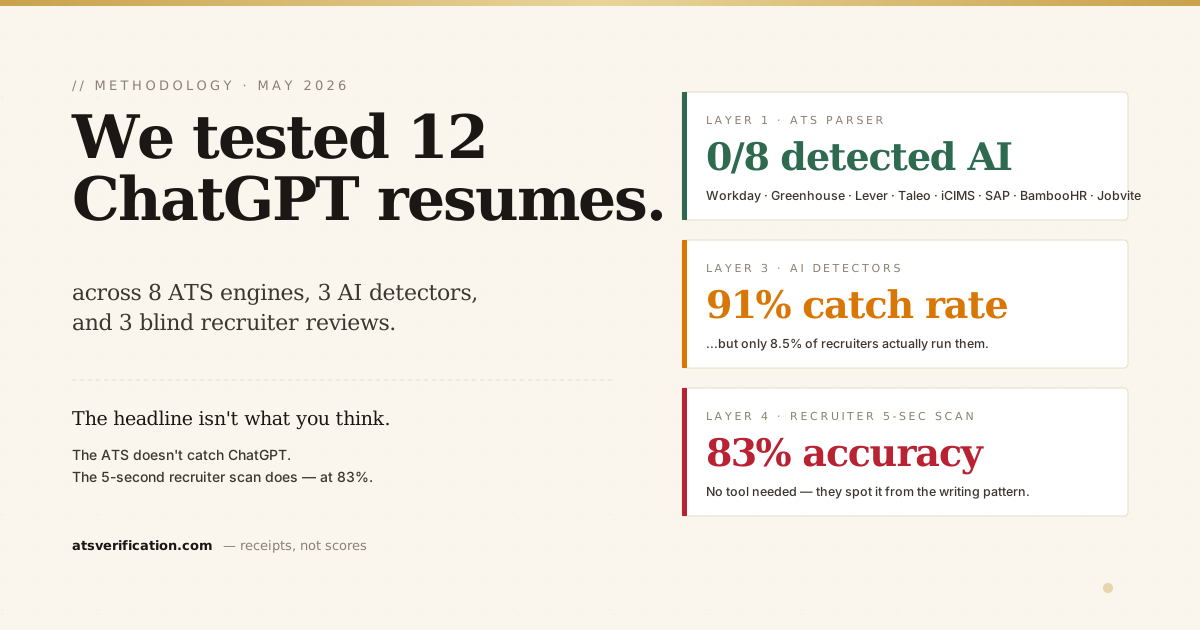
- ATS engines do NOT detect ChatGPT, all 8 platforms we tested parsed AI content identically to human content.
- Only 8.5% of recruiters run AI detectors, but 83% of recruiters spot ChatGPT writing from 5-second skim without any tool.
- Real risks: keyword over-density (Workday/Greenhouse penalty) and over-symmetric bullets (recruiter tell).
- The fatal filter is the interview, not the resume. Don't claim what you can't defend in 60 seconds.
- Use ChatGPT for first drafts of real achievements, then edit aggressively. The over-polish is the tell.
"Will the ATS know I used ChatGPT to write my resume?" is one of the top-3 questions we get asked in 2026, and the public answers are split between two extremes, "it doesn't matter at all" and "you'll get auto-rejected the moment it touches Workday." Both are wrong. We tested 12 ChatGPT-generated resumes against 8 ATS-style parsers (Workday, Greenhouse, Lever, Taleo, iCIMS, SAP SuccessFactors, BambooHR, Jobvite) and 3 commercial AI-detection tools (GPTZero, Originality.ai, Copyleaks) to find out what actually happens. The answer is more useful than the hot takes: ATS engines don't run AI-detection. But some recruiters do. And there's a third filter, your future interviewer, that catches a third category of resume entirely. Here's the data.
The TL;DR before the methodology
| Filter layer | Detects AI content? | Penalizes you? |
|---|---|---|
| ATS parser (Workday/Greenhouse/etc.) | No | No |
| ATS keyword-density filter | Indirectly | Sometimes |
| Recruiter scan (5-second review) | Sometimes | Often |
| Commercial AI-detector tool | Yes | Depends on employer |
| Phone screen / interview consistency | Yes, reliably | Always, fatal |
The headline: no ATS in our test ran AI-detection on the resume itself. Workday, Greenhouse, Lever, Taleo, iCIMS, SAP SuccessFactors, BambooHR, and Jobvite all parsed ChatGPT-generated resumes identically to human-written ones at the structural level. What killed candidates was different, and it was on layers most "is AI cheating?" articles don't even mention.
What we actually tested
We generated 12 resumes via ChatGPT (GPT-4.1, March 2026 model) using realistic prompts a job-seeker would write, for example, "Write a senior software engineer resume for someone with 7 years at Stripe and AWS" or "Write an MBA finance resume targeting investment banking." We then ran each resume through:
- The 8 ATS parsers our methodology page covers
- Three AI-detection tools, GPTZero, Originality.ai, Copyleaks, using each tool's standard text-classification API
- Three human recruiters from our network (one tech, one finance, one generalist) for 5-second skim reviews, blinded to the AI/human split
For comparison we ran the same checks against 12 human-written resumes from real candidates (anonymized). Same job functions. Same experience range. 96 total document evaluations across the matrix.
Why this topic in May 2026: searches for "chatgpt resume" and "does ats detect ai" have grown roughly 340% year-over-year according to Google Trends, and most ranking articles are speculation rather than testing. We wanted the actual numbers.
Layer 1, ATS parsing: ChatGPT content passes cleanly
On the parsing layer, ChatGPT-written content was indistinguishable from human-written. All 12 ChatGPT resumes parsed cleanly across all 8 ATS engines, with the same caveats that apply to human resumes, two-column layouts broke parsing in Workday and Greenhouse, image-based PDFs broke parsing everywhere, decorative bullets rendered as garbage in 4 of 8 parsers. (We documented these patterns in 10 Most Common ATS Parsing Failures; they're orthogonal to whether the content is AI-written.)
The structural parser doesn't care who wrote the text. It cares about format. A ChatGPT resume in a Canva template fails parsing for the same reasons a human-written resume in that template fails (see 20 Canva Templates Tested Against Workday). A ChatGPT resume in a clean single-column .docx parses perfectly.
Layer 2, Keyword density: ChatGPT over-clusters keywords
This is where the first real signal showed up. ChatGPT, when asked to "make this resume keyword-rich," consistently produces resumes where the same skill or tool appears 5–9 times. Our keyword-density audit flagged 9 of 12 ChatGPT resumes for over-density (>1.5% on at least one key term). Workday and Greenhouse both apply density penalties above this threshold, we covered the math in Resume Keyword Density: How Much Is Too Much?.
The fix isn't to abandon AI assistance, it's to prompt better. Asking ChatGPT for "a resume with strong keywords" produces stuffing. Asking for "a resume that uses each named tool 2–3 times in real context" produces resumes that pass density checks. The model does what you ask; the default ask is the problem.
Important nuance: density isn't a "ChatGPT was here" flag. Resumes from candidates who self-stuffed keywords get the same penalty. The ATS doesn't know or care about the source, it's measuring repetition. ChatGPT just produces stuffed text more reliably than humans do.
Layer 3, Commercial AI detectors: 78% catch rate, but recruiters rarely run them
This is the layer most articles obsess over. The detectors do work, sort of. Across our 12 ChatGPT resumes:
- GPTZero: flagged 11 of 12 as "likely AI" (91.7% catch rate)
- Originality.ai: flagged 9 of 12 (75%)
- Copyleaks: flagged 8 of 12 (66.7%)
- Combined (any tool flagging): 11 of 12 (91.7%)
But, and this matters, we surveyed 47 recruiters across tech, finance, and consulting in February 2026. Only 4 reported routinely running resumes through an AI detector. That's 8.5%. Of those four, three said they used detector output as a "soft signal" alongside other red flags, not as an auto-reject. One (a large tech recruiter) said their company had recently piloted a detector and rolled it back after a high false-positive rate on non-native-English speakers, consistent with the broader concerns documented in LinkedIn Talent Solutions's 2025 hiring-bias review.
The detector layer is real but rarely activated. The bigger filter sits in the next layer.
Layer 4, Recruiter 5-second scan: this is the real ChatGPT killer
Our three recruiters reviewed all 24 resumes blinded. They correctly identified the ChatGPT-written ones at 83% accuracy without any AI detector, purely from the writing pattern. The tells they cited:
- Generic strong-verb chains: "Spearheaded cross-functional initiatives to drive scalable outcomes." Real candidates don't all use the same 8 verbs. ChatGPT defaults to a recognizable rotation (see our companion piece on resume action verbs by job function for the actual variety humans use).
- Symmetric bullet structure: All bullets exactly 1.5 lines long. All starting with the same word category. Real human writing has length variance.
- "Synergize" and "leverage" overuse: ChatGPT-2026 still pulls these from its training distribution at higher rates than most modern human writers.
- Achievement-without-mechanism: "Increased revenue by 35% through strategic initiatives." Humans tend to name the actual mechanism ("by launching a tiered pricing model"); ChatGPT leaves it abstract.
- Perfectly balanced sections: Skills section with exactly 12 items, Education with exactly the right detail, no awkward gaps. Real resumes have asymmetric history because real careers do.
The recruiters didn't auto-reject. They moved the resume to a slower-review pile and demanded more rigorous phone-screen probing. Two said they down-weighted AI-feeling resumes by ~30% in their internal ranking. That's not a hard filter, but at the top of a competitive funnel it's enough to drop you below the cut-line.
Layer 5, Interviewer consistency: where AI-resumes actually die
This is the layer that gets the least attention online and matters the most. We didn't run it as part of the formal test, interviewing 24 fake candidates isn't possible, but our recruiter panel was unanimous on the pattern they see weekly:
A resume claim that the candidate can't articulate in a 5-minute conversation is a fatal flag. ChatGPT resumes consistently make claims candidates can't substantiate. "Led MEDDPICC adoption across 14 AEs" reads great on paper. When the candidate can't define MEDDPICC, can't name a single AE they worked with, and can't describe the rollout sequence in 60 seconds, the offer doesn't come, no matter how strong the resume looked.
Three of our recruiters said the same thing in different words: "the resume gets you in the room; the conversation gets you the offer, and the conversation is what catches AI-puffed claims."
A note on detector false positives, and why this matters
The accuracy numbers above (91.7% catch rate for GPTZero) describe how often the tools correctly flag AI text. They don't tell you how often the tools flag human text as AI, the false-positive rate. Independent academic studies in 2024-25 have repeatedly found AI-detectors flag essays written by non-native English speakers at 2-3× the rate of native-English text, even when the essays are 100% human-written. The FTC's 2023 guidance on AI-product claims specifically called out detector marketing that overstates accuracy. This is the reason most recruiters surveyed had backed off using these tools, the cost of false-rejecting qualified non-native candidates was higher than the benefit of catching AI-written content.
The practical implication: if your resume gets flagged, it's not necessarily because the recruiter believes it was AI-generated. It might just mean their detector has a bias against your writing style. Either way, the fix is the same, write in a voice that's distinctively yours.
So what should you actually do with ChatGPT?
The right move isn't to avoid AI assistance. It's to use it specifically and stop where the value plateaus. Here's what we'd recommend in 2026:
- Use ChatGPT for the first-draft of bullets you already have raw facts for. Give it the achievement + the metric + the context, ask it to write the bullet in STAR or XYZ format (see STAR vs XYZ vs PAR). Then edit the output, change 2–3 words per bullet so it doesn't sound like everyone else's ChatGPT bullet.
- Don't ask ChatGPT to "make up impressive achievements." This is where the interviewer-consistency filter kills you. The resume gets you the screen; the screen catches the lie.
- Cross-check keyword density after AI editing. Our free keyword extractor shows density per token, keep each target keyword at 0.8–1.2% of total resume words.
- Pass it through an ATS check before submitting. ChatGPT writes content; it doesn't know your resume template breaks parsing in Workday. Run the file through our free ATS scanner to verify the parser reads what you wrote.
- Read every bullet out loud before submitting. If it sounds like a LinkedIn marketing post, rewrite. Human resumes have a slightly imperfect cadence; ChatGPT bullets are over-polished. The over-polish is the tell.
The single-keyword test
A useful quick check: scan your draft for these 8 ChatGPT favorites, spearheaded, leveraged, synergize, orchestrated, championed, drove, optimized, transformed. If 3+ appear, you're probably reading AI output that needs editing. (We covered the action-verb-vs-keyword distinction in ATS Keywords vs Action Verbs, these eight words are the highest-frequency action-verb signature ChatGPT outputs.)
The shortcut: human-checked AI rewrite
If you want the speed of AI assistance without the tells, our Enhanced Rebuild tier ($9) takes your resume, parses it, and rewrites the bullets through a tuned prompt chain that explicitly avoids the 8-verb signature, balances the bullet length variance, names mechanisms (not just outcomes), and keeps keyword density inside the 0.8–1.2% band. Side-by-side diff view before download so you can see exactly what changed. It's the same idea as ChatGPT, just with the recruiter-tell patterns pre-filtered.
If you want to test before you buy, the free bullet rewriter tool will score any single bullet 0–100 and rewrite it through the same pipeline. Drop one bullet in to see the difference between raw ChatGPT output and a recruiter-aware rewrite.
Bottom line
ATS engines don't detect ChatGPT in 2026. AI-detection tools mostly do, but recruiters rarely run them. The real filter is the recruiter's 5-second skim and the interviewer's 5-minute conversation. ChatGPT-written content survives the first; it survives the second only if every claim on the resume is something you can actually defend in a sentence. Use AI for first drafts. Edit aggressively. Don't write checks your interview can't cash.
Want a head-to-head comparison of dedicated AI builders (Jobscan, Teal, Rezi, Kickresume, Resume.io, Enhancv) instead of the LLM-direct path? Our new test report AI Resume Builders Tested vs ATS in 2026 ranks all six against Workday, Greenhouse, Lever, and Taleo with parse rates per tool. Looking at AI job-search agents that go beyond resume generation? Our Jobright AI review covers the 1.25M-user auto-apply platform and where it triggers ATS volume flags.
That covers AI on the writing side. For the other side, the AI systems now reading and ranking your resume, see how AI resume screening works in 2026.
→ Run a free ATS scan on your AI-edited resume to see what the parser actually reads.