Correction, 17 October 2026. Earlier versions of this article said recruiters give each role 6 seconds of attention, read a metric in half a second, and gave average word counts for each format. Those figures had no source, so we have removed them. The comparison now rests on how each format reads on the page, and the examples are unchanged.
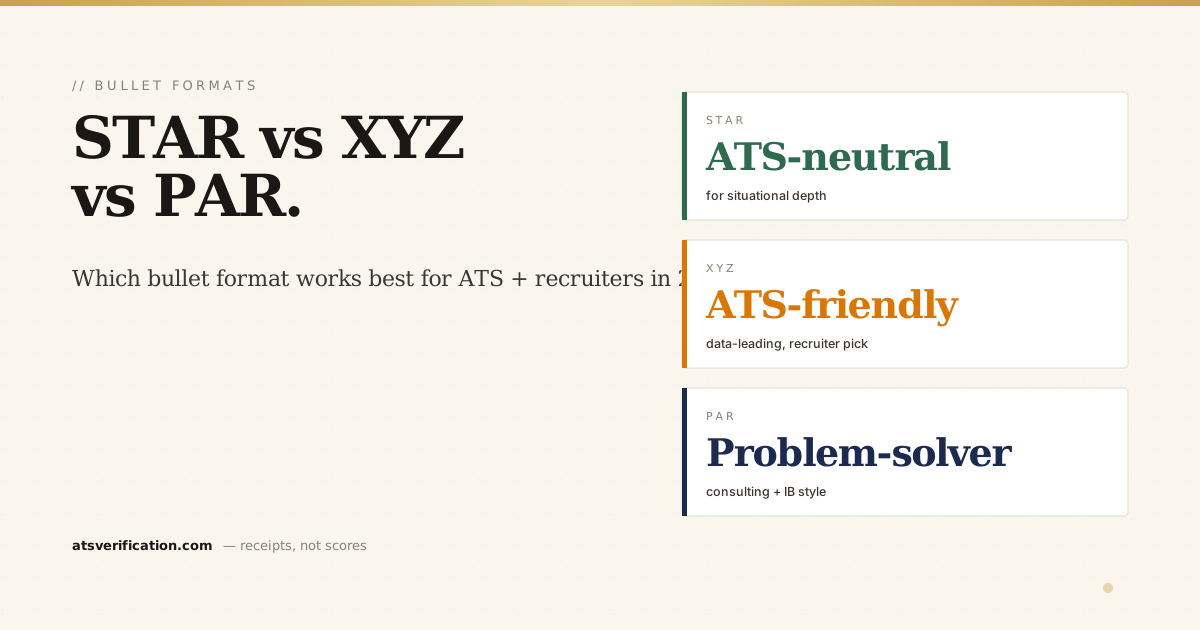
Three resume bullet frameworks dominate career advice: STAR, XYZ, and PAR. They're all "good", but they're not equal. For a resume that parses cleanly AND lands with human recruiters, one usually works better than the others. Here's the honest comparison.
The three frameworks at a glance
STAR, Situation, Task, Action, Result
Originally an interview framework, adapted to resume bullets:
"When the company faced a 30% cost overrun on a major project (Situation), I was tasked with auditing the budget (Task). I rebuilt the forecasting model and introduced weekly variance reviews (Action), reducing overrun to 8% by quarter-end (Result)."
XYZ, "Accomplished X by doing Y, resulting in Z"
Popularized by Google's Laszlo Bock:
"Reduced project budget overrun from 30% to 8% by rebuilding the forecasting model and introducing weekly variance reviews."
PAR, Problem, Action, Result
Simplified version of STAR:
"Project running 30% over budget; rebuilt forecasting model and introduced weekly variance reviews; reduced overrun to 8%."
Which one wins?
For resumes specifically: XYZ usually wins. Here's why:
1. XYZ is denser per line of resume real estate
Resumes have ~6 bullets per role × 4-5 roles = 24-30 bullets total. Each bullet should fit on 1-2 lines. Compare the three examples above: the STAR version is the longest, the PAR version the shortest. XYZ hits the sweet spot, enough context to be meaningful, short enough to scan.
2. XYZ leads with the OUTCOME
Recruiters skim. Leading with "Reduced budget overrun from 30% to 8%..." catches the eye instantly. STAR buries the result at the end, by the time the reader reaches it, they've often skipped to the next bullet.
3. XYZ is ATS-friendly by structure
To a parser, every one of these formats is plain text, so none of them is "rejected". What XYZ does is keep each bullet short and on one topic, with the action verb (Reduced, Led, Built, Delivered) and the skill words close together. That makes the bullet easy to read in the parsed text and easy to match when a recruiter searches for a skill, without any keyword stuffing.
4. STAR works for behavioral interviews, not resumes
STAR was designed for verbal answers in interviews where you have 60-90 seconds per response. On a resume, a recruiter is skimming, often across many applications. The frameworks aren't interchangeable.
How to write XYZ bullets that work
Pattern: [Strong verb] [outcome with number] by [action], [optional context/keyword].
Examples:
- "Reduced month-end close cycle from 12 days to 5 days by automating intercompany reconciliation in SAP."
- "Generated $2.3M in new pipeline by launching outbound campaign targeting mid-market FP&A leaders."
- "Cut customer support tickets by 38% by rewriting onboarding documentation and adding in-app tooltips."
- "Delivered IFRS 16 lease accounting transition for $40M portfolio with zero audit findings."
Notice each one: verb at start, metric immediately after, action method, optional keyword/context. A skimming recruiter sees "Reduced... by 38%" first and decides whether to read the rest.
When NOT to use XYZ
- Roles without quantifiable outcomes: early-career roles, support functions where impact is qualitative. Use action+context instead: "Built and maintained internal documentation portal used by 50+ team members daily."
- Process-heavy roles: legal, compliance, audit. Use action+scope: "Conducted internal audits across 14 entities, identifying 28 control gaps."
- Recent graduates with no job experience: use achievements from coursework, internships, side projects with the same XYZ structure.
The 5-bullet limit per role
More than 5-6 bullets per role dilutes impact. Recruiters skim, and the first few bullets get the most attention. Your strongest XYZ bullets should be at the top.
For long careers (10+ years, 6+ roles), use 5 bullets on most-recent roles, 3 bullets on roles 5+ years old, and 1 line summary on roles 10+ years old.
The action verb list (XYZ-compatible)
Leadership: Led, Directed, Headed, Managed, Oversaw, Spearheaded, Drove, Championed
Building: Built, Created, Designed, Developed, Engineered, Architected, Launched, Established
Optimization: Reduced, Cut, Streamlined, Optimized, Improved, Accelerated, Automated, Eliminated
Growth: Grew, Scaled, Expanded, Increased, Boosted, Accelerated, Generated
Delivery: Delivered, Shipped, Executed, Implemented, Deployed, Released, Completed
Analysis: Analyzed, Assessed, Audited, Investigated, Evaluated, Reviewed, Diagnosed
Avoid weak verbs: "Was responsible for," "Helped with," "Worked on," "Assisted in." These add words without adding meaning.
Not sure which of your bullets need this treatment? Here are the lines a resume roast burns first, and how to fix each one.
The bottom line
For most resume bullets, XYZ is the right format. It's dense, outcome-led, ATS-friendly, and recruiter-scannable. STAR belongs in interviews. PAR belongs in casual context.
If you've been writing STAR bullets and not hearing back, rewriting them to XYZ is a cheap, worthwhile change to try.
Want to test a single bullet right now? Paste it into the free resume bullet rewriter for an instant strength score, weak-verb flags, and rewrites in STAR, XYZ and PAR format.
Run your resume through ATS Verification to see exactly how the parser extracts your bullets, and whether the structural issues (not just bullet format) are blocking you in the first place.
→ Free ATS scan, see whether your bullets parse correctly