In 2026 I was admitted to the Executive MBA programmes at both Oxford Saïd and London Business School. This is the comparison I searched for during my decision and never found, written by someone who actually held both offers, paid the deposit, and starts at LBS in September. Six factors decided it. One of them will probably decide yours too, and it may not be the one you expect.
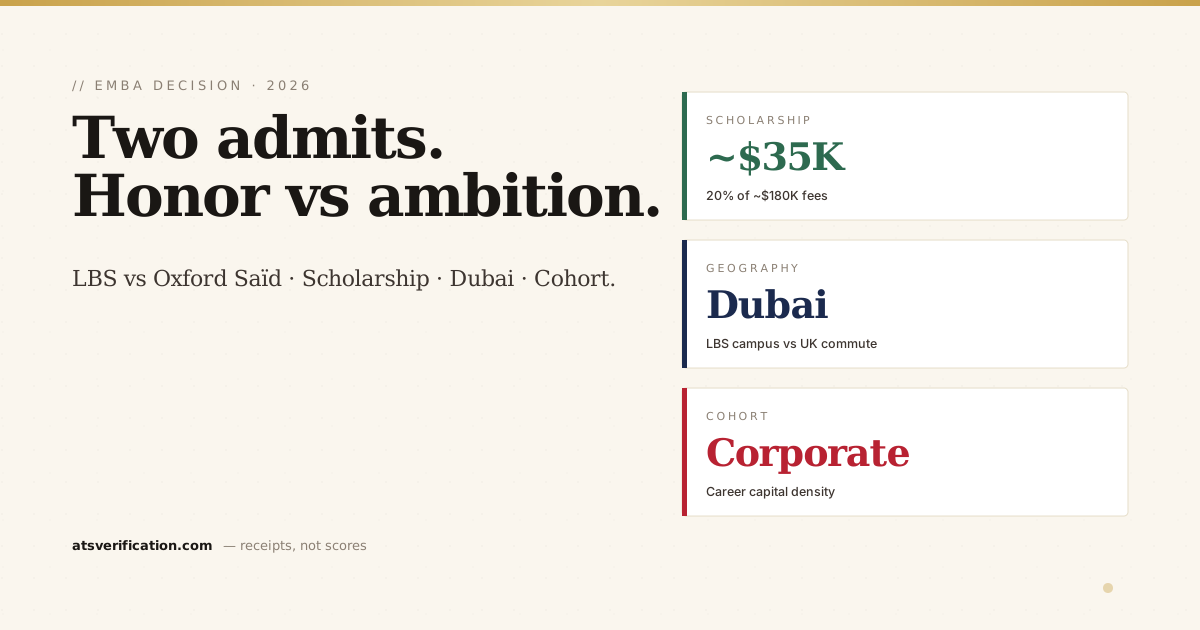
- Scholarship percentages deceive, do the dollar math. "20%" sounds modest; on fees approaching $180K it's roughly $35K, which reshapes the whole ROI calculation.
- Choose the cohort, not the crest. Oxford's classroom is deliberately diverse, educators, civil servants, public-sector leaders. LBS is densely corporate. Neither is better; they optimize for different lives.
- Geography compounds over 20 months. LBS's Dubai campus meant studying where I live; Oxford meant a UK commute for every module.
- For finance careers specifically, LBS's alumni network is the asset, it's one of the deepest finance communities of any business school in the world.
- Admissions speed is a signal. LBS shortlisted, interviewed, and admitted me a month before Oxford's decision arrived. By then my mind was made up.
Where I started from
Context matters in these decisions, so here's mine: I'm a Regional Finance Manager for the Middle East & Africa, ACCA-qualified, based in Dubai, with a career built in corporate finance. I applied to MBA programmes over two cycles, three full-time admits in 2025 that I declined, then the EMBA round in 2026 that ended with offers from both Oxford Saïd and LBS, and an Educational Opportunity Scholarship from LBS. I'm optimizing for one thing: acceleration of a corporate finance career. Keep that lens in mind, if your goal differs, some of my six factors may point you the other way.
Factor 1: The scholarship, think in dollars, not percentages
LBS named me an Educational Opportunity Scholar with a 20% award. Twenty percent sounds incremental until you put it against the fee schedule: with EMBA fees approaching $180K, that's roughly $35,000, for many candidates, an entire year of saving. Oxford's offer carried no funding for me.
The principle generalizes: candidates anchor on percentages because that's how scholarships are announced, but your spreadsheet only understands currency. A 20% award at an expensive programme can outweigh a 35% award at a cheaper one, and self-funded EMBA candidates (an increasing share, as employer sponsorship declines) should weight this factor far more heavily than the prestige delta between two elite schools.
Factor 2: The finance network, the asset I'm actually buying
Strip away the coursework and an EMBA at this level is substantially a network purchase. So the real question is: whose network? LBS sits in Europe's financial capital and has spent five decades feeding investment banks, asset managers, private equity, and corporate finance functions across EMEA. For a finance professional, the alumni directory is the product: the people who can pull you into a CFO track, a fund, or a board seat are disproportionately LBS alumni.
Oxford's network is broader and in some dimensions grander, but breadth was not my problem. Depth in finance was. If you're in tech, government, social impact, or planning a sector switch toward policy or entrepreneurship, weigh this factor differently.
Factor 3: Geography, Dubai campus vs UK commute
This was the quiet heavyweight. LBS operates a campus in Dubai, I study an executive programme in the city where I live and work. Oxford's EMBA meant flying to the UK for every module block: flights, hotels, visa logistics, and annual leave burned on travel days, multiplied over the length of the programme, on top of a full-time regional finance role.
EMBA attrition and misery rarely come from the coursework, they come from the logistics stacking on top of an unforgiving job. When two programmes are this close in quality, pick the one whose geography you can sustain for 20 months without your employer, family, or health filing a complaint.
Factor 4: The FT rankings, used honestly
Rankings played a genuine role in my decision, and I'll cite them precisely because this is where comparison posts usually get sloppy. In the Financial Times EMBA Ranking 2025, LBS placed #13 globally against Oxford Saïd's #15. In the FT Executive Education Open Rankings 2026, LBS ranked #1 with Saïd in a tie at #7. The FT methodology leans on measured career and salary outcomes, which is exactly the dimension a finance careerist should care about.
Full honesty: QS ranks Oxford Saïd the world's #1 EMBA in 2026, three years running. Rankings disagree because methodologies weigh different things. I chose the FT's outcome-weighted lens because it matches my objective; if employer-brand surveys matter more to your industry, the QS view may serve you better. Use rankings as one input with a known methodology, never as the decision.
Factor 5: Admissions speed, and what it signals
LBS ran its process, shortlisting, interview, application review, fast. I held an LBS offer roughly a month before Oxford's decision arrived. By the time Oxford said yes, my deposit psychology had already settled. Momentum is real in two-offer races.
But beyond psychology, process speed is a data point about the institution. A programme that turns around a senior candidate in weeks is telling you how its operations treat your time, a preview of how module scheduling, administration, and career services will feel for two years. (The mechanics of that fast process still run through software: an admissions reader may see your resume as an uploaded file or as text pulled from it, which is why EMBA resumes should stay single-column and machine-readable.)
Factor 6: The cohort, the factor that should actually decide it
Here's the truest difference between these two programmes, and the one nobody puts this plainly:
Oxford is about honor; LBS is about ambition. The Oxford EMBA classroom is deliberately, wonderfully diverse, educators, civil servants, military officers, public-sector leaders, people from genuinely different walks of life. The brand carries a prestige that transcends industry. If you want your thinking stretched by people whose worlds don't resemble yours, Oxford wins that dimension outright.
LBS's cohort is almost purely corporate, bankers, consultants, regional managers, P&L owners. Every syndicate discussion, every coffee, every WhatsApp group is career-adjacent. For someone unapologetically ambitious about a corporate finance trajectory, that density is the entire point: I'm not buying perspective, I'm buying proximity.
Decide what you're optimizing for, breadth of perspective or density of career capital, and this factor alone probably makes your choice.
Where Oxford genuinely wins
- Universal brand transcendence: "Oxford" opens doors in government, academia, and societies where business-school brands mean little. LBS is elite within business; Oxford is elite everywhere.
- QS #1 EMBA in 2026, for the third consecutive year, by that methodology, the world's top programme.
- Cohort diversity, covered above, and for many candidates it's the right answer.
- The collegiate experience, matriculation, college membership, the apparatus of an 800-year institution. If that moves you, no business school replicates it.
None of these were my optimization targets. All of them are legitimate reasons to choose differently than I did.
The decision in one table
| Factor | LBS | Oxford Saïd |
|---|---|---|
| My funding | 20% scholarship (~$35K) | None offered |
| Finance network depth | Exceptional (EMEA finance capital) | Strong, broader than deep |
| Logistics from Dubai | Dubai campus | UK travel per module |
| FT EMBA 2025 / FT Exec Ed 2026 | #13 / #1 | #15 / #7 (tie) |
| QS EMBA 2026 | Top 10 | #1 |
| Admissions speed (my cycle) | ~1 month faster | Slower decision |
| Cohort character | Densely corporate, career capital | Diverse, breadth & prestige |
If you're applying to either
Practical notes from someone who just went through both funnels: the application resume matters more at EMBA level than candidates expect, it must prove scope (P&L, headcount, geography), not potential, and it should stay readable however the schools' application systems store it. The same single-column, machine-readable rules from the MBA resume format guide apply, and the general principles of ATS-safe MBA application resumes hold for executive programmes too. The resume that carried both of my admits followed exactly those rules, and became the blueprint for the MBA & EMBA resume builder we now run. If you just want to check that your current resume parses cleanly before a deadline, the scan is free.
Whichever side of this choice you land on: both rooms are full of people worth knowing. I optimized for the room where everyone is chasing the same thing I am. In September, I'll find out if I chose right.
→ MBA & EMBA application resume builder, built from the resume that earned both of these admits