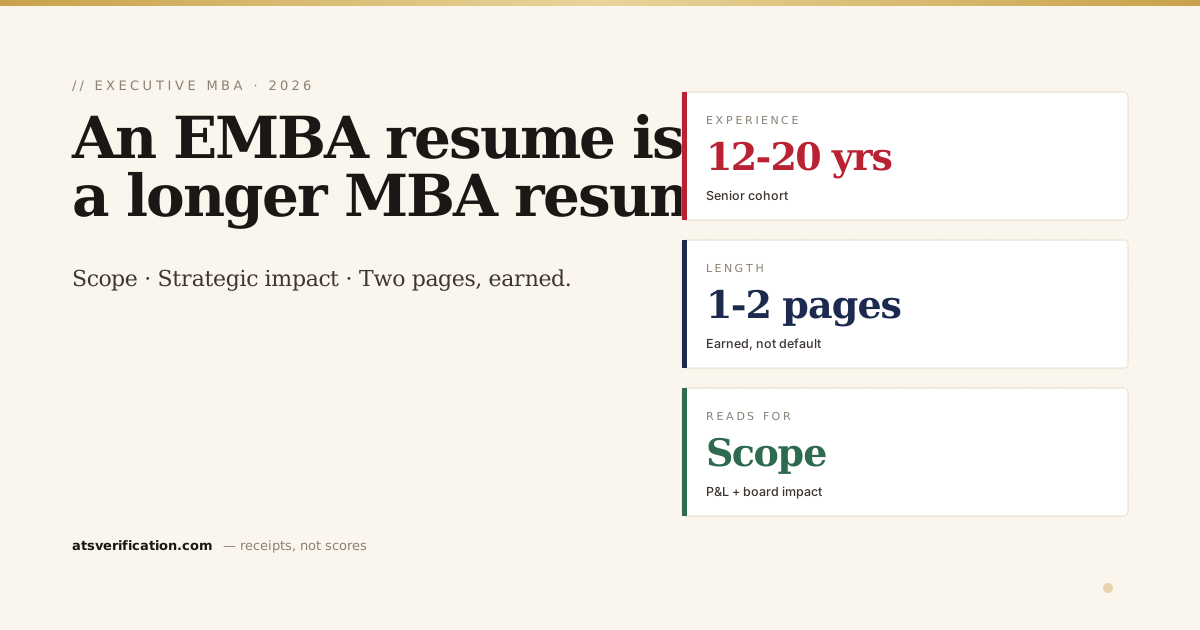
I am starting an Executive MBA at London Business School in September 2026, where I was named an Educational Opportunity Scholar (I held an Oxford Saïd admit too, why I chose LBS is its own story). Getting there meant two application cycles and a lot of resume drafts, and one thing I learned the hard way is that an EMBA resume is not just a full-time MBA resume with more years on it. The audience is different, the length rules are different, and what the admissions committee is scanning for is different. This guide is what I wish I had read before my first draft. (Applying to full-time programs this Round 1 instead? The verified September deadlines and finishing plan are in our 2026 deadline guide.)
- EMBA cohorts are senior, the resume must prove scope and strategic impact, not just competence
- Unlike a full-time MBA resume, an EMBA resume can usually run to two pages, but only if the second page earns it
- Many EMBA programmes waive the GMAT, so your resume carries more of the decision
- Lead every role with scope (P&L, headcount, geography); lead every bullet with a quantified outcome
- School application portals often parse your resume through an ATS, keep it single-column and scannable
Who an EMBA resume is actually written for
The single biggest mistake senior applicants make is treating the EMBA resume like a promotion application. It is not. A work resume answers one question: can this person do the job? An EMBA resume answers a different one: has this person already operated at a senior, strategic level, and will they raise the level of a cohort full of other senior leaders?
That distinction matters because of who sits in an EMBA classroom. According to the Executive MBA Council, the industry body for EMBA programmes worldwide, the typical Executive MBA student is around 38 years old with well over a decade of work experience and several years of management responsibility. Your peers will be directors, VPs, founders, and senior specialists. The admissions committee is not asking whether you can keep up, they are asking what you will add. Your resume is the first evidence.
This is also why the EMBA resume is heavier on scope than a full-time MBA resume. A 27-year-old applying to a two-year programme is being assessed on trajectory and potential. A 40-year-old applying to an EMBA is being assessed on what they already run. The numbers that matter are P&L size, headcount, budget authority, geographic span, and the seniority of the decisions you influence.
EMBA resume vs full-time MBA resume
The two documents share DNA, both are impact-led, both must pass the "so what?" test on every line, but they diverge on the things that decide admission. If you have read our school-by-school MBA resume format guide, this is the executive-track version of the same logic.
| Factor | Full-time MBA | Executive MBA |
|---|---|---|
| Typical experience | 3–7 years | 12–20 years |
| Length | Strict 1 page | 1–2 pages (programme-dependent) |
| Read for | Trajectory + potential | Scope + strategic impact |
| Test | GMAT/GRE usually required | Often waived |
| Headline signal | Growth and leadership moments | P&L, headcount, board-level work |
| Earlier roles | Most roles fit on the page | Compress 10+ year-old roles to one line |
The one-page question, and why EMBA gets more room
For a full-time MBA, one page is close to non-negotiable. For an EMBA, the rule loosens: most programmes accept two pages because there is simply more career to represent, and a single page would force you to bury the senior scope that earns your place. This is the rare case where the usual one-page-versus-two-pages debate tips toward two.
But two pages is a privilege, not a default. The test is brutal and simple: does the second page contain anything an adcom would change their mind over? If page two is your 2009 analyst role spelled out in four bullets, cut it. The discipline is the same as a one-pager, you have just been given a little more canvas to show two decades of scope. Use the first page for your last two or three roles in full, and let the second page carry earlier career in compressed form.
What EMBA admissions committees read for
Strip away the school-specific nuances and EMBA adcoms are scanning for four things:
- Scope of responsibility. What do you own? Revenue, cost, people, regions. Make it the first thing in every role, not something buried in a bullet.
- Strategic and board-level impact. M&A, restructuring, market entry, executive-committee decisions, board reporting. EMBA programmes want leaders who already operate above their title.
- Trajectory of seniority. Promotions and expanding remit, shown clearly. If you have grown within one company, stack the titles so the climb is obvious at a glance.
- The whole leader. Board seats, mentoring, professional bodies, community impact. EMBA cohorts are built around peer learning, so adcoms look for people who lead beyond their job description.
Notice what is not on that list: a long skills inventory, certifications stacked three deep, or a paragraph summarising your career. Senior resumes that lean on those read as junior. Lead with outcomes. If you want the mechanics of turning a duty into a quantified outcome, we wrote a whole guide on quantifying achievements without inventing numbers, and another on STAR vs XYZ bullet structure.
How to structure the EMBA resume
A clean EMBA resume runs in this order:
FULL NAME (centered, bold)
City, Country • Phone • Email • LinkedIn

EXECUTIVE PROFILE  (3-4 lines, current scope + forward direction)

PROFESSIONAL EXPERIENCE
  Title, Company | City | Dates
  Scope line: P&L / headcount / geography
  - Quantified, strategic outcome
  - Quantified, strategic outcome

  [Earlier Career, older roles compressed to one line each]

EDUCATION  (degrees + any scholarship / honours)

LEADERSHIP & COMMUNITY  (board roles, mentoring, professional bodies)

CERTIFICATIONS / LANGUAGES  (one compact line each)
The Executive Profile at the top is where the EMBA resume differs most from a junior one. In three or four lines it states what you run today and where you are heading, the forward-looking frame an adcom uses to read everything below it. This is distinct from the post-MBA recruiting resume, which we cover separately in our MBA admissions vs recruiting resume guide.
Common EMBA resume mistakes
- Submitting the work resume unchanged. It won you your job; it will not win you an EMBA seat. Different question, different document.
- Duty lists instead of outcomes. "Responsible for the regional budget" says nothing. "Owned a USD 100M regional P&L across three entities, improving forecast accuracy 20%" says everything.
- Two pages of equal weight. The second page should thin out, not repeat the density of the first.
- Burying scope in prose. Put P&L, headcount, and geography on their own line under each role so a scan catches them.
- A design-heavy template. Columns, sidebars, and text boxes look polished but break in application portals. Senior does not mean decorative.
Yes, your EMBA resume may have to pass an ATS
It is easy to assume that a human reads every application at this level. Often they do, but the resume usually reaches them through a portal that parses it first. Business-school application systems (Slate, Salesforce, and custom platforms) extract your resume into structured fields, and the same things that break a corporate application at a Workday or Greenhouse employer break it here: two-column layouts, tables, graphics, and contact details stranded in a header.
Before you upload anything, run it through a free check. Our free ATS scan shows you exactly what eight major parsers extract from your file, if your name, scope lines, or dates come out scrambled, the layout is the problem, not your career.
Want it built for you?
If you would rather not wrestle with formatting, our MBA & EMBA resume builder generates an admit-grade resume in your target school's conventions, including a dedicated Executive MBA mode tuned for senior, two-page-friendly profiles. It is a one-time build, not a subscription, and it applies the same "lead with scope, prove with numbers" discipline this guide is built on.
Frequently asked questions
Can an EMBA resume be two pages?
Usually yes. EMBA applicants typically have 12–20 years of experience, and most programmes accept a two-page resume. A few still ask for one page, so check the specific instructions, but unlike a full-time MBA, two pages is normal here.
Do Executive MBA programmes require the GMAT?
Many waive it for candidates with enough seniority, a strong quantitative record, or a professional qualification like ACCA, CFA, or CPA. Because the test is often off the table, your resume carries more of the decision.
Should I mention employer sponsorship on my EMBA resume?
No, sponsorship lives in the application form and sponsorship letter, not the resume. But make your scope, budget authority, and decision rights obvious, because those signal sponsorship-worthiness.
How is an EMBA resume different from my work resume?
Your work resume proves you can do a job. An EMBA resume proves you already operate at a senior, strategic level and will elevate a peer cohort, so it emphasises scope, board-level impact, and quantified outcomes over tasks.
Will an EMBA application resume pass an ATS?
It may have to, many schools collect applications through portals that parse your file. Keep it single-column with standard headings, and run a free ATS scan before you upload.