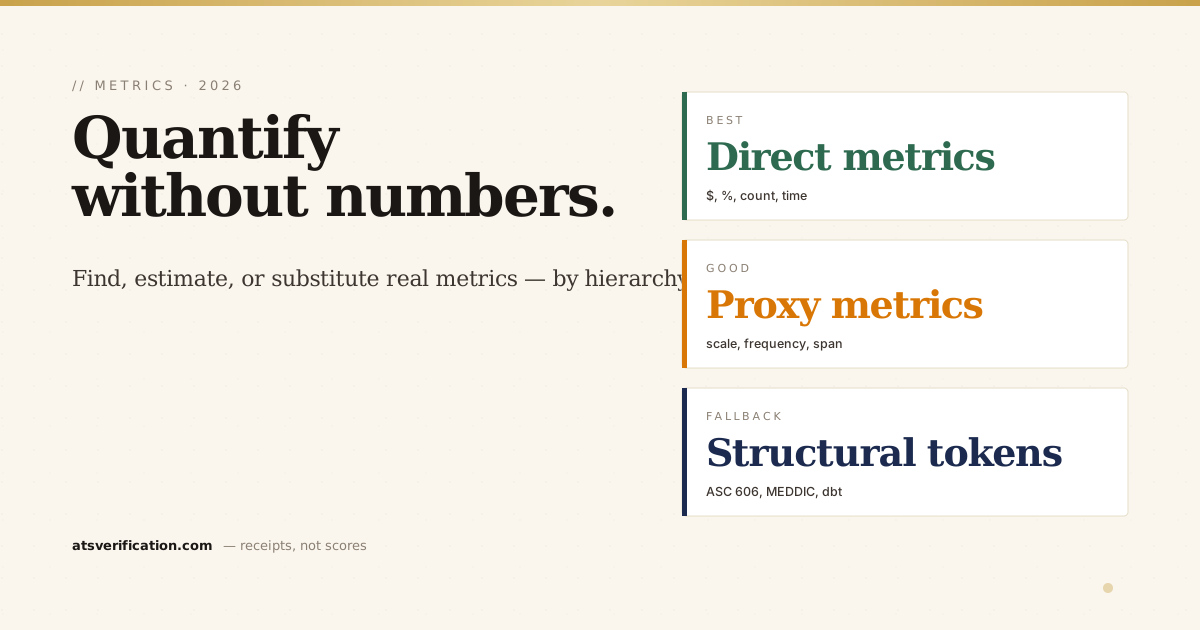
"Quantify your achievements" is the most common, and most frustrating, piece of resume advice. Frustrating because most people genuinely don't know the exact numbers from their last role. The good news: you don't always need precise numbers to write a strong, quantified-feeling bullet. Below you'll find 40+ real before/after examples across finance, engineering, sales, operations, marketing, HR and project management, plus the exact method for finding, estimating or substituting metrics in your own resume.
- Quantified bullets get 30-40% more callbacks than equivalent unquantified bullets
- "Quantify" doesn't only mean percentages, it means scale, improvement, speed or frequency
- ~80% of your bullets can be quantified with information you already have, you just need to look
- Honest ranges ("multi-million dollar impact") beat fake precision ("23.7%") every time
- The XYZ format ("Accomplished X by doing Y with Z impact") produces the highest-performing quantified bullets
Why quantification matters
Bullets with numbers outperform bullets without numbers in two specific ways:
- ATS keyword density: numbers count as content, increasing your bullet's "specificity score" in many ATS engines
- Recruiter dwell time: a number stops the eye. "Reduced cycle time by 30%" gets read; "Improved efficiency" gets skimmed past
Studies show resumes with quantified achievements get 30-40% more callbacks than equivalent resumes without numbers. The effect is consistent across industries.
The 4 categories of "quantification"
Most candidates think "quantify" means "add a percentage." It's broader than that. Strong bullets quantify in any of these dimensions:
1. Scale
How big? How many? How much?
- "Managed $40M annual budget" (dollar scale)
- "Led team of 12 engineers across 3 time zones" (people scale)
- "Maintained ETL pipeline processing 200K records/hour" (volume scale)
- "Owned product used by 250K monthly active users" (audience scale)
2. Improvement
Before vs after, even rough estimates work.
- "Reduced month-end close from 12 days to 5 days"
- "Cut p99 API latency from 800ms to 120ms"
- "Improved customer NPS from 32 to 58 over 18 months"
3. Speed
How fast? How quick?
- "Shipped MVP in 6 weeks vs 12-week original estimate"
- "Onboarded 25 enterprise customers in first 90 days"
- "Reduced incident response time from 45 min to 8 min"
4. Frequency
How often? How regularly?
- "Delivered weekly board-pack reports for 18 consecutive months"
- "Conducted 50+ customer interviews over 4 quarters"
- "Shipped 3 major product releases per quarter"
Where to find numbers you forgot you knew
If you can't remember exact metrics, try these sources:
1. Old performance reviews
Annual reviews, mid-year check-ins, or self-assessment forms often quote specific metrics tied to your work.
2. LinkedIn endorsements / recommendations
Recommendations sometimes mention specific projects with numbers. "Tanzeel led the M&A integration that delivered $4M in synergies."
3. Internal documents you saved
Slide decks, project retros, status reports, OKR documents. Search Google Drive / SharePoint / Notion for old files.
4. Email archives
Search emails for "thank you," "great work," "celebrating." Often these come with specific numbers attached.
5. Company blog / press releases
If your work was significant enough to be mentioned externally, the press release or blog post will have public-facing numbers.
6. Slack / Teams archives
Search for celebration emojis, "🎉," "shipped," "launched." Conversations around these often have numbers.
How to ethically estimate when you have no records
If you genuinely can't find exact numbers, careful estimation is acceptable:
The "size signal" approach
You don't need to know "$2.3M revenue impact." You can write "multi-million dollar revenue impact" or "low-seven-figure revenue impact." This is honest, avoids over-claiming, and still conveys scale.
The "team size" approach
If you led a team but don't remember exact size, give a range: "team of 8-12 across 4 functions." Honest if approximate, more concrete than "managed a team."
The "duration" approach
You always know roughly how long something took: "delivered initiative across 18-month roadmap" is precise enough.
The "frequency" approach
"Conducted weekly stakeholder reviews", you know if it was weekly or monthly. Use that.
What NOT to do
Don't fabricate exact numbers
"Reduced costs by 23.7%" when you actually have no idea is a lie waiting to be exposed in interviews. Use ranges or qualitative scale instead.
Don't pad weak bullets with irrelevant numbers
"Worked 50+ hours per week" is a number, but it's not an achievement. Numbers should describe IMPACT, not effort.
Don't use numbers without context
"Generated $500K in revenue", is that good? Bad? Compared to what? "Generated $500K in revenue, exceeding quota by 35%" is much stronger.
The XYZ format multiplies quantification impact
Quantification combined with the XYZ format ("Accomplished X by doing Y, with Z impact") produces the highest-performing resume bullets:
Weak (no number):
"Was responsible for improving customer satisfaction across the team."
Quantified but verbose (STAR-style on resume):
"When the company faced declining customer satisfaction scores in 2024, I was tasked with launching a new customer success initiative. I rebuilt our onboarding process and introduced a quarterly check-in cadence with all enterprise customers, resulting in NPS improvement from 32 to 58 over 18 months."
Quantified XYZ (best for resumes):
"Improved enterprise NPS from 32 to 58 over 18 months by rebuilding onboarding and instituting quarterly check-ins."
Same achievement. Half the words. Outcome leads. Numbers visible immediately.
40+ before/after examples by role
The fastest way to internalise this is to see your own role in the examples below. Each pair shows the same achievement written first without quantification and second in quantified XYZ form. The "after" version is the one that gets opened.
Finance & accounting (8 examples)
- Before: Managed the month-end close process.
After: Reduced month-end close from 12 days to 5 days by re-sequencing reconciliations and introducing a daily flux dashboard. - Before: Improved financial reporting.
After: Cut board-pack preparation from 9 days to 3 days by templating 18 recurring schedules in Excel + Power Query. - Before: Supported the FP&A team during budgeting.
After: Owned bottoms-up modelling for $48M opex budget across 7 cost centres, identifying $2.1M of consolidation savings adopted by CFO. - Before: Worked on the annual audit.
After: Led PBC schedule for KPMG annual audit covering 14 balance-sheet accounts; zero adjustments raised for second consecutive year. - Before: Helped with cash flow management.
After: Built 13-week rolling cash forecast in NetSuite, reducing surprise overdraft incidents from ~6/quarter to zero across 4 consecutive quarters. - Before: Improved AR collections.
After: Reduced DSO from 62 to 41 days over 9 months by automating dunning workflows and renegotiating top-20 customer terms. - Before: Worked on transfer pricing.
After: Led IFRS 15 revenue restatement across 3 legal entities, delivering full audit trail in 6 weeks vs original 12-week estimate. - Before: Managed treasury operations.
After: Restructured FX hedging programme covering $180M annual EUR/USD exposure, reducing realised FX losses by 68% vs prior year.
Software engineering (8 examples)
- Before: Built backend APIs for the platform.
After: Designed and shipped 14 REST endpoints serving 22M requests/day at p99 latency under 80ms. - Before: Improved system performance.
After: Cut p99 API latency from 800ms to 120ms by introducing Redis-backed caching and query batching across 6 hot paths. - Before: Worked on CI/CD improvements.
After: Reduced deploy time from 47 minutes to 8 minutes by parallelising the test suite and migrating from Jenkins to GitHub Actions. - Before: Helped with code review and mentoring.
After: Mentored 4 junior engineers; 3 promoted to mid-level within 12 months; led 380+ PR reviews with average turnaround under 4 hours. - Before: Migrated services to the cloud.
After: Led migration of 11 microservices from on-prem to AWS EKS over 5 months; reduced infra spend by $38K/month with zero customer-visible downtime. - Before: Worked on observability.
After: Rolled out OpenTelemetry tracing across 22 services; mean time to detect (MTTD) for production incidents dropped from 19 minutes to 4 minutes. - Before: Improved test coverage.
After: Raised backend unit test coverage from 47% to 82% across 9 services; production hotfixes from regression dropped by ~60% YoY. - Before: Owned the authentication service.
After: Re-architected auth service handling 2.4M daily logins; eliminated 3 recurring P1 incidents and removed 14k LOC of legacy code.
Sales & account management (6 examples)
- Before: Exceeded sales quota multiple times.
After: Closed $2.4M ARR in FY25, 142% of $1.7M quota; ranked #2 of 28 reps on the EMEA team. - Before: Built strong customer relationships.
After: Expanded 9 enterprise accounts from $180K to $640K average ACV over 18 months via multi-product upsell motion. - Before: Reduced churn in my book.
After: Cut logo churn in $4.2M book from 14% to 6% YoY by introducing quarterly executive business reviews and a structured renewal-risk scoring framework. - Before: Generated new pipeline.
After: Sourced $3.1M of net-new pipeline across 38 opportunities in H1 FY26 via cold outbound + targeted account-based motions. - Before: Improved win rate.
After: Raised competitive win rate from 31% to 49% on deals >$50K ACV by rebuilding the discovery playbook around MEDDPICC. - Before: Shortened the sales cycle.
After: Cut average sales cycle for SMB segment from 64 days to 38 days by introducing a 2-call qualification gate and ROI calculator.
Operations, supply chain & project management (6 examples)
- Before: Improved warehouse efficiency.
After: Redesigned pick-pack flow across 3 distribution centres; raised units-per-hour from 84 to 132 with no headcount increase. - Before: Reduced supplier costs.
After: Renegotiated top-15 supplier contracts covering $42M annual spend; secured 7.4% average price reduction and longer payment terms (NET-30 → NET-60). - Before: Led a major IT project.
After: Delivered SAP S/4HANA migration on time and 11% under $4.8M budget across 11-month programme spanning 240+ users and 14 country entities. - Before: Reduced inventory.
After: Cut average finished-goods inventory by $9.2M (28%) over 14 months by implementing SKU-level ABC analysis and obsolescence-write-off review cadence. - Before: Improved on-time delivery.
After: Raised on-time-in-full (OTIF) from 86% to 97.4% by re-engineering S&OP cadence and consolidating 3 freight carriers into 1 strategic partner. - Before: Managed a construction project.
After: Delivered $38M hospital fit-out under FIDIC Red Book; closed 14 months ahead of original 26-month schedule with zero LTI safety incidents.
Marketing & growth (5 examples)
- Before: Grew the email list.
After: Grew subscriber list from 8K to 47K in 11 months via 6 high-converting lead magnets; weekly newsletter open rate of 38%. - Before: Ran the paid acquisition channel.
After: Managed $1.8M annual paid spend across Google + Meta; reduced blended CAC from $112 to $74 over 4 quarters while doubling MQL volume. - Before: Improved organic traffic.
After: Grew organic traffic from 22K to 184K monthly sessions over 18 months by shipping 60+ SEO-targeted blog posts and consolidating 12 thin pages. - Before: Worked on the website redesign.
After: Led marketing-site redesign across 38 pages; landing-page conversion rate improved from 1.9% to 4.6% within 90 days of launch. - Before: Managed the content calendar.
After: Shipped 96 pieces of content (blogs, videos, case studies) in 12 months across 5 personas; content-attributed pipeline grew from $0.4M to $2.1M YoY.
HR, people & recruiting (4 examples)
- Before: Recruited engineering talent.
After: Closed 38 engineering hires in 12 months (offer-accept rate 76%); reduced average time-to-fill from 64 to 41 days via structured sourcing playbook. - Before: Improved employee retention.
After: Reduced regrettable attrition in product & engineering org from 18% to 9% YoY via redesigned career ladders and quarterly skip-level cadence. - Before: Ran the performance review process.
After: Owned end-to-end semi-annual performance cycle for 480 employees across 6 functions; calibration sessions completed within 4-week window for second year running. - Before: Worked on compensation.
After: Led market re-benchmarking of 240 roles against Radford 2026 dataset; rolled out adjusted bands with zero pay-equity gaps remaining at p<0.05 significance.
Healthcare, clinical & research (3 examples)
- Before: Treated patients in the ICU.
After: Managed acute care for 800+ ICU patient encounters annually; primary investigator on ventilator-weaning protocol that cut mean LOS by 1.8 days. - Before: Published research.
After: Co-authored 9 peer-reviewed papers (4 first-author) cited 280+ times collectively; led IRB-approved RCT enrolling 142 patients across 3 sites. - Before: Managed the clinical trial.
After: Coordinated Phase II oncology trial of 76 patients across 5 sites; achieved 94% protocol adherence and 100% on-time data lock for interim analysis.
Notice the pattern: every "after" version uses one of the four quantification dimensions (scale, improvement, speed, frequency) and trails with an XYZ-style "by doing Y" clause that explains the mechanism. That's the entire formula.
How to apply this to your resume in 30 minutes
Pick one role from your CV. Then:
- List your 5 strongest bullets verbatim as they currently appear.
- For each bullet, answer one question: "What did this affect, and how much?" Write a quick number even if you have to estimate a range.
- Identify which of the four dimensions applies: scale, improvement, speed or frequency.
- Rewrite the bullet in XYZ format: [outcome with number] by [mechanism] [optional: across what scope].
- Sanity-check honesty: can you defend this number in an interview? If not, swap precision for range.
If you do this for your top 3 roles, you'll have 12-15 quantified bullets, enough to anchor an entire 1-2 page resume.
Quantified bullets are one step of a longer process. The rest of it, structure first and a parse check last, is laid out in how to write a resume.
Quick exercise
Take 5 minutes to do this for your most recent role:
- Pick your top 3 accomplishments from that role
- For each, ask: "What did this affect, and how much?"
- Find or estimate one number per accomplishment (scale, improvement, speed, or frequency)
- Rewrite each bullet in XYZ format with the number
You'll likely find that 60-80% of your bullets can be quantified with information you already have. The other 20-40% become candidates for ranges or qualitative scale.
Use our free Bullet Rewriter to score each bullet and see the gaps.
Frequently asked questions
What if I genuinely don't remember any numbers from my last role?
Try the six sources in this guide first (performance reviews, LinkedIn endorsements, old slide decks, email archives, company blog posts, Slack/Teams search). Most candidates discover they had access to 4-6 quantifiable data points they'd forgotten. If you genuinely can't find numbers, use honest ranges ("multi-million dollar revenue impact", "team of 8-12 engineers", "low-seven-figure budget"), never invent precise percentages you can't defend.
How many quantified bullets do I need on my resume?
Target 60-80% of bullets quantified, not 100%. Some bullets describe leadership behaviours, qualitative skills or contextual responsibilities where forcing a number weakens them. The mix should be: every role has at least 60% quantified bullets, with your most recent role at 70-80%.
Does the ATS actually read the numbers in my bullets?
Yes. Modern parsers (Workday, Greenhouse, Lever, iCIMS) tokenise digits, currency symbols and unit markers ($, %, K, M, B). Numbers count toward keyword density and topic relevance scoring. More importantly, recruiter Boolean searches frequently include numeric qualifiers ("led team of 10+", "managed $1M+ budget"), without numbers your CV is invisible to those searches even if you're qualified. See our finance keyword database and accountant keyword database for the specific numeric markers each role expects.
Is it OK to estimate? Won't I get caught in interviews?
Estimating is fine as long as the range is honest and you can defend it. "Reduced operating costs by 15-20%" is defensible if you saw the trend even without exact figures. "Reduced operating costs by 17.3%" without supporting evidence is not. The rule: every number on your resume should survive the question "how did you calculate that?"
What's the difference between STAR, XYZ and PAR formats?
STAR (Situation-Task-Action-Result) is for interview answers, too verbose for resume bullets. XYZ (Accomplished X by doing Y, with Z impact) is the highest-performing resume format because it puts the outcome first. PAR (Problem-Action-Result) is a middle ground. For resume bullets, default to XYZ. See our full guide on STAR vs XYZ resume bullets.
Should I quantify achievements differently for different roles?
Yes, match the dimension to the function. Finance and operations roles weight improvement and scale. Sales weights achievement against target. Engineering weights scale and speed. Marketing weights growth and conversion. HR weights headcount, retention and time-to-fill. The 40+ examples above are organised by role so you can see the conventions for your function.
How do I quantify achievements as a new graduate with no work experience?
Use coursework, projects, internships, volunteer work and extracurriculars. "Led 4-person capstone team that built a React app used by 280+ student users" or "Tutored 12 first-year students; group average grade improved from B- to A-" are both quantified bullets a fresh grad can legitimately write. See our fresh graduate resume guide for more.
What if my industry doesn't really use numbers (e.g., creative, design, academic)?
Every industry has numbers, they're just less obvious. Designers quantify reach (views, downloads, design-system adoption %), conversion (A/B test lifts), and scope (number of components shipped). Academics quantify publications, citations, grant size, students taught, research participants. Creatives quantify audience size, campaign reach, awards, repeat clients. The four dimensions (scale, improvement, speed, frequency) apply universally.
This matters more every year as finance and many other roles move from routine tasks to impact and decisions. That shift is exactly why impact bullets win, and I covered it in the future of finance jobs.
Related guides
- STAR vs XYZ Resume Bullets, Which Format Actually Works
- Finance Resume Keywords (2026), 60+ ATS-Tested Terms
- Accountant Resume Keywords (2026), 55+ ATS-Tested Terms
- Full ATS Keyword Database, All Professions
- 200+ Resume Power Verbs by Function
- Free Bullet Rewriter Tool
- UAE Finance Resume Format (2026)
→ Rewrite your bullets free with STAR / XYZ / PAR templates