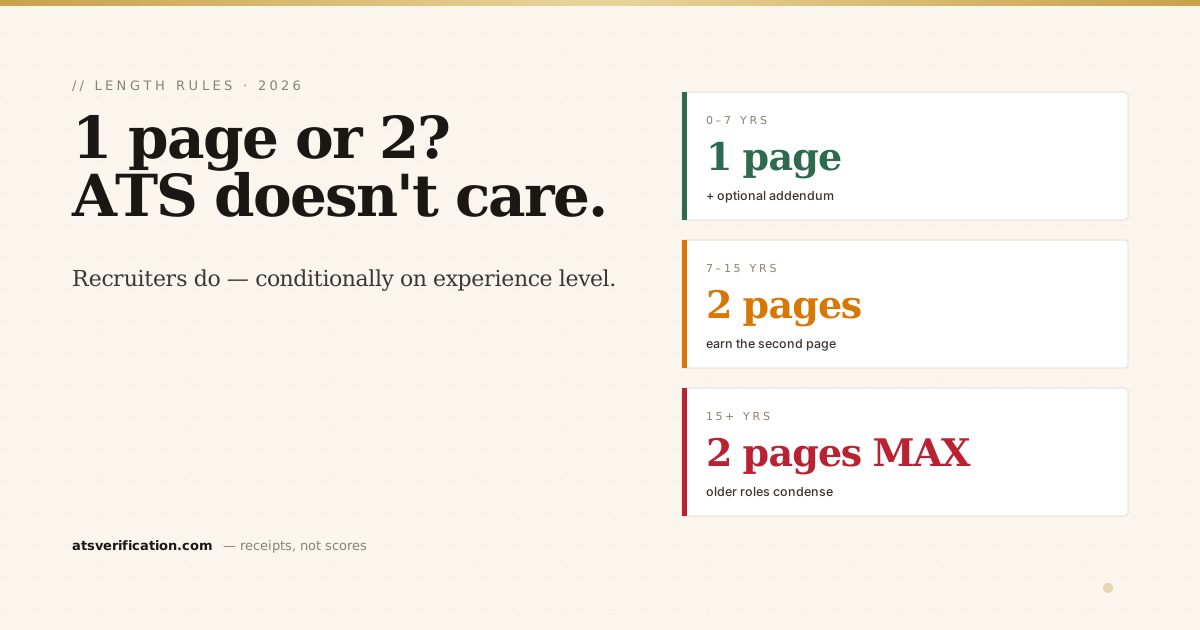
"Always 1 page" vs "2 pages is fine if you have experience", this debate has been going on for 20 years and nobody agrees. The honest answer depends on three factors: your years of experience, the role's seniority, and where you're applying. Here's the data-backed breakdown.
The simple answer (most people)
| Years of experience | Recommended length |
|---|---|
| 0-3 years (entry level) | 1 page |
| 3-7 years (mid-level) | 1 page (preferred), 2 pages acceptable |
| 7-15 years (senior) | 2 pages |
| 15+ years (executive) | 2 pages (preferred), 3 pages acceptable |
| Academic / research | CV: as long as needed (publications matter) |
Does the ATS care about length?
Most ATS engines don't penalize length directly. They parse whatever you give them. A 5-page resume parses identically to a 1-page resume.
However, length matters indirectly:
- Recruiters do care. A human reviews your resume after the ATS surfaces it. A 5-page resume from a 5-year-experience candidate signals poor editing.
- Some ATS engines truncate very long resumes (rare, but happens). Anything over 4 pages is risky.
- Page-count keywords don't exist. The ATS doesn't track pages, only word count and content extraction.
Country / region differences
United States
Strong 1-page bias for entry to mid-level. 2 pages acceptable for 7+ years experience. 3 pages for executive/scientific roles only, full conventions in our US resume format guide. (Applying to business school? The length rules flip by programme, see when two pages is the right call in our Executive MBA resume guide.) And the great exception: US federal resumes run 3-5 pages by design, a 1-page resume gets rated ineligible on USAJOBS. See the federal resume guide.
United Kingdom / Europe
2-page CV is standard, regardless of experience level. The "CV" expectation in UK/EU includes more detail (full work history, hobbies sometimes, references). 1-page resumes can read as "underqualified" in UK markets. (Different country, different document rules, see CV vs resume by country.)
UAE / GCC / Middle East
2 pages standard. Often includes photo, personal details (DOB, nationality, marital status). See our UAE-specific guide.
India
2-3 pages common, especially for tech roles where projects/certifications expand the document. Less length pressure than US.
China / Japan
Different conventions entirely (CV/履歴書 format with photos, fixed templates). Outside the scope of this article.
When to use 1 page
- You have less than 7 years of work experience
- You're applying to US-based roles
- You're early-career or transitioning industries
- The application explicitly limits to 1 page (most MBA programs enforce a strict one page, as do certain consulting firms)
When to use 2 pages
- You have 7+ years of relevant experience
- You're applying to UK/EU/MEA markets
- You have substantial project/certification depth that needs space
- You're senior-level (Director, VP, C-suite) and need to demonstrate scope
- You're applying for academic / research / technical positions where publications matter
Common length mistakes
Mistake 1: Stretching 1.3 pages to 2
If your content fills 1.3 pages, condense to 1 page. Don't pad with weak content to fill 2. Recruiters can tell when content is filler.
Mistake 2: Squeezing 1.5 pages to 1
If you genuinely have 1.5 pages of valuable content, don't shrink fonts to 8pt to fit on 1 page. Use 2 pages instead. Below 10pt fonts hurt readability for both ATS and humans.
Mistake 3: Using 3 pages when 2 will do
"More information = better" is wrong. Recruiters skim. Add a 3rd page only when every line on it adds genuine value. Otherwise cut.
Mistake 4: 4+ pages for a 5-year-experience candidate
This is the most common over-length mistake. Long lists of every project, every responsibility, every tool. Cut ruthlessly. You're not writing a memoir.
How to cut a resume from 2 pages to 1
- Tighten margins: 0.5-0.75 inch all sides (not 1 inch). Default Word margin is too generous.
- Reduce font size: 10pt body, 11pt section headers, 16pt name. Don't go below 10pt body.
- Cut older roles: jobs older than 10-15 years can be summarized in 1-2 lines. Roles older than 15 years can be omitted entirely. (See how far back a resume should go; for experienced candidates this also reduces age bias and keeps the ATS years-of-experience field aligned, see resume tips for workers over 50.)
- Remove weak bullets: any bullet that doesn't have a verb + outcome is removable.
- Remove "References available upon request": assumed; wastes a line.
- Combine education sub-bullets: if you list 5 honors and awards, combine into 1 line.
- Reduce line spacing: 1.0-1.15 line spacing (not 1.5).
How to expand a resume from 1 page to 2 (if needed)
Most candidates need to cut, not expand. But if your 1-page resume feels thin and you have 7+ years of experience to demonstrate:
- Add a "Key Achievements" section above Experience with 3-5 standout wins
- Expand bullets on most-recent roles (4-6 bullets vs 2-3)
- Add a "Selected Projects" section if relevant
- Add Certifications section if you have any
- Don't pad with weak content, better to stay at 1 page than fill 2 pages with filler
Test parsing regardless of length
Length is a UX decision for recruiters. Parsing is a technical decision for ATS. Even a perfectly-pitched 1-page resume fails if the ATS can't extract your name.
Not sure whether you're over or under? The free resume length checker gives you an instant word count, page estimate, and a 1-page-vs-2-page verdict in seconds.
Run your resume through ATS Verification, at any length, to confirm it parses correctly before you debate page count.
→ Free ATS scan, make sure your resume parses correctly first