Correction, 17 October 2026. Earlier versions of this article gave a 97% figure for Fortune 500 ATS use and a 6 to 8 second recruiter first pass without sources, and said which ATS "dominates" each sector. We have removed the unsourced figures, linked the Fortune 500 finding to its source, and softened the market claims. The format rules themselves are unchanged.
The United States has some of the most distinctive resume conventions in the world, and a heavily automated hiring pipeline. Research has repeatedly found that nearly all Fortune 500 companies use an ATS. If you're applying to US employers, as an American or from abroad, these are the rules that actually matter in 2026.
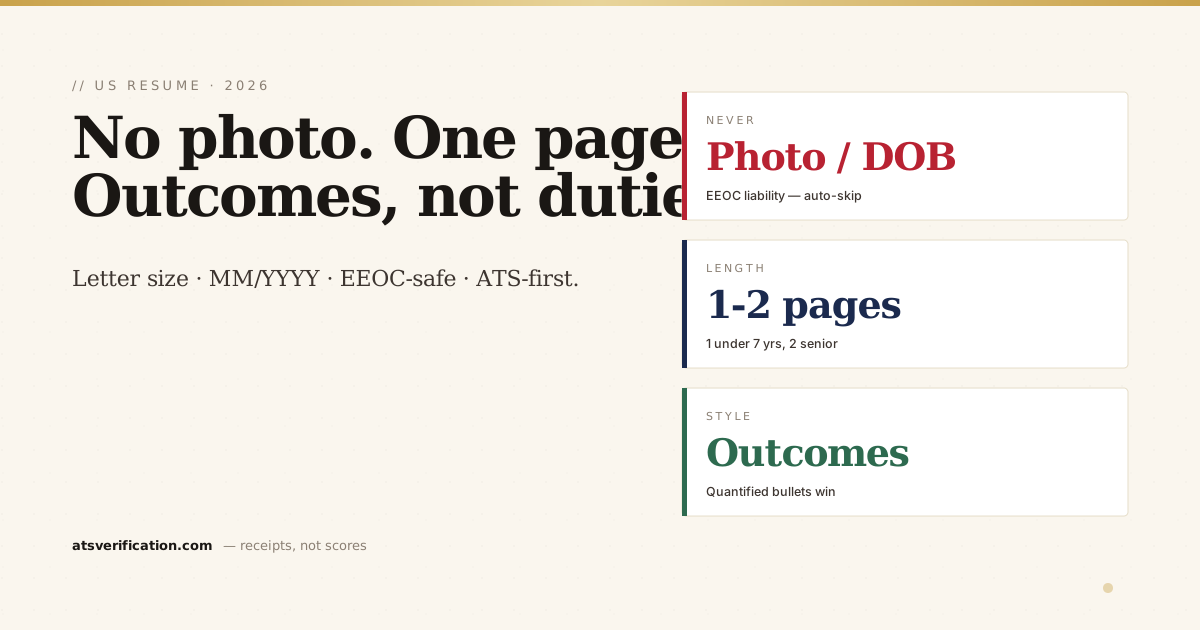
- No photo, no date of birth, no marital status, no nationality. US anti-discrimination law makes this information a liability, so many recruiters would rather not receive it.
- 1 page under ~7 years of experience, 2 pages senior. The 1-page bias is real in the US, stronger than anywhere else.
- Accomplishments, not duties. American recruiters expect quantified results ("cut close time 40%"), not responsibility lists.
- Letter size (8.5×11"), not A4. A small detail that can shift margins when printed and signals "international applicant" to US recruiters.
- "Resume" ≠ "CV" in America. A CV is an academic document. Send a resume unless explicitly asked otherwise.
What makes a US resume different
If you learned resume-writing in the UK, the Gulf, South Asia, or continental Europe, the US format will feel stripped down, by design. (For the full country-by-country comparison, see our CV vs resume rules by country guide.)
| Element | US expectation | Why |
|---|---|---|
| Photo | Never | Discrimination-liability risk, so many US recruiters see a photo as a problem |
| Date of birth / age | Never | Age discrimination is federally prohibited (ADEA, 40+) |
| Marital status, religion, nationality | Never | Protected characteristics under EEOC rules |
| Length | 1 page (<7 yrs) / 2 pages (senior) | Recruiters skim the first pass quickly |
| References | Omit entirely | "References upon request" is considered wasted space |
| Paper size | Letter (8.5×11") | A4 pages print with odd margins on US Letter paper |
| Spelling | American English | "Optimised" vs "optimized", many keyword searches are literal |
The anti-discrimination point is not folklore. The EEOC's prohibited practices make age, religion, national origin, and family status legally radioactive in hiring decisions, which is why US recruiters treat resumes carrying that information as a liability, not a courtesy.
The standard US resume structure (ATS-safe order)
- Header: Name, city + state (no street address), phone, email, LinkedIn. In the document body, never in the Word header/footer, which some parsers skip or misplace.
- Professional Summary: 2-3 lines. Title-matched to the role, with your strongest quantified claim.
- Experience: Reverse-chronological. Company, title, location, dates (MM/YYYY). 3-6 accomplishment bullets per recent role.
- Education: Degree, institution, year. GPA only if recent and 3.5+.
- Skills: A clearly-labeled flat list, this is what recruiter Boolean searches hit.
- Optional: Certifications, selected projects. No hobbies unless directly relevant.
Single column. No tables, no text boxes, no two-column sidebars, the classic parsing problems we see often in scans (here are the 10 most common ATS parsing failures with examples).
Accomplishments beat duties, the most American rule of all
The single biggest cultural difference: US recruiters read for outcomes. "Responsible for monthly reporting" reads as filler; "Cut monthly close from 9 days to 5 by automating reconciliations" reads as evidence. If your bullets don't carry numbers, fix that before anything else, our 40+ before/after quantification examples show the pattern for every major role family.
The ATS layer: who's actually parsing you
US employers use a range of systems. Large enterprises commonly use products such as Workday, Oracle Taleo, SAP SuccessFactors or iCIMS; many tech companies use Greenhouse, Lever or Ashby. Each handles files a little differently, and each employer configures its own. Our platform guides for Workday, Greenhouse, and Lever cover the practical points. The scoring mechanics, parsing, keyword matching, ranking, are explained in how ATS scoring works.
For keyword selection, don't guess: the US government's O*NET occupational database is a public taxonomy of occupations, tasks and skills, and our profession keyword databases are built on it.
For international applicants
- Work authorization: Don't volunteer visa details on the resume. If you need sponsorship, handle it in application questions, not as a resume header line.
- Convert your CV: Strip photo and personal data, compress to US length, re-spell to American English, switch to Letter size. Applying from India specifically? We wrote a dedicated guide for Indian professionals applying to US jobs.
- Degree equivalence: State your degree plainly ("Bachelor of Commerce, equivalent to US Bachelor's degree" is unnecessary; just "B.Com, University of Mumbai, 2018").
The one big exception: federal jobs
Everything above applies to private-sector hiring. US federal government jobs (USAJOBS) run on opposite rules, 3-5 page resumes, hours-per-week listings, supervisor contacts. Don't send a 1-page private-sector resume to a GS posting; see our federal resume & USAJOBS guide. (Transitioning from the military? Your resume needs a translation layer before format even matters, the military-to-civilian guide covers MOS crosswalking, de-jargoning, and clearance placement.) Applying in Canada too? The rules are close but not identical, see the Canadian resume format guide.
If you're a student or new graduate
The rules above hold, but four things specific to American campus hiring decide more than the format does. Summer internships recruit almost a year in advance, so the recruiting timeline by industry matters more than any wording change. Handshake employers filter students by profile fields rather than resume text, explained in the Handshake guide. Fewer employers screen on GPA than a few years ago, which changes the answer to whether to include yours (the source figures are in that guide). And international students lose more applications to the two work authorization questions on the form than to anything on the page.
Three professions where the rules differ
Most of this guide is universal across US private-sector hiring, but three fields run on different machinery and deserve their own treatment. Nursing applications are screened on licence, compact status and certifications before experience is read, covered in the RN credential guide. K-12 teaching runs on form-first district systems such as AppliTrack, where structured fields do the screening rather than a resume parser, covered in the teacher application guide. And accounting had its licensure model change underneath it, with many states now offering alternative CPA pathways, covered in the accounting guide.
Check the layer you can't see
Format rules are necessary but not sufficient, a resume can follow every convention above and still parse wrong because of one table or a header-embedded contact line. Run a free scan to see exactly what our parser extracts from your resume: name, titles, dates, skills, field by field.
→ Free ATS scan, see what a parser extracts from your resume