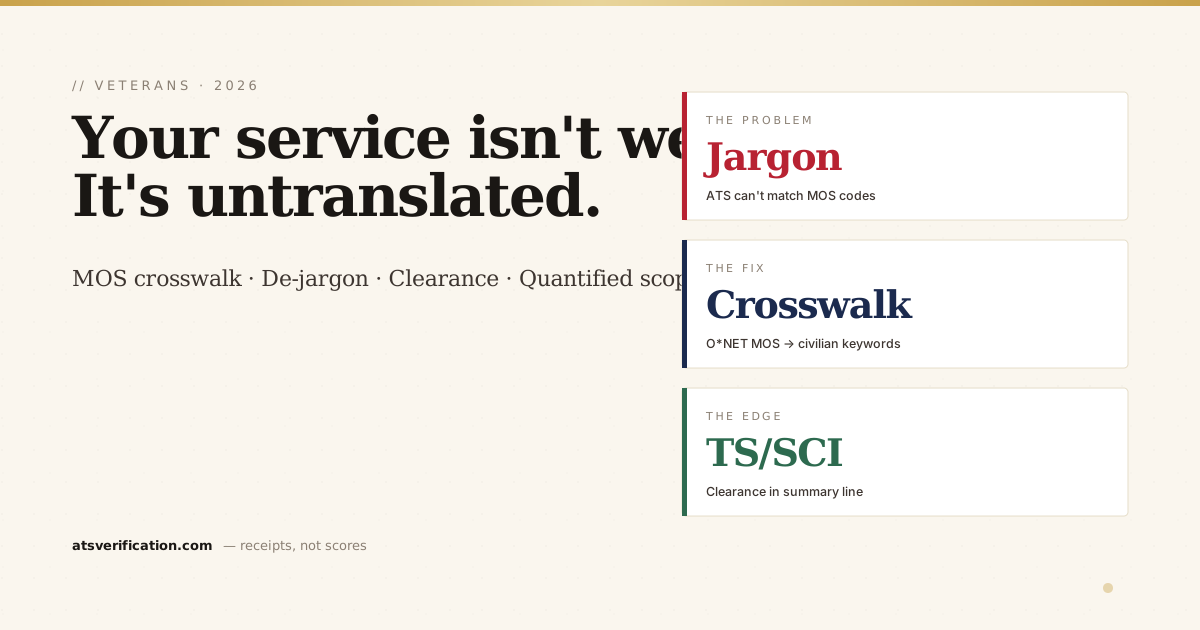
Around 200,000 American service members leave the military every year, and most discover the same brutal fact: the resume that perfectly describes their service is unreadable to both the ATS and the recruiter. Not because the experience is weak. Because it's written in a language civilian hiring systems don't speak. This guide is the translation layer.
- You're being filtered twice: the ATS can't match "11B" or "NCOIC" to any job description keyword, and the recruiter gives the survivors a 6-second skim they can't decode.
- Translate the job, not just the title. "Platoon Sergeant" means nothing to a logistics recruiter; "supervised 38 personnel and $4.2M of equipment" means everything.
- Use the O*NET crosswalk to convert your MOS/rate/AFSC into the civilian occupation vocabulary ATS keyword matchers actually scan for.
- An active security clearance is a headline asset for defense and government-contractor roles, put it in your summary line, not buried at the bottom.
- Civilian private-sector resume: 1-2 pages. Applying federal instead? The rules invert completely, 3-5 pages on USAJOBS.
Why strong military careers fail civilian screening
Civilian hiring runs on keyword matching between your resume and the job description, that's the core of how ATS scoring works. A job description for an operations manager asks for "team leadership," "logistics coordination," "inventory management," "safety compliance." A military resume says "NCOIC," "OPORD execution," "property book," "convoy operations." Every one of those is a true match in substance, and a zero match in text. The system isn't rejecting your experience; it literally cannot see it.
Then comes the human layer. The average recruiter spends seconds on a first pass and has never served. Acronyms they have to decode are lines they skip.
Step 1: Crosswalk your MOS to civilian occupations
The Department of Labor's O*NET Military Crosswalk converts any MOS, rating, or AFSC into matched civilian occupations, with the exact vocabulary those occupations use. This matters because many HR systems derive their role keyword sets from the same O*NET taxonomy (our own profession keyword databases are built on it).
| Military role | Civilian translation | Keywords the ATS wants |
|---|---|---|
| 11B Infantry Squad Leader | Operations Team Lead | team leadership, operations, training, risk management |
| 92Y Unit Supply Specialist | Supply Chain / Inventory Specialist | inventory management, procurement, logistics, asset accountability |
| 25B IT Specialist | IT Support / Network Administrator | network administration, help desk, system maintenance, cybersecurity |
| 68W Combat Medic | Emergency Medical Technician / Healthcare Technician | patient care, emergency response, triage, medical records |
| E-7 Platoon Sergeant | Operations Supervisor / Manager | personnel supervision, performance management, scheduling, budget accountability |
Write the civilian translation as your job title, with the military title in parentheses if you want it preserved: "Operations Supervisor (Platoon Sergeant, U.S. Army)". The ATS matches the first phrase; the parenthetical keeps you honest in the interview.
Step 2: De-jargon every line
| You wrote | Write instead |
|---|---|
| NCOIC / OIC | Supervisor / Manager in charge |
| Squad / platoon / company | Team of 9 / unit of 38 / organization of 140 |
| OPORD / FRAGO | Operational plan / revised directive |
| TDY / PCS | Business travel / relocation |
| Property book valued at $4.2M | Accountable for $4.2M in equipment and assets |
| Conducted PMCS | Performed preventive maintenance and equipment inspections |
The test: hand your resume to a civilian friend. Every term they stumble on, the recruiter stumbles on too, and the ATS never matched it in the first place.
Step 3: Convert rank into scope, and duties into outcomes
Civilian resumes run on quantified outcomes, it's the most American resume rule of all (see the full US resume format guide). Military careers are unusually rich in quantifiable scope; most veterans just never write it down:
- Weak: "Served as Platoon Sergeant responsible for soldiers and equipment."
- Strong: "Supervised, trained, and evaluated 38 personnel; maintained 100% accountability of $4.2M in vehicles and equipment across 3 deployments with zero losses."
- Weak: "Managed unit supply operations."
- Strong: "Directed inventory operations for 600-person organization, processing 2,400+ requisitions annually and cutting excess stock 22%."
Numbers, percentages, dollar values, headcount, every bullet. Our quantification guide with 40+ before/after examples shows the pattern across role families, and pairing each with a strong opening verb (the action-verb guide) completes the bullet.
Security clearance: your most underused keyword
For defense contractors (Lockheed Martin, Boeing, RTX, Northrop Grumman, Booz Allen) and cleared government roles, an active clearance is often the single highest-value line on your resume, recruiters run Boolean searches for it directly. If yours is active:
- Put it in your summary line: "Operations supervisor with active TS/SCI clearance and 8 years of logistics leadership."
- Spell it out once: "Top Secret/Sensitive Compartmented Information (TS/SCI)", acronym-only can miss literal matchers.
- Never list investigation dates or adjudication details, "active TS/SCI" is sufficient and appropriate.
Awards: translate the weight, not just the name
"Meritorious Service Medal" reads as decoration to a civilian. Add the context that gives it hiring weight: "Meritorious Service Medal, awarded for leading a 12-person team through a no-notice 6-month deployment with zero safety incidents." The award names the recognition; the clause names the competence.
Private-sector vs federal: two different resumes
Everything above targets the civilian private sector: 1-2 pages, quantified bullets, standard sections (the full conventions are in our US resume format guide). If you're applying to federal positions on USAJOBS, the rules invert, 3-5 pages, hours per week, supervisor contacts, and your veterans' preference claim with DD-214 documentation. We cover that flow in the federal resume & USAJOBS guide. Most transitioning veterans should maintain both versions.
Beyond the resume itself, two programs worth knowing: DOL VETS (employment services and hiring-event calendars for veterans) and DoD SkillBridge (industry internships during your final 180 days of service, often a direct hiring pipeline at major employers).
Check the translation before you apply
After rewriting, you have a resume full of new vocabulary, but is it parsing? Tables from old military formats, multi-column DD-214-style layouts, and headers carrying contact info all break extraction (the 10 most common parsing failures). Run a free scan to see exactly what a civilian ATS extracts from your translated resume, name, titles, dates, clearance line, skills, before a recruiter ever does.
→ Free ATS scan, see your service record the way civilian hiring software reads it
We also built a dedicated page for transitioning service members, with a free ATS-safe Word template that has the civilian translation guidance written into every section: the military-to-civilian resume page. Direct download, no email gate.