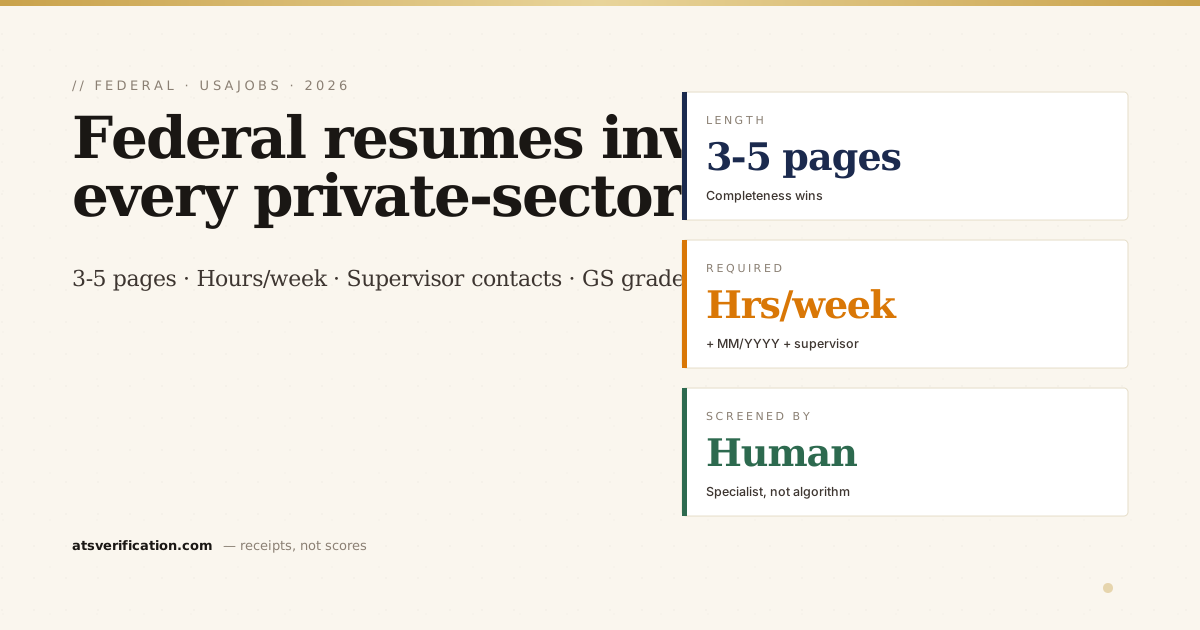
The US federal government is the country's largest employer, and its resume rules are the opposite of everything private-sector advice teaches. The polished 1-page resume that wins interviews at a Fortune 500 company gets rated "ineligible" on USAJOBS, usually without a human ever explaining why. Here's how federal hiring actually reads your resume in 2026.
- Federal resumes run 3-5 pages. A 1-page resume literally cannot contain the information HR specialists are required to verify.
- USAJOBS is not a keyword-ranking ATS. A human HR specialist rates your eligibility, but they check your resume against the announcement's exact language, so keywords still decide your fate.
- Each job needs: month/year dates, hours per week, and (for recent roles) supervisor name and contact. Missing fields = ineligible, not "lower ranked."
- Mirror the announcement's "specialized experience" wording almost verbatim, the specialist is matching your text against it line by line.
- One year of specialized experience at the next-lower GS grade is the core eligibility test for most postings.
Federal vs private-sector: the rules invert
| Element | Private sector | Federal (USAJOBS) |
|---|---|---|
| Length | 1-2 pages | 3-5 pages |
| Hours per week | Never listed | Required per job |
| Supervisor name + phone | Never listed | Expected for recent roles |
| Dates | MM/YYYY | MM/YYYY mandatory, missing months can void the experience |
| Detail level | Punchy quantified bullets | Exhaustive duties + accomplishments (specialists verify, not skim) |
| Who screens | ATS ranking + recruiter skim | Human HR specialist applying eligibility rules |
| Salary history | Omit | Optional since 2025 reforms, but GS grade expected for prior federal roles |
If you're coming from (or also applying to) the private sector, keep two versions, the federal master document and a compressed private-sector resume built by the normal rules (our US resume format guide covers that side).
How USAJOBS screening actually works
A persistent myth says USAJOBS runs a keyword-scoring ATS like Workday. It doesn't. The pipeline is:
- You apply via the USAJOBS resume builder or an uploaded document, plus a self-assessment questionnaire.
- An HR specialist reviews your resume against the announcement's eligibility and "specialized experience" requirements, and verifies your questionnaire answers are supported by your resume text. Claim "expert" on the questionnaire with no supporting resume evidence and you'll be rated down or marked ineligible.
- Eligible + best-qualified candidates go onto a certificate ("cert") sent to the hiring manager.
So while there's no algorithmic ranking, the screening is more literal than a private ATS, a human is matching your words against the announcement's words, line by line. The official USAJOBS guidance on what to include is the baseline; most rejected first-time applicants simply didn't include the mandatory fields. (Curious how private-sector ranking differs? See how ATS scoring works.)
The eligibility test: specialized experience at the next-lower grade
Most GS announcements require 52 weeks of specialized experience equivalent to the next-lower GS level. The announcement defines that specialized experience in a specific paragraph, and your resume must demonstrably contain it. The safest technique: take the announcement's specialized-experience sentences and make sure each one is answered, in similar vocabulary, inside the relevant job entry on your resume. That's not keyword stuffing; it's giving the specialist the exact evidence they're required to find. Grade and pay structures are defined by the OPM General Schedule.
What every federal job entry must contain
- Job title (+ GS series/grade if it was a federal role)
- Employer, city, state
- Start and end dates as MM/YYYY
- Hours per week (e.g., "40 hours/week"), part-time experience is prorated, so omitting hours can erase years of credit
- Supervisor name and phone (recent roles), with "may contact / contact me first"
- Detailed duties and accomplishments, quantify where possible (numbers still persuade humans; our quantification guide applies here too)
Veterans' preference
Eligible veterans receive hiring preference points and can claim them in the questionnaire with supporting documents (DD-214). If that's you, also look at announcements open to "veterans" hiring paths specifically, competition is materially lower than "public" postings. And before any of that: your military experience needs translating into the vocabulary HR specialists and ATS matchers can read, MOS crosswalk, de-jargoning, quantified scope, covered in our military-to-civilian resume guide.
Format mechanics
The USAJOBS resume builder guarantees structural compliance, at the cost of formatting control, for a first federal application it's the safer choice. If you upload a document instead, the same parsing hygiene as the private sector applies: single column, no tables or text boxes, standard headings, real text (not scanned images). The classic parsing failures break uploaded federal resumes too. Length anxiety doesn't apply here, this is the one US context where the 1-vs-2-page debate is irrelevant: completeness wins.
Check the document before you apply
Whether you build or upload, the text layer has to be extractable, supervisor lines, hours per week, and month/year dates included. Run a free scan to confirm every field of your federal resume parses as real, readable text before you submit a 5-page document into a 3-week announcement window.
→ Free ATS scan, verify your federal resume's text layer parses cleanly