Job seekers moving between markets face a confusing patchwork of advice. The Gulf expects a "CV" with conventions of its own. America insists on a one-or-two-page "resume" and recoils at photos. South Asian formats carry personal-details blocks that would alarm a London compliance officer. Which rules apply when you're applying from Lahore to Dubai, Mumbai to a US remote role, or Riyadh to anywhere?
There are really two sets of rules: what human reviewers in each market expect, and what the parsing software requires. The second set is global, and it wins ties, because software reads your document first. (New to that idea? Start with what an ATS is and how it reads your resume.)
- Outside North America, "CV" and "resume" mean the same document, don't overthink the word
- What changes by market is content: length, photos, and personal details
- The parsing rules are identical everywhere, same software (Workday, SuccessFactors, Greenhouse) in every country
- Maintain one master in strict ATS format; create market versions by adjusting content, never structure
- Never put a photo or personal-ID block on a portal/ATS submission, anywhere
CV vs resume: what the words mean where
(Writing one from scratch? See how to write a CV for the step-by-step version.)
In the USA and Canada, a resume is the short marketing document (one to two pages) and a CV is a long academic record used in research and medicine. In the UK, Ireland, Australia, the Gulf, India and Pakistan, "CV" simply means the document you apply for jobs with, the words are interchangeable in practice, and nobody is judging your terminology. What differs by market is content convention: length, photos, and personal details.
Region by region
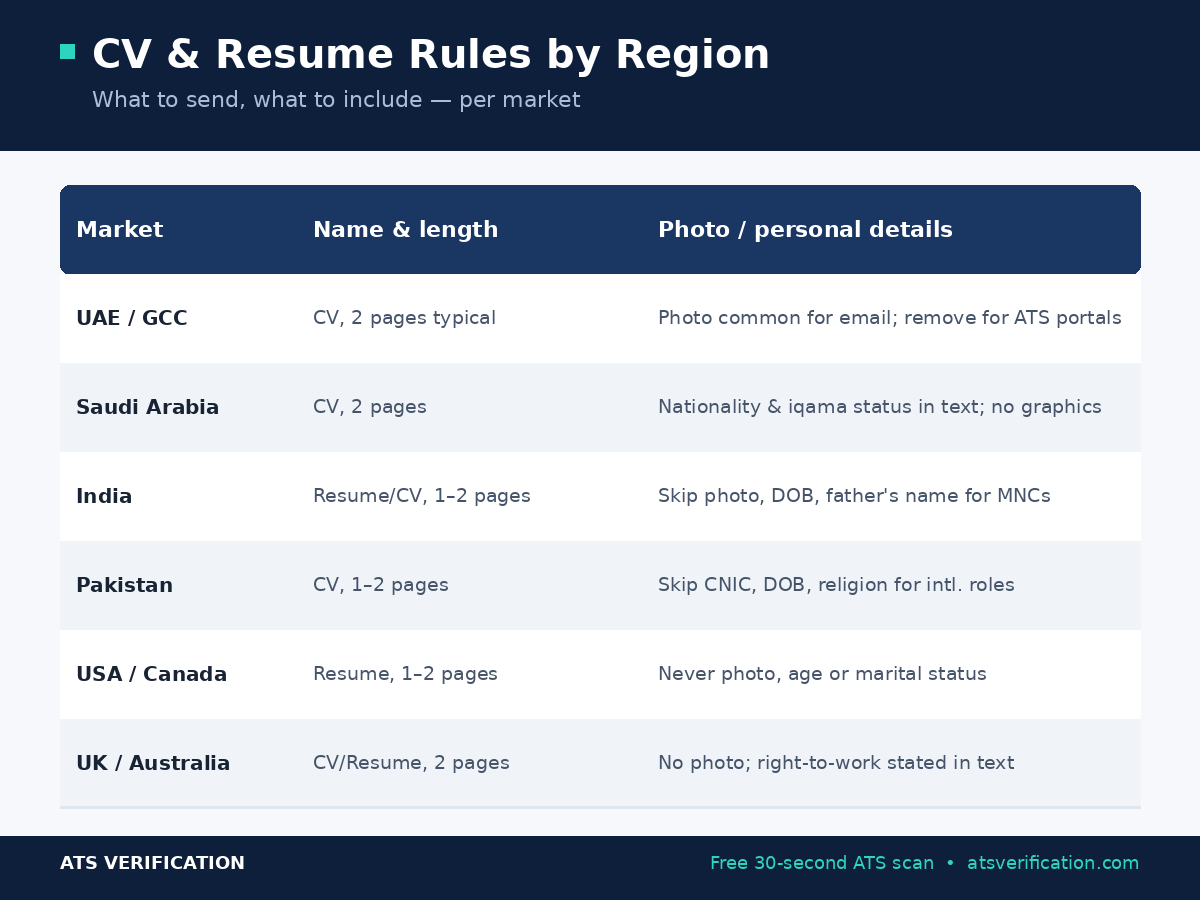
UAE and the wider GCC. Two pages is the comfortable norm. Photos remain common on CVs emailed directly to recruiters, but portal and ATS submissions should omit them, parsers can't read them and global employers' compliance processes increasingly flag them. State location, visa status and notice period in plain body text near the top; UAE recruiters filter on availability before anything else. (More: ATS resume rules for the UAE.)
Saudi Arabia. Same structural rules as the UAE, with two additions: state iqama status or relocation readiness explicitly, and spell out certifications in both forms ("Project Management Professional (PMP)") because Saudi enterprise filters are strict on credentials. English unless the posting requests Arabic. (More: Saudi Arabia ATS guide.)
India. One page for freshers, two for experienced professionals. The traditional biodata block, photo, date of birth, father's name, marital status, declaration line, should be dropped entirely for MNC, GCC-employer and product-company applications; it parses badly and adds compliance noise. Keep one clean contact line with +91 phone, email, city, LinkedIn. (More: India ATS resume guide.)
Pakistan. The same principle as India: drop CNIC numbers, date of birth, religion and domicile from any international version. Two pages standard. For Gulf applications, add the availability line; for remote work, foreground the in-demand skills and time-zone flexibility. (More: Pakistan ATS CV guide.)
USA and Canada. One to two pages, never a photo, never age, marital status or nationality. Right to work is handled in application-form questions, not on the resume. Quantified achievement bullets are the dominant style and what recruiters expect to skim. (More: US ATS resume rules, and the full US resume format guide for 2026.) One major exception: US federal government jobs invert these rules entirely, 3-5 pages with hours-per-week and supervisor contacts, see the federal resume & USAJOBS guide.
UK, Ireland, Australia. Two pages standard, no photo, no personal details beyond contact information. A single line on right-to-work status ("UK right to work, Skilled Worker visa" or "Australian PR") saves recruiters a filtering step and yourself a silent rejection.
The rules that never change
Beneath every regional difference, the parsing layer is identical, because these markets buy the same software, Workday, SAP SuccessFactors, Oracle Taleo, Greenhouse, iCIMS, Lever. Whatever the country:
- One column. Tables, text boxes and sidebars scramble extraction everywhere.
- Contact details in the body, not the header, parsers skip headers in Dubai exactly as they do in Dallas.
- Standard section headings, standard fonts, standard bullets.
- One date format throughout: "Jan 2021 – Mar 2024."
- Words, not graphics: no skill bars, no icons, no photos on portal submissions, anywhere.
- Text-based DOCX or PDF, never a scanned image.
A useful mental model: regional conventions decide what content you include; the parser decides how everything must be formatted. Confusing the two is how candidates end up with a "localized" CV that no market's software can read. (See the full list in the 10 most common parsing failures.)
The seventh market: remote-first employers
Remote-first companies deserve their own entry, because they hire across all the regions above while following none of their conventions. A distributed startup hiring from Dubai, Karachi, Bengaluru and Austin simultaneously runs one pipeline, almost always Greenhouse or Lever, and applies US-style norms by default: no photo, no personal details, achievement-led bullets, tight length.
For candidates in the Gulf and South Asia, this means your "international remote" version is effectively your US version, with two additions remote recruiters specifically search for: your time zone stated plainly ("UTC+5, comfortable with 4-hour US-East overlap") and your remote toolchain named explicitly where true (Slack, Notion, Jira, Linear, async documentation). Written-English quality carries extra weight here, the resume is itself the first work sample for a job conducted in writing.
The practical setup: one master, market overlays
Maintain one master document in strict ATS format containing everything. From it, generate market versions by adjusting content, never structure: add the availability line for Gulf applications, trim to the tightest two pages for the US, add the right-to-work line for the UK. Five minutes per market, instead of five competing templates drifting out of date. (On length specifically, see one page vs two pages.)
Then verify the master actually parses. Our free scan shows you the extracted output, every field, every role, every date, against the behavior of the same enterprise systems these markets share, and flags anything broken. No signup. If you need a rebuild, one-time pricing starts at $5 with a 30-day money-back guarantee.
Frequently asked questions
Is a CV longer than a resume?
Only in North American usage, where "CV" means the academic document. Everywhere else the terms describe the same one-to-two-page application document.
Do Gulf employers require photos?
No portal requires one, and ATS submissions should not include one. A separate photo version for direct-email situations covers the traditional expectation where it still exists.
Can I use the same CV for the UAE and the USA?
The same structure, yes, and you should. Adjust content: the UAE version carries visa and notice-period details that the US version omits, and the US version trims to the tightest possible two pages.
What format works in every country?
Single column, standard headings, contact in body text, consistent dates, no graphics, text-based file. It's the one format every parser in every market reads cleanly.
One CV, every market, parsed correctly, check yours free.