I applied to MBA programs over two cycles. In 2025 I was admitted to Boston University Questrom, WashU Olin, and USC Marshall, three full-time programs. I did not enrol. Leaving a settled finance career to study full-time was the wrong call for my situation. I waited a year and reapplied for an Executive MBA. In 2026 I was admitted to Oxford Saïd and London Business School. I chose LBS for its brand strength in finance, and was named an Educational Opportunity Scholar, the full six-factor LBS-vs-Oxford decision is here. I start in September 2026.
Between my early resume drafts and the version that worked, the single biggest change was this: I stopped writing job descriptions and started writing impact. That one shift is the heart of this guide.
- MBA resumes are not better-written work resumes, they are a different format entirely
- Adcoms spend 30-90 seconds per resume on the first pass; they are scanning for outcomes, not duties
- HBS, Stanford GSB, and LBS each read for slightly different things, one resume cannot be all three
- Every bullet should answer the question "what did this achieve?" not "what did I do?"
- One page is non-negotiable for most programs (LBS allows slightly more flex than HBS)
Why MBA resumes are different (and most applicants miss this)
Adcom reads roughly 3,000 resumes per cycle. First-pass review is 60–90 seconds per resume at top-tier programs. That is not enough time to read job descriptions, it is barely enough to scan for outcomes and structure. If your resume is paragraph-heavy, light on numbers, and reads like a job application, the reviewer has already moved on by the time they reach your second bullet. To see the difference line by line, our MBA resume examples rewrite nine typical job bullets into adcom format.
This is also why every consultant-written guide repeats the same principle: the "So What?" test. For every bullet, ask "so what?" If the answer is not obvious within two seconds of reading, the bullet has failed and needs to be rewritten. "Created a new financial model for Project Ness" fails the test. "Built financial integration model for the Caterpillar acquisition, identifying $5M in synergies and accelerating due diligence by 3 months" passes it. Same work, different framing, and adcoms only read the second one.
Most applicants make the same mistake I made in my early drafts: they submit their work resume unchanged. This is the resume that won them their current job, so it feels like the strongest document they have. But that resume was written for employers who want to hire you for a specific role. An MBA resume is read by an adcom evaluating you for an entire two-year programme. The audience is different. The question being answered is different. So the format must be different.
The work resume answers: "Can this person do the job?"
The MBA resume answers: "Has this person already led, achieved, and grown, and will they do so again over the next two years?"
Different questions, different formats.
The one change that turned 7 drafts into an admit
I wrote my MBA resume eight times. The first seven were variations on the same theme, better-edited versions of a work resume. They described what I was responsible for. They described what teams I led. They described what processes I oversaw.
The eighth draft stopped doing that. Every bullet started answering one question: what changed because I was there?
Here is the practical difference, using a finance-manager example from my own experience:
Job description mode (what I did for 7 drafts):
"Responsible for managing month-end close process across three legal entities. Oversaw a team of seven and reported into the CFO. Worked closely with FP&A and external auditors."
Impact mode (the version that worked):
"Re-sequenced reconciliations across 3 legal entities and 7-person team; reduced monthly close cycle from 12 days to 6 days while restoring Qatar entity to break-even within 9 months."
Same job. Same team. Same employer. Completely different signal.
The first version tells the reviewer I was responsible for things. The second tells them what changed because of me, quantified, named, time-bound. The second version takes the same physical space on the page but conveys ten times the information.
If your current resume is the first version of every bullet, you are not the candidate the adcom is looking for. Not because you have not done the work, you almost certainly have, but because you are not showing them you have done the work.
The four dimensions every MBA bullet needs
An MBA-ready bullet contains one or more of these four dimensions. None is enough alone, the strongest bullets contain at least two.
1. Scale
How big? How many? How much? "$48M opex budget across 7 cost centres" is a scale signal. "Team of 12 across 3 time zones" is a scale signal. "200K monthly active users" is a scale signal. Without scale markers, adcoms cannot calibrate whether your achievement is impressive in absolute terms.
2. Improvement
Before vs after. "Reduced monthly close from 12 days to 5" is improvement. "Cut p99 latency from 800ms to 120ms" is improvement. The key is the delta, a single state ("close was 5 days") is much weaker than the journey ("from 12 to 5"). Adcoms read deltas as leadership signals.
3. Speed
How fast? Within what window? "Delivered 11-month programme on time and 11% under $4.8M budget" is speed. "Shipped MVP in 6 weeks vs 12-week estimate" is speed. Speed is particularly relevant for operational and execution-led roles.
4. Frequency
How often? At what cadence? "Delivered weekly board-pack reports for 18 consecutive months" is frequency. "Closed 38 engineering hires in 12 months" is frequency. Frequency is the dimension most applicants forget, it signals reliability and rhythm.
Every bullet on your MBA resume should contain at least one of these four. Most of your strongest bullets will combine two.
School-by-school format conventions
The four dimensions are universal. The voice, structure, and emphasis vary by school. Here is what each of the three schools I focused on reads for.
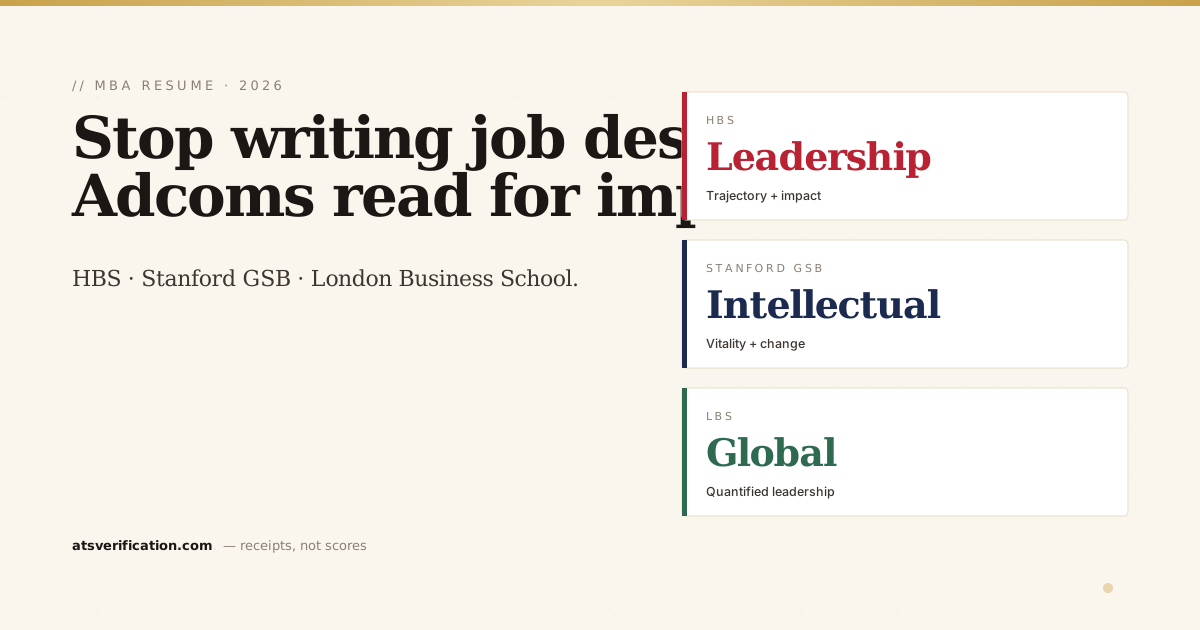
HBS, leadership trajectory and quantifiable impact
HBS reads for leadership trajectory, quantifiable impact, strategic thinking, and future potential. The bullet voice they reward is action-first, outcome-led, strategically named (not abstract).
Structural conventions:
- Education first if <3 years experience; experience first otherwise
- Leadership / community section is mandatory and weighted heavily
- Skills section minimal, technical and language only
- One page, strict
HBS bullet voice favours strong action verbs: "led", "drove", "architected", "diagnosed", "scaled", "influenced", "negotiated", "secured". HBS bullet voice penalises weak verbs: "responsible for", "worked with", "helped", "assisted in", "involved in".
An HBS-style bullet:
"Led 4-person team to redesign customer onboarding flow, reducing 30-day churn from 18% to 7% and unlocking $2.3M annual revenue."
Stanford GSB, intellectual vitality and personal change
Stanford GSB reads for intellectual vitality, personal change, ambition combined with humility, and impact-driven thinking. The bullet voice they reward is slightly more narrative, show curiosity and learning, acknowledge complexity, less corporate-jargon.
Structural conventions:
- Same experience/education ordering rules as HBS
- Personal interests section is optional but valued
- Less formal corporate language is permitted
- Slightly more white space between sections
GSB bullet voice favours: "investigated", "discovered", "designed", "tested", "iterated", "learned", "navigated", "diagnosed". GSB bullet voice penalises: "maximised", "optimised", "leveraged", "synergised" (too consultant-flavoured).
A Stanford GSB-style bullet:
"Curious why customer onboarding stalled at 18% churn, ran user research with 47 customers; redesign reduced churn to 7%, generating $2.3M annual revenue."
LBS, global perspective and quantified leadership
London Business School reads for global perspective, quantified leadership, multi-cultural experience, and business pragmatism. The bullet voice they reward is quantified, pragmatic, business-outcome-focused, less narrative than GSB, more direct than HBS.
Structural conventions:
- Languages section is mandatory (either in Skills or its own section)
- International experience surfaced prominently in bullets where relevant
- UK conventions: comma after city names ("London, UK"), British date format ("MMM YYYY")
- Slightly more length flexibility than HBS but still one page strict
LBS bullet voice favours direct verbs: "delivered", "led", "managed", combined with currency markers (£/€/$) and international scope phrases where relevant.
An LBS-style bullet:
"Led 4-person team across UK, India, and UAE to redesign customer onboarding flow; reduced 30-day churn from 18% to 7%, unlocking £1.8M annual revenue."
EMBA, strategic depth and senior-stakeholder influence
Executive MBA programmes follow different format rules than full-time. I am applying to LBS for the September 2026 EMBA cohort, so this is the format I know most intimately. The shift from a full-time MBA resume to an EMBA resume is not just about length, it is a different document built around different signals. I unpack the full executive-track version in our dedicated Executive MBA resume guide.
Structural conventions for EMBA candidates (typically 8–15+ years of experience):
- 1-2 pages is acceptable instead of strict 1-page
- Early-career roles (10+ years ago) are compressed to 1-2 lines or omitted unless they show a critical pivot
- Board memberships, advisory roles, and external community leadership are surfaced as primary signals of senior peer recognition, not as optional add-ons
- If you have been in a single role for 5+ years, break it into "Key Achievements by Phase" to show evolution within the tenure (not flat duty lists)
- Industry committee memberships, non-profit boards, advisory positions are listed prominently
EMBA bullet voice favours strategic-decision language: scope of influence, cross-border initiatives, multi-million-dollar programmes, C-Suite or Board interaction.
An EMBA-style bullet:
"Restructured MEA finance operations across 4 entities and 3 currencies; renegotiated Group governance with London C-Suite, securing $12M of working capital and accelerating Q4 close by 4 days."
Notice the difference: the full-time MBA bullets above lead with action and quantified outcome. The EMBA bullet leads with scope (cross-entity, cross-currency), names the influence (Group governance, London C-Suite), and quantifies the strategic impact ($12M working capital + 4-day close acceleration). EMBA adcoms read for the kind of leadership that already operates at the senior decision-making level, they want to see evidence of it.
The five mistakes I made in my first seven drafts
I did not figure this out cleanly the first time. Here are the specific things that were wrong with my drafts that the eighth version fixed.
Mistake 1: Listing job duties instead of impact
Every bullet described what I was responsible for. Adcoms do not care what you were responsible for. They care what you achieved.
Mistake 2: Burying the GMAT/GRE score
I had a strong test score buried at the bottom of an Education line. Move it to the top of Education, on its own line if needed. Adcoms scan for it within the first 10 seconds.
Mistake 3: Using generic AI-rewritten phrases
Phrases like "spearheaded cross-functional initiatives" or "leveraged data-driven insights" mark the resume as AI-generated. Adcoms read 3,000 of those a year and tune them out immediately. Use specific, named verbs tied to concrete outcomes.
Mistake 4: Missing extracurricular leadership
HBS in particular weighs the Leadership / Community section heavily. If you have ever led anything outside work, a community foundation, a religious institution, a sports team, a professional society, surface it. Same impact-mode bullets apply.
Mistake 5: Two-page resumes
Adcoms reject two-page MBA resumes on sight for most programs. One page is the rule. If you cannot fit your career into one page, your career is not the problem, your editing is.
Score and GPA benchmarks (so the resume doesn't have to compensate)
A perfect resume cannot save an application with weak quantitative signals. For context, here are the score and GPA benchmarks adcoms expect at the top tier (based on published 80% class profiles, May 2026):
- M7 target (HBS, Stanford GSB, Wharton, Booth, Kellogg, MIT Sloan, Columbia): GMAT Focus 730+ / GMAT Classic 700+ / GRE 325+; undergraduate GPA 3.5+
- T15 target (Haas, Tuck, Yale, Stern, Fuqua, Ross, Darden, Cornell, Anderson, plus international peers LBS / INSEAD / Oxford / Cambridge): GMAT Focus 700+ / GMAT Classic 680+ / GRE 320+; undergraduate GPA 3.3+
- Below 3.0 GPA: Mitigate with a strong test score plus post-undergraduate coursework (HBX CORe, Wharton Online, Stanford LEAD) plus a clear narrative explaining context. The resume cannot fix this alone.
- GMAT / GRE waivers are increasingly common but trade signal strength for convenience. At HBS, Stanford GSB and Wharton, a waiver can be a disadvantage unless you have exceptional quantitative proof (CFA Charter, heavy analytical work experience, finance role).
The point: if your scores are below the 80% range, the resume becomes a more important signal. Every quantified achievement, every leadership demonstration, every named impact compensates for the gap. If your scores are at or above the 80% range, the resume needs to confirm the academic signal, same level of quantification, but without the same compensation pressure.
School clusters, the strategic framework
Most applicants pick schools by ranking. Adcoms read for fit. Here is how the top programmes cluster by strength, so your resume can lean into what each school weights:
- Cluster A (Elite Global Brand), HBS, Stanford GSB. Best for general management, entrepreneurship, VC/PE, C-suite track.
- Cluster A- (Finance & Consulting Powerhouse), Wharton. Best for investment banking, private equity, hedge funds, consulting, healthcare.
- Cluster B (Industry Specialisation), MIT Sloan (tech, operations, analytics), Chicago Booth (finance, economics, flexible curriculum), Kellogg (marketing, general management, collaborative culture), Columbia CBS (finance, media, NYC location advantage).
- Cluster B- (Regional Leaders & Niche Strengths), Berkeley Haas (tech, sustainability, Bay Area), Dartmouth Tuck (general management, tight-knit community), Yale SOM (social impact, healthcare, integrated curriculum).
- International peers, London Business School (finance, global focus), INSEAD (one-year programme, consulting and global), Oxford Saïd (general management, Europe-Asia bridge), Cambridge Judge (entrepreneurship, finance).
Tailor each resume to the school's strength. If you apply to Wharton, surface finance vocabulary heavily. If you apply to Kellogg, surface marketing and collaborative team accomplishments. If you apply to LBS, surface international scope and quantified leadership. Generic resumes that work everywhere often work nowhere. And if you are doing this against the clock, the verified Round 1 dates and a week-by-week finishing plan are in our 2026 deadline guide.
Why I built a tool around this
By the time my eighth LBS draft was ready, I had spent something like 30-40 hours rewriting the same resume. Reading adcom interviews, reverse-engineering published successful resumes, talking to people in the LBS community, iterating on what worked. The cost was not the $29 a tool would have been, it was the three weeks of evenings I could have spent on essays or recommendations instead.
That is the gap this product fills. The MBA Resume Builder at ATS Verification takes your existing resume, asks five questions about your application context, and transforms the document into HBS, Stanford GSB, or LBS format, using the same patterns I learned the hard way. It does not write your essays. It does not write your recommendations. It does not guarantee admission. It guarantees a resume that survives adcom skim, which is the foundation everything else on the application stands on.
If you are applying this cycle, you do not have three weeks to spare on resume drafts. You have essays to write. You have recommendations to chase. You have employers to manage around your application timeline. Spend the $29 on the resume foundation. Spend the saved weeks on the parts of the application only you can do.
Frequently asked questions
How many bullets per role on an MBA resume?
3-5 bullets per role for your most recent position, 2-3 for older positions. Every bullet should pass the "what did this achieve?" test. If a bullet describes a duty rather than an outcome, cut it or rewrite it.
Should I include my entire career or only the last 10 years?
Include enough to show trajectory but cut anything older than 12-15 years to a single line. Adcoms care most about your most recent 5-7 years. Earlier roles are context, not signal.
How important is the GPA?
HBS, Stanford GSB, and LBS all want to see your GPA if it is above 3.5/4.0 or equivalent. If lower, omit it and let your test score carry the academic signal. Do not lie, adcoms verify GPAs against transcripts.
What about international applicants whose grading systems are different?
State your GPA in your local scale and include the conversion if known. LBS in particular has extensive experience reading international transcripts and does not penalise different scales.
Should I include hobbies and interests?
Stanford GSB explicitly values interests. HBS is neutral. LBS reads them as colour but not as signal. If you include them, they must be specific, "marathon running" not "fitness", "competitive bridge" not "card games". Generic interests are filler.
How do I quantify achievements when I work in a function without obvious metrics?
Every function has metrics if you look. Designers quantify by reach and adoption. Researchers quantify by publications and citations. Operations quantify by cost reduction and cycle-time improvement. People functions quantify by retention and hiring velocity. See our deep-dive on quantifying resume achievements with 40+ before/after examples.
How do I handle a career gap?
Acknowledge it briefly, frame it constructively (sabbatical, caregiving, illness recovery, founding attempt, deliberate skill-building), and move on. Most adcoms do not penalise gaps; they penalise applicants who try to hide them.
Does this product write my MBA application essays too?
No. The MBA Resume Builder is strictly the resume. Essays are a separate component that should be authored personally, they are your story, in your voice, with input from people who know you well.
Related guides
- The MBA Resume Builder, HBS, Stanford GSB, LBS Format
- Quantify Resume Achievements, 40+ Before/After Examples
- STAR vs XYZ vs PAR Resume Bullets, Which Format Actually Works
- 200+ Resume Action Verbs by Job Function
- Why Your Resume Is Not Getting Interviews, 10 Most Common Failures
- Finance Resume Keywords (2026), 60+ ATS-Tested Terms
→ Get started, pick HBS, Stanford GSB, or LBS from $29 one-time
If you are deciding between doing this yourself, hiring a consultant, or using software, I compared every option honestly in the best MBA resume builders.