Few topics in job searching generate more confident misinformation than applicant tracking systems. Advice ricochets around LinkedIn and career forums, some of it outdated by a decade, some never true, some true in exactly the opposite direction claimed. Acting on the wrong version costs interviews.
Looking for your resume score? Our free resume review gives you a 0-100 score for how cleanly software can read your file, with every problem named and a fix for each. No signup.
Here are the ten most persistent ATS myths, checked against how parsing and screening actually behave in 2026. (For the foundation, see what an ATS is and how it reads your resume.)
- The ATS doesn't "auto-reject 75%", it parses and filters; humans reject
- Text-based PDFs are fine; the "never use PDF" rule is a decade out of date
- White-text keywords appear in plain sight in the recruiter's parsed view, never do it
- Match scores are word-overlap estimates recruiters never see, verify extraction first
- You can see what the ATS reads, run a parsing-first scan and the folklore becomes a checklist
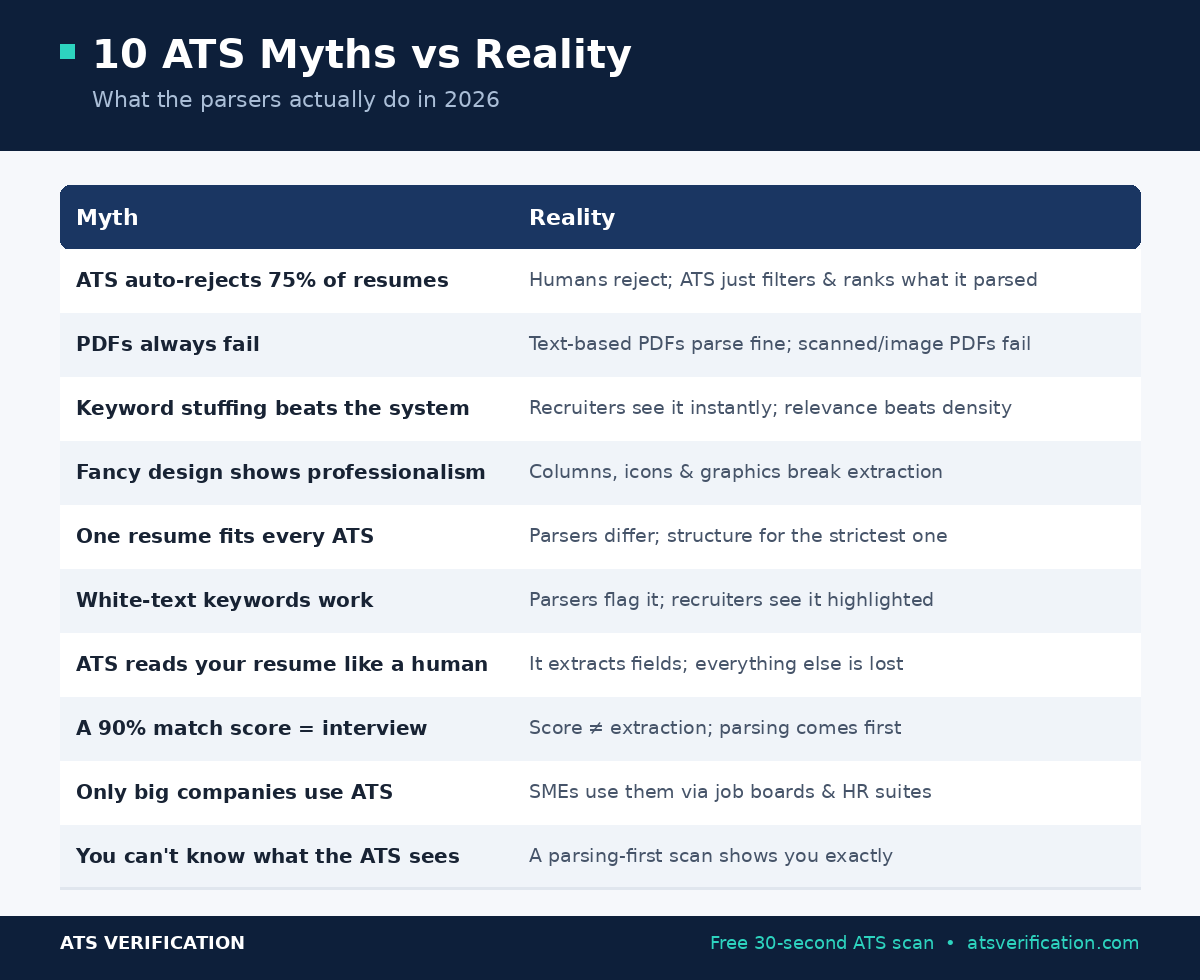
Myth 1: "The ATS automatically rejects 75% of resumes"
The most-quoted statistic in job searching, and it's not how the software works. An applicant tracking system parses, stores, filters and ranks, humans decide rejections. What the statistic gestures at is real, though: resumes that parse badly or miss the recruiter's filter terms never surface, which feels identical to auto-rejection. The fix isn't beating an algorithmic judge; it's making sure your data arrives intact and searchable.
Myth 2: "Never submit a PDF"
Outdated. Modern parsers handle text-based PDFs well, and PDF preserves your layout for the human who eventually reads it. The real rule: the PDF must contain selectable text. Scanned documents, photographed pages, and flattened design-tool exports parse as empty or garbled. Quick test: if you can select and copy the text in your PDF, parsers can read it. (Full breakdown: PDF vs Word for ATS.)
Myth 3: "Keyword stuffing beats the system"
Stuffing gets you past nothing and costs you the human read. Recruiters see keyword walls instantly, and many systems surface the original document right beside the parsed profile. Worse, stuffed terms without supporting evidence collapse at the first screening call. Use the job description's exact vocabulary for skills you genuinely have, once, in context, with evidence.
Myth 4: "A creative design makes you stand out"
It makes you stand out to humans at networking events and disappear in databases. Columns merge, icons vanish, skill bars extract as nothing, and text boxes get skipped. If your industry values design portfolios, link to one, the resume itself is a data document first. (See the 10 most common parsing failures.)
Myth 5: "One ATS-optimized resume works everywhere"
Mostly true for structure, false for content. A simply formatted single-column resume is read well by most parsers, so you never need five templates. But recruiters filter on job-specific keywords, so the content needs light tailoring per application. Structure once; tailor words per job.
Myth 6: "White-text keywords are a clever hack"
The oldest trick, and the most self-defeating. Parsers extract white text exactly like black text, which means it appears, visibly, in the recruiter's parsed view and highlighted in their search results. You're not hiding keywords from the human; you're showing the human that you tried to. Many systems and recruiters treat it as an integrity flag. Never. (The same logic applies to AI-generated resume tricks.)
Myth 7: "The ATS reads my resume like a person would"
It extracts fields; it doesn't comprehend. Context, implication, career-change narrative, "obviously I know Excel if I built financial models", none of that transfers unless it's written as extractable text. If a skill matters, name it. If a date matters, format it. The parser gives no benefit of the doubt.
Myth 8: "My 90% match score means I'll get an interview"
Match scores are third-party estimates of word overlap, recruiters never see them, and no score certifies that your resume extracted correctly in the first place. A resume can score 90% on keywords while its work history parses scrambled. Verify extraction first; treat scores as rough keyword guidance at most. (Here's how ATS scoring actually works.) It is also why the best ATS resume checker shows you the actual parse rather than a number.
Myth 9: "Only big corporations use an ATS"
A decade out of date. ATS functionality is now bundled into job boards, HR suites and recruiting tools used by companies of every size. If you applied online, assume parsing happened. The threshold question isn't company size, it's whether a portal sat between you and a human inbox.
Myth 10: "There's no way to know what the ATS sees"
The myth that keeps all the others alive. You can see exactly what parsers extract from your resume, the fields, the text, the gaps, by running a parsing-first scan. Once you've read your own extraction, ATS advice stops being folklore and becomes a checklist: these three things broke, fix them, verify, done. (Our methodology explains how.)
Where the myths come from, and why they persist
Most ATS folklore has a traceable origin. The "75% auto-rejection" figure has circulated for more than a decade with no published study behind it. It points at something real, resumes that never surface in a recruiter's search, but pins it on robot judges. "Never use PDF" was sound advice around 2010, when parsers genuinely choked on them, and has been recycled ever since. The white-text trick worked briefly in the era before parsed-text views, and its legend outlived its function by fifteen years.
The myths persist because the system gives no feedback. When an application disappears, candidates reach for whatever explanation is circulating, and silence can't disprove any of them. A rejected candidate who blames the 75% robot feels no need to check whether their two-column template scrambled their dates, which is the actual, checkable, fixable cause in a large share of cases. The antidote is direct observation: look at your own parse, and the guesswork ends.
The pattern behind the myths
Notice what the durable myths have in common: they treat the ATS as either an unbeatable judge or a gullible gatekeeper. It's neither. It's a parser feeding a database that humans search. Resumes fail mechanically, wrong structure, missing keywords, unreadable files, and mechanical failures have mechanical fixes.
Our free scan shows you your resume's actual extraction, flags 15+ specific parsing failures, and requires no signup. One-time rebuilds from $5 if you want the fixes done for you, no subscription, 30-day money-back guarantee.
Frequently asked questions
Do ATS systems reject resumes without a human seeing them?
Knockout questions (work authorization, licenses) can auto-disposition applications. Resume parsing itself doesn't reject, but a badly parsed resume is effectively invisible, which produces the same outcome.
Is DOCX or PDF better in 2026?
Both are fine when text-based and simply formatted. Follow the employer's instruction if one is given; otherwise either works.
Do ATS systems use AI now?
Many platforms have added AI-assisted ranking on top of parsing. This raises the stakes of the same fundamentals: clean extraction and honest, specific, keyword-aligned content, because the models work from the same parsed data.
What's the single highest-impact ATS fix?
Converting a table- or column-based layout to a clean single column. Tables and columns are among the most common extraction problems, and this one change fixes them.
Stop guessing what the ATS sees, run the free scan.