Search "best ATS resume checker" and you get a dozen tools, all promising you a score out of 100. Here is the uncomfortable truth: that score is the problem, not the feature. The best ATS scanner does not hand you a number you can't verify, it shows you exactly what the software read off your resume. This guide breaks down what actually makes an ATS checker good, compares the field honestly, and explains why we built ATS Verification to win on the one thing that decides whether you get seen.
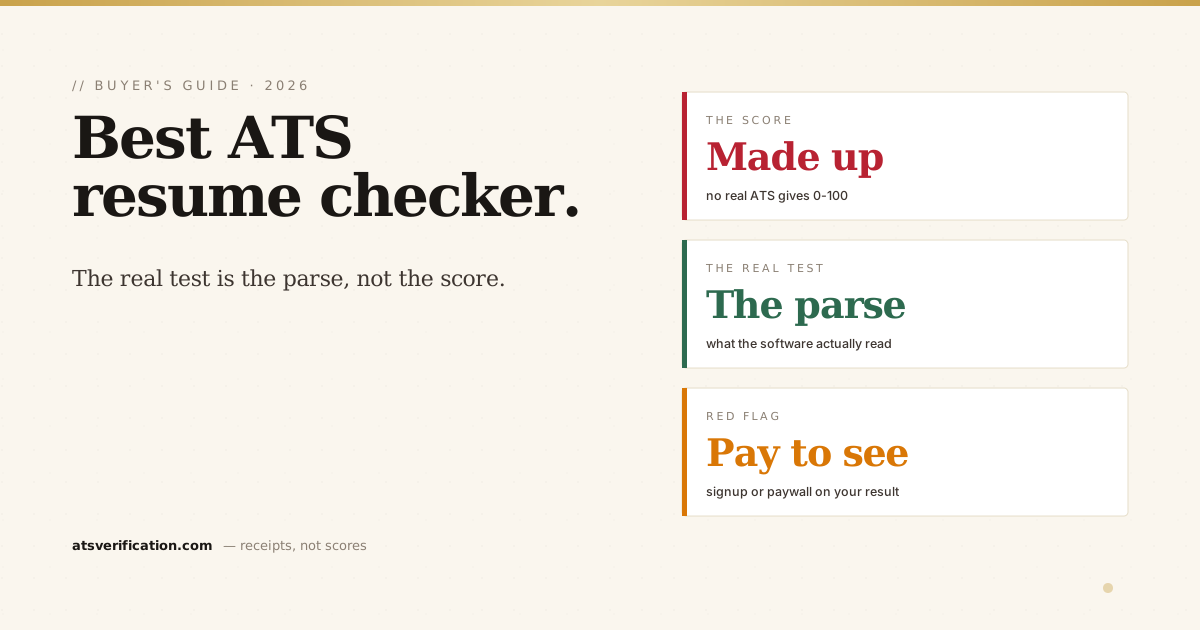
- The real test is the parse, not the score. The best scanner shows the actual text an ATS extracts from your resume, field by field, not a made-up percentage.
- Watch for the gate. A signup wall, an email gate, or "pay to see your score" are red flags. A good check shows your result immediately.
- Privacy is part of quality. Your resume is sensitive. The best tools parse it and delete it, not store it.
- Transparency beats a black box. A published, checkable methodology is worth more than "proprietary AI."
- We built ATS Verification to be the best at one job: showing you precisely what the parser extracts, free, with no signup and no fake score.
"Best ATS scanner" is usually the wrong question
Most tools that call themselves an ATS checker do the same thing: they take your resume, compare it to some keywords, and show you a confident number, 64%, 82%, whatever. It feels precise. It is not. Real applicant tracking systems like Workday and Greenhouse do not hand your resume a universal score out of 100 that a recruiter stares at. That number is generated by the checker site, not by the system you are actually trying to pass. We unpack the mechanics in how ATS scoring really works and bust the score myth in the ATS myths still fooling job seekers.
So the better question is not "which tool gives me the best score?" It is "which tool shows me the truth, what the software actually read?" Because if the parser scrambled your job title or dropped your skills section, no score on earth will save you. The recruiter searches the parsed text; if your information isn't in it, you are invisible (see how recruiters actually sort candidates).
5 things that actually make an ATS scanner good
Judge any ATS resume checker against these five. The best one clears all five; most clear one or two.
- It shows the parse, not just a score. The single most useful thing a scanner can do is show you the raw text the ATS extracted, your name, titles, dates, skills, exactly as the software tagged them. That is the truth. A score is an opinion.
- No gate. No signup, no email wall, no "create an account to see your results." If a tool hides your own result behind a form, it is a lead-capture funnel first and a scanner second.
- Privacy by design. Your resume holds your name, contact details, and work history. The best tools parse it in memory and delete it, rather than storing it to train a model or build a profile.
- Transparent methodology. "Proprietary AI score" tells you nothing. A good tool publishes how it works and where its keyword data comes from, so you can check it instead of trusting it.
- Actionable and honest. It should tell you the specific thing to fix, a two-column layout, a table, a header-buried contact line, without inventing fake urgency to sell you an upgrade. (For the four-question test that separates an honest checker from score theater, see are ATS resume checkers accurate.)
How the field actually stacks up
There are three broad categories of "ATS checker" in the market. None is evil; they are just built for different jobs. Here is the honest split.
| Type | Best for | The catch |
|---|---|---|
| Score-first checkers | Matching your resume to a specific job description at volume | Gives you a percentage that no real ATS produces; the deep features are usually behind a paywall or a scan limit |
| Builder + bolted-on checker | Writing a resume from scratch inside a template | The checker is a secondary feature, often behind a trial; the templates themselves (columns, sidebars) can be what breaks parsing |
| Parser-first scanners | Seeing exactly what an ATS extracts, before you apply | Diagnostic, not a full builder, it shows you the problem and how to fix it, rather than writing the whole resume for you |
If you want to write a resume inside a template, a builder is fine. If you run dozens of applications against specific postings and want a keyword-match workout, a score-first tool earns its keep (we said as much in our honest Jobright review and our AI resume builders test). But if your actual question is "can the software even read my resume?", the question that decides whether a human ever sees you, a parser-first scanner is the right tool, and it is the one most checkers skip.
Why we built ATS Verification to be the best at one thing
We did not try to be everything. We built the best parser-first ATS scanner, because that is the gap nobody honest was filling. Here is what that means, measured against the five criteria above:
- It shows the parse, field by field. Upload your resume and you see the actual extracted text, name, job titles, dates, skills, the way the software tagged each one. You catch the exact thing that got mangled, not just that something did. The most common breakers are in the 10 most common parsing failures, and the foundational explainer is what an ATS is and how it reads your resume.
- No gate. The scan is free. No signup, no email wall, no account. You see your result on the spot. Our full 7-point ATS-friendly self-check is free to follow too.
- Privacy by design. Files are parsed in memory and deleted within about 60 seconds. We do not store your resume.
- Published methodology. Our keyword data comes from O*NET and hundreds of real job descriptions, and we publish how it works rather than hiding behind "proprietary AI."
- No fake score, and honest about scope. We do not invent a number to scare you into upgrading. The scan and tools are genuinely free. The only paid part is an optional, one-time resume rebuild if you want the fix done for you, and you never have to touch it.
That is the honest case for "best": best at showing you the truth, for free, without a catch. Not best at everything, best at the thing that decides whether you get seen.
Test any ATS scanner yourself in 60 seconds
Don't take our word for it, or anyone's. Run your resume through any checker and ask three questions: Did it show me the actual extracted text, or just a number? Did it make me sign up or pay to see my own result? Does it tell me what it does with my file? If the honest answer is "it just gave me a score and asked for my email," that was never a scanner. It was a sales funnel wearing a lab coat.
See the truth for yourself, free
The best way to judge a scanner is to use it. Run a free scan and see exactly what an ATS extracts from your resume, name, titles, dates, skills, field by field, with no signup, no fake score, and your file deleted within a minute.
For the reasoning behind that no-fake-score approach, our founder explains it in why ATS Verification is different from other resume tools.
Prefer to think of it as a review rather than a scan? Same tool, described plainly: get a free resume review, instant and with no email gate.
And if you are weighing a human resume writer against software entirely, we wrote the honest split, including when the $200 writer genuinely wins: resume writing services vs software.
Since we are one of the tools on this list, the fairest thing we can do is publish our own numbers where you can audit them. That is what why we publish our parsing data live and refuse to sell you a score is about, including the conversion rate that makes the free scan a bad funnel and a good product.
Applying outside the US?
The criteria above hold everywhere, but three markets have conventions that change which tool suits you, and in two of them the largest employers do not read a CV at all. Those are covered separately in the UK guide, the Canada guide, and the Europe guide, which opens with why the EU's own Europass format is a parsing hazard.
→ Free ATS scan, see the real parse, not a made-up number