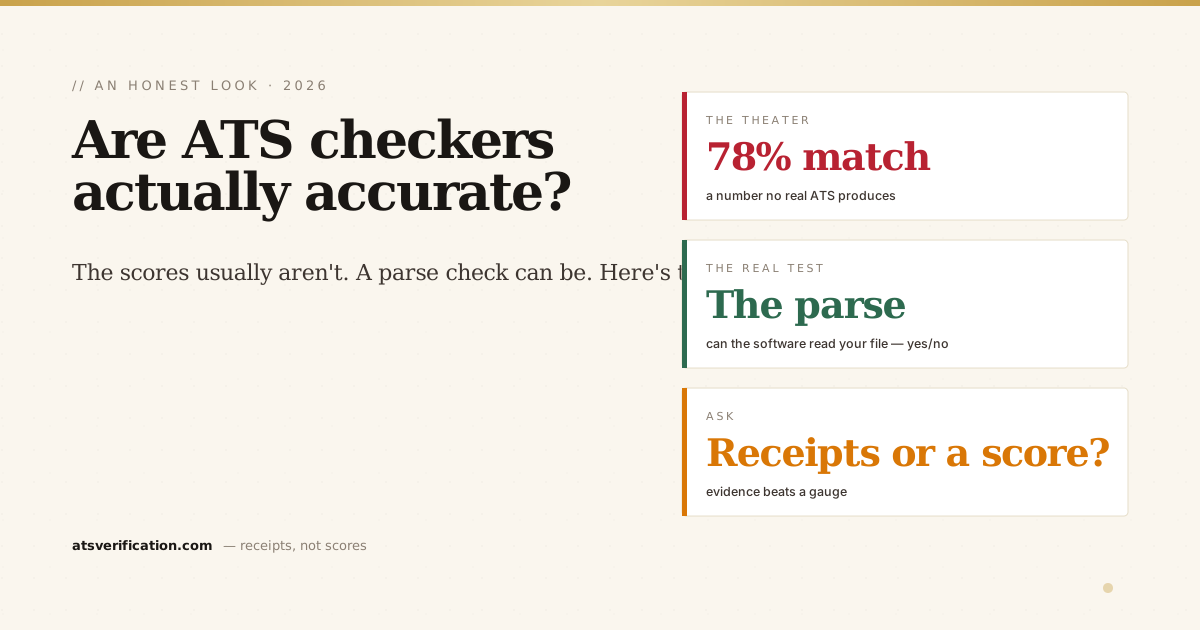
Type "ATS resume checker" into Google and you'll get a wall of tools promising to score your resume out of 100. Paste your CV, wait a few seconds, and a confident number appears: "78% match." It feels precise, and precision feels like accuracy. But here's the uncomfortable question almost none of those tools answer honestly: where does that number come from? The answer changes how you should use every ATS checker you've ever tried, including whether you should trust the score at all.
- No real ATS gives you a 0–100 score. Workday, Greenhouse, Taleo and the rest parse and store your resume and let recruiters search it. The "match %" you see on checker sites is invented by the checker, not measured from any real system.
- That doesn't make checkers useless, it makes the score the wrong thing to trust. One thing about your resume genuinely is measurable: whether the software can read it (the parse).
- Honest and theater look identical for three seconds. Both flash a result. The difference is whether the tool shows you evidence, the actual extracted text, or just a number.
- Four questions separate a real checker from a scoreboard. Does it show the parse? Does it avoid inventing a match %? Is its method published? Does it charge you for the number itself?
- The accurate answer to "will I get the interview" isn't a percentage. It's binary at the first gate: can the machine read you, yes or no.
Where the score actually comes from
An applicant tracking system does three things with your resume: it parses the file into structured text, stores that as a candidate record, and lets a recruiter search and filter those records (the full mechanics are in what is an ATS and how it reads your resume). Notice what's missing: nowhere in that pipeline does the ATS compute a "your resume is 78% good" score and show it to anyone. Recruiters see your parsed record and their own search results, not a grade on your CV.
So when a checker tool shows you "78%," that number was generated by the tool, usually by counting how many keywords from a job description appear in your resume. That's a keyword-overlap estimate dressed up as a verdict. It can be a rough directional hint, but it is not a measurement of anything a real ATS does, and treating it as a grade is where people go wrong (more on the ranking reality in how ATS scoring works).
Why the fake score persists
Three reasons. First, a number feels precise, "78%" reads as science in a way "your resume looks fine" never will, even when the fine print is identical. Second, it drives upgrades, a low score creates urgency ("unlock the fixes to raise your score!"), which is a conversion tactic, not a diagnosis. Third, it's cheap to fake, counting keyword overlap takes milliseconds and needs no real parsing engine. The incentives all point toward a big confident number, whether or not it means anything.
What actually is measurable
Here's the honest part that most "these tools are all scams" takes miss: one thing about your resume is genuinely, objectively testable, whether the software can read your file correctly. That's not an opinion or a keyword guess. Either your name extracted or it came out glued together; either your two-column layout held or it scrambled your work history; either your skills are still searchable or they fused into one blob. This is the real first gate, and it's pass/fail, not a percentage. A checker that measures this is measuring something real. A checker that only scores keyword overlap is not.
How to tell an honest checker from score theater
You can evaluate any ATS tool in under a minute with four questions:
- Does it show you the extracted text? An honest checker shows you what the parser actually pulled from your file, receipts you can verify. Theater shows you a number and hides the evidence.
- Does it avoid inventing a match %? Any tool that leads with "you're a 92% match!" is scoring keyword overlap and calling it a verdict. Be suspicious of the precision.
- Is its method published? Can you see how it decides what passes and fails? We published a full parsing benchmark, one resume, six layouts, run through the same pipeline, so you can check the work, not just trust the claim.
- Does it charge you for the number, or for the fix? Paying to "unlock your full score" is paying for theater. Paying to actually rebuild a resume the software can read is paying for an outcome.
That's also the honest way to compare tools generally, see the best ATS resume checkers for how the category stacks up on these criteria rather than on who shows the shiniest gauge.
So, are ATS checkers accurate?
The honest answer is: the scores usually aren't, but a parse check can be. If a tool is handing you a match percentage and calling it your resume's grade, treat that number as a loose hint at best, it isn't measuring anything a real ATS produces. But if a tool shows you the actual text extracted from your file, that is accurate, because it's not an estimate, it's the literal output the software would work from. Judge a checker by whether it gives you evidence or a scoreboard.
See it for yourself
You don't have to take our word for any of this, that's the whole point. A free ATS scan shows you the extracted text from your real resume: whether your name survived, whether your sections stayed in order, whether your skills are still searchable. No invented match score, no "unlock your grade," no signup. Just the receipt of what the machine actually reads, which is the only accurate answer to whether your resume will make it past the first gate. (Wondering whether it's even safe to upload your file? That's covered in is it safe to upload your resume to an ATS checker, and the "is my score good?" debate is one of many in ATS resume questions from Reddit.)
Our founder wrote about why he refused to build a fake score in the first place: why ATS Verification is different from other resume tools, and later set out the whole position, live failure data, no invented score, one payment rather than a subscription, in why we publish our parsing data live and refuse to sell you a score.