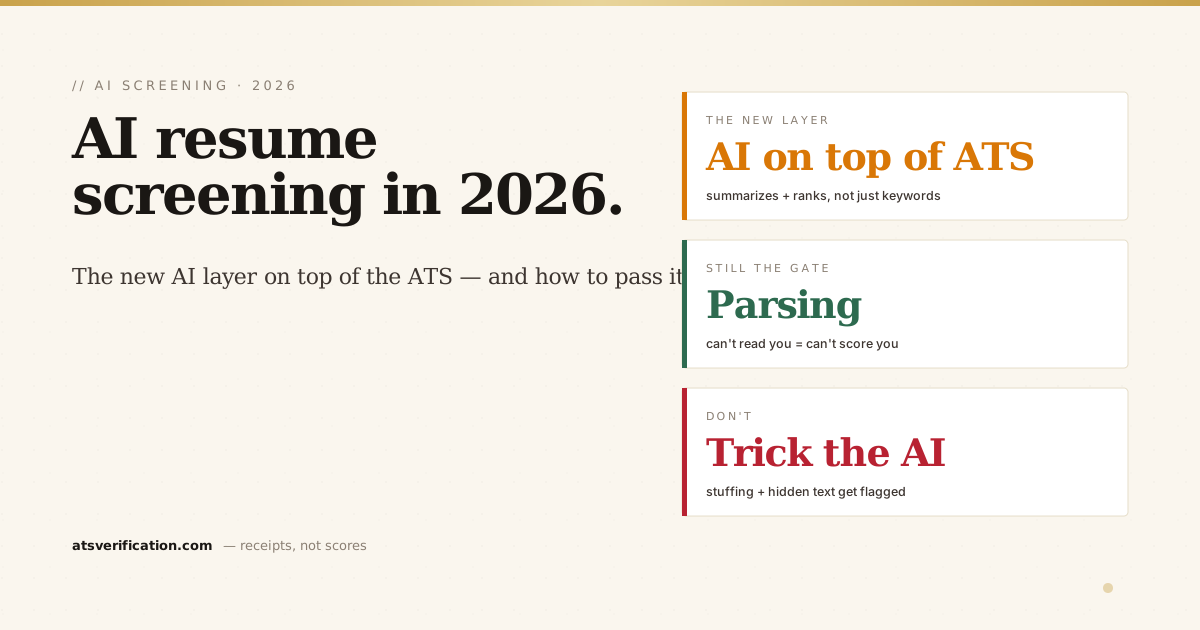
For twenty years the gatekeeper was the same: an applicant tracking system that parsed your resume into fields and matched it against keywords. In 2026 a second gatekeeper has arrived, AI that reads, summarizes and ranks candidates on top of that old keyword layer. Here's what "AI resume screening" actually is this year, what's marketing hype, and exactly how to make your resume pass both machines.
- There are now two machines, not one. The classic ATS parser and keyword match still run first; a newer AI/LLM layer increasingly summarizes and ranks the candidates that survive it.
- Most "AI screening" is still keyword and rules. True large-language-model screening is spreading fast but is not universal. Be skeptical of vendors who imply a sentient AI reads every resume.
- Parsing is still the gate. If the software can't extract your text cleanly, neither the keyword filter nor the AI can evaluate you. A broken layout fails you before any AI sees a word.
- AI rewards meaning, not keyword stuffing. Semantic matching understands synonyms, so clear, specific, factual writing beats cramming exact phrases. Stuffing and hidden text now get flagged, not rewarded.
- A human still decides. AI shortlists and summarizes; it rarely makes the final call. Write for the parser, the AI, and the recruiter who reads the top of the pile.
What "AI resume screening" actually means in 2026
"AI screening" is used loosely, so let's be precise. In most 2026 hiring pipelines there are two distinct layers:
- The classic ATS layer (still the backbone). Your file is parsed into structured fields, name, contact, titles, dates, skills, and matched against the job description's keywords. This is the same mechanism we break down in how ATS scoring actually works, and it still does most of the filtering.
- The AI layer (the new part). On top of parsing, a growing number of platforms run a large-language-model step that summarizes each resume, scores it against the role in plain language, drafts recruiter notes, or clusters similar candidates. Workday, Greenhouse and newer tools like Ashby have all shipped AI features along these lines.
The honest picture: the AI layer is spreading quickly but is not universal, and a lot of what gets marketed as "AI" is still rules and keyword logic with a friendlier label. Industry bodies like SHRM report rising adoption of AI in recruiting, while regulators including the U.S. EEOC have opened initiatives on algorithmic fairness in hiring, which is precisely why responsible employers keep a human in the loop rather than letting an AI auto-reject. Treat "AI screening" as a real and growing layer, not a magic judge.
How the AI screening pipeline works
When you click submit on a role at a large employer in 2026, your resume typically moves through this sequence:
- Parse. The system extracts plain text and structure from your PDF or DOCX. Tables, columns and graphics can scramble here, the failure modes are catalogued in the 10 most common ATS parsing failures.
- Knockout filter. Screening questions (work authorization, minimum years, location) remove anyone who fails the basics, before a resume is read at all. This is still the biggest silent cut, as we cover in how recruiters actually sort candidates.
- Keyword and skills match. The parsed text is scored against the job description's must-have skills and titles.
- AI summarize and rank (where enabled). An LLM reads the parsed text, writes a short summary of your fit, and may assign a plain-language score or rationale the recruiter sees.
- Recruiter review. A human opens the shortlist, usually surfaced via search and the AI summary, and decides who advances.
Notice that the AI step sits in the middle, not at the door. It works on the text that the parser already extracted. That ordering is the single most important thing to understand, and it leads straight to the next point.
What AI actually changes for your resume, and what it doesn't
| What changed with AI | What stayed the same |
|---|---|
| Semantic matching: AI understands that "P&L ownership" and "managed budget" are related, so exact-phrase matching matters a little less. | Parsing is still the gate. If the AI can't read your text, it can't evaluate the meaning. |
| Summarization: AI compresses your resume into a few lines the recruiter sees first. Clear, factual bullets summarize accurately; vague ones summarize into mush. | Quantified results still win. A measurable outcome is as persuasive to an AI summary as to a human skim. |
| Plain-language scoring: some tools output a written rationale, not just a number. | A human makes the final decision. The AI shortlists; it rarely hires or rejects on its own. |
The practical upshot: AI rewards resumes that are clear, specific and machine-readable, which is exactly what a good human reader rewards too. The era of gaming a dumb keyword counter is ending, not intensifying.
Three myths about AI resume screening
Myth 1: "AI rejects most resumes in seconds." The fast rejections people experience are overwhelmingly caused by knockout questions and parsing failures, not an AI passing judgment. An AI that summarizes your resume can only do so once the parser has read it.
Myth 2: "You need to trick the AI with hidden keywords or white text." This is the most damaging myth in 2026. Stuffing invisible keywords or repeating terms to spike a score is now actively detected and can flag your application as manipulative. The research on healthy keyword levels is in resume keyword density: how much is too much, the safe move is to mirror the job's real language, covered in tailoring your resume to the job description without stuffing.
Myth 3: "If I write with AI, the AI screener will reject me." Screeners are not reliable AI-text detectors, and most employers do not run detection on resumes. The real risk with AI-written resumes is generic, samey bullets a human spots in five seconds, we tested this across platforms in does a ChatGPT resume trigger ATS flags.
How to pass AI resume screening
Everything above collapses into five moves:
- Make sure it parses. Single column, standard headings (Experience, Education, Skills), no tables or text boxes, a real text-based PDF or DOCX. If the parser garbles you, the AI never gets a clean read. Start from the rules in our ATS-friendly resume format guide.
- Mirror the job's real language. Use the posting's actual skills and titles, and their natural synonyms, in your summary, titles and skills section. Semantic AI rewards genuine overlap, not repetition.
- Lead with quantified, factual outcomes. Numbers and concrete results summarize cleanly for both the AI and the recruiter. Vague duty-lists summarize into nothing memorable.
- Don't try to trick it. No invisible text, no keyword walls, no fake titles. Modern systems flag manipulation, and a human still reads the finalists.
- Verify before you apply. The only way to know how a machine reads you is to look at the extracted text. Run a free scan and confirm your name, titles, dates and skills come out correctly.
The one thing AI hasn't changed
For all the talk of AI, the gate is still the same: can the machine read your resume at all? A two-column template, a name rendered as a graphic, or a skills grid built as a table will fail the parser, and a resume the parser can't read is invisible to every layer that comes after it, AI included. If you only do one thing, make your resume readable. The deeper explainer on this is what an ATS is and how it reads your resume.
AI screening doesn't reward tricks. It rewards a resume that is clear, specific and machine-readable, which is the resume a human wants to read anyway.
See what the machine reads from your resume
Before your next application, check the layer every AI screener depends on. Run a free scan and see exactly what gets extracted from your resume, name, titles, dates, skills, field by field, with no invented match score attached.
→ Free ATS scan, see your resume the way an AI screener's parser sees it