In the UAE, more roles are filled through LinkedIn than through any job board, recruiters and agencies search it proactively, and a warm referral routinely jumps you past hundreds of portal applications. But most job seekers use LinkedIn passively: a thin profile and a "please help me find a job" mass-message that gets ignored. This is the active version, how to be found, who to reach, and the exact messages that get replies. It's the deep-dive companion to our how to find a job in the UAE guide.
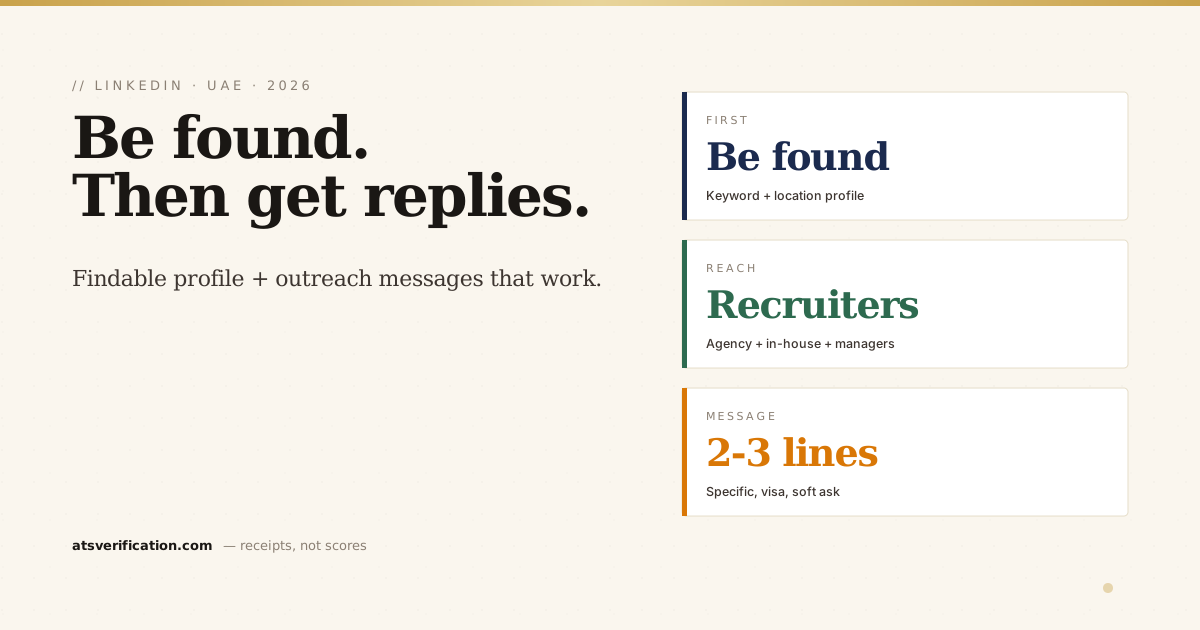
- Be findable first. A keyword + location headline, UAE location, and "Open to Work" enabled get you surfaced in recruiter searches before you message anyone.
- Target recruiters and hiring managers, including agency recruiters (Michael Page, Hays, Robert Half, Cooper Fitch, Charterhouse), who place a large share of UAE professional roles.
- Short, specific, no-ask-on-first-contact messages outperform long pitches. Two or three lines, one clear point.
- Warm before you ask, engage with someone's posts for a week before the DM, so you're a familiar name, not a cold stranger.
- LinkedIn search is keyword-matched like an ATS, the vocabulary in your profile is what determines whether recruiters find you at all.
Step 1: Make your profile a magnet, not a wall
Before any outreach, fix the profile, because LinkedIn's recruiter search ranks profiles by keyword relevance, much like an ATS ranks resumes (a parallel we explain in how ATS scoring works). If your profile doesn't contain the words recruiters search, you're invisible regardless of how good you are.
- Headline: role + specialty + location. "Financial Analyst | FP&A & Budgeting | Dubai" beats "Hardworking professional seeking opportunities." Recruiters search by title and city.
- Location: set to United Arab Emirates (or "Open to relocating to UAE"). Recruiters filter on it hard.
- About + Experience: write in the vocabulary of the roles you want, the same keywords that appear in the job descriptions. This is what surfaces you in search.
- "Open to Work": on. Recruiters-only mode if you're employed; the public green frame if you're not and want maximum visibility.
- Photo + banner: a clean professional headshot. In the relationship-driven Gulf market, a real face matters.
Step 2: Connect with the right people
Don't mass-connect. Build a focused network of people who actually influence hiring:
- Agency recruiters in your field, they place a huge share of UAE professional roles and are paid to find candidates. Connecting with them is genuinely welcome.
- In-house recruiters and talent-acquisition staff at your target companies.
- Hiring managers in your function (e.g. Finance Directors if you're in finance).
- People already in the role you want at target companies, they can refer you internally.
Step 3: The messages that actually get replies
The rules: keep it short, be specific, lead with relevance, and don't dump your life story or ask for a job in the first message. Copy and adapt these:
Connection request to a recruiter
"Hi [Name], I'm a [role] with [X] years in [sector], based in Dubai and exploring new opportunities. I see you recruit in this space and would value being connected."
Follow-up after they accept (the soft ask)
"Thanks for connecting, [Name]. Quick context: I'm a [role] specialising in [1–2 specialties], UAE residence visa, available [immediately / 30 days]. If anything in [their sector] comes across your desk that fits, I'd love to be considered, happy to send my CV. Either way, glad to be connected."
Reaching a hiring manager about a specific role
"Hi [Name], I applied for the [role] on your team and wanted to introduce myself directly. I've [one specific, relevant achievement with a number]. I'd welcome the chance to share why I think I'd be a strong fit. Thank you for considering."
Asking someone in your target company for a referral
"Hi [Name], I'm applying for [role] at [company] and saw you're on the [team]. Would you be open to a quick 10-minute call about what it's like there? And if it feels like a fit after, I'd be grateful for a referral. No pressure either way."
Why these work: they're short, they state your visa/availability (what UAE recruiters filter on), they give one concrete reason to reply, and they don't demand anything heavy upfront. The number in the hiring-manager message is doing the heavy lifting, quantified proof, the same principle as quantified resume bullets.
Step 4: Warm the relationship before the ask
The single biggest upgrade to reply rates: engage before you message. For a week or two, leave genuine, substantive comments on the posts of the recruiters and companies you're targeting. By the time your connection request or DM lands, you're a name they recognize, not a cold stranger. In the Gulf's relationship-first culture, this matters more than almost anywhere.
The mistake that wastes all of this
You can network perfectly and still lose, if the CV you send when a recruiter says "share your CV" doesn't survive their company's ATS. The big UAE employers run Workday, SuccessFactors, and Taleo; a beautifully designed CV that scrambles in the parser turns your hard-won referral into a blank profile. Before you start outreach, run a free scan so the CV you send actually reads cleanly. (Format specifics for the UAE are in our Dubai/UAE resume format guide; the full search playbook is in how to find a job in the UAE.)
For the broader rules and "Open to Work" mechanics, LinkedIn's own Jobs platform is the place to set preferences; and UAE labour and visa procedures are governed by MOHRE.
Networking from outside the UAE? Pair this with how to apply for Dubai jobs from abroad, the header lines and channels that make an overseas application competitive.
→ Free ATS scan, make sure the CV you send after networking actually parses