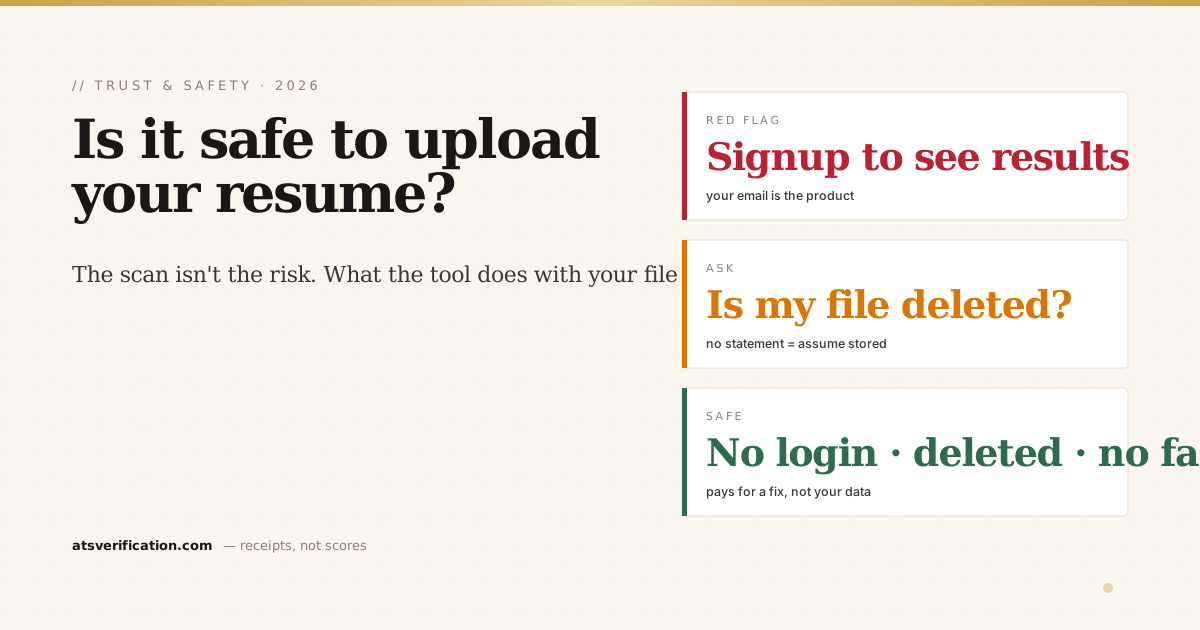
A resume is one of the most personal documents you own. It has your full name, your phone number, often your home address, your entire career history, and a direct line to your professional identity. So the instinct to pause before uploading it to some website you just found is a good one. Here's the honest answer to whether it's safe, what a trustworthy resume checker does with your file, the red flags that should stop you, and how to tell the difference in under a minute.
- Uploading isn't automatically risky, but the tool's data practices decide. Two checkers can do the same scan; one deletes your file in seconds, the other stores it and monetizes your email.
- The biggest red flag is being forced to hand over your email or create an account just to see your results. That's a lead-capture funnel, not a resume tool.
- Watch what happens to the file. Trustworthy tools parse in memory and delete promptly; sketchy ones keep it, and your resume becomes their data asset.
- A tool that fakes a "match score" is already being dishonest with you, a small but telling sign of how it treats you elsewhere (more in are ATS checkers accurate).
- You don't have to upload at all to get a first read. The copy-paste test checks the basics with zero data leaving your computer.
What "safe" actually means here
Safety isn't about whether a website can read your resume, any scanner has to read the file to check it (see what an ATS is and how it reads your resume). Safety is about what happens after: does the tool keep your file, harvest your contact details, sell or share your data, or hold your results hostage behind a signup? Those are the real risks, and they vary enormously between tools that otherwise look identical.
The red flags that should stop you
- It demands your email or an account before showing results. This is the most common one. If a "free scan" makes you sign up to see what it found, the product isn't the scan, it's your email address, and your resume was the bait.
- No clear statement about your file being deleted. If a tool won't tell you plainly that it doesn't store your resume, assume it does. Your document sitting on someone's server indefinitely is exactly what you don't want.
- Vague or missing privacy terms. A trustworthy tool tells you, in plain language, what it does with your data. Walls of legalese that reserve the right to "share with partners" are a warning.
- It invents a precise "match score." No real applicant tracking system outputs a 0–100 score, a tool that fabricates one is willing to mislead you for effect. That says something about the rest of it.
- Aggressive upsells the moment you upload. Manufactured urgency ("47 critical errors, upgrade now!") is a sales tactic, not a diagnosis.
What a trustworthy checker looks like
- Results without a signup. You see what it found immediately, no email wall, no account.
- Your file is parsed in memory and deleted quickly, and the tool says so clearly.
- No invented score. It shows you real, verifiable output, the actual text extracted from your file, not a number it made up.
- Plain-language data terms you can actually read, and no reselling of your information.
- It sells you a fix, not your data. If there's a paid tier, you're paying for a better resume, not "unlocking" what should have been free.
That last point matters: a business model built on charging a fair price for a real service is far safer than a "free" tool that quietly monetizes the people who use it. In the US, you can also check whether a service honors its stated privacy commitments, the FTC's guidance on privacy and security is a useful baseline for what responsible data handling looks like.
The zero-upload option
If you're still uneasy, you don't have to upload anything to get a first read. The copy-paste test, open your resume, select all, copy, paste into Notepad, shows you roughly what a parser extracts, with no file ever leaving your computer. It won't catch everything, but it's a genuinely private way to check whether your resume is fundamentally readable.
Where we stand
We built ATS Verification to be the version of this that we'd trust with our own resumes: no login, no account, your file parsed in memory and never stored, and no invented match score, just the actual text an ATS reads. We charge for the paid rebuild, not for your data or your email. You can read how we compare on these criteria in the best ATS resume checkers. Whether you use us or not, the checklist above travels with you: judge any resume tool by what it does with your file and whether it tells you the truth. Our own answers to that checklist, including the failure data we publish live and the reason there is no score, are set out in why we publish our parsing data live.