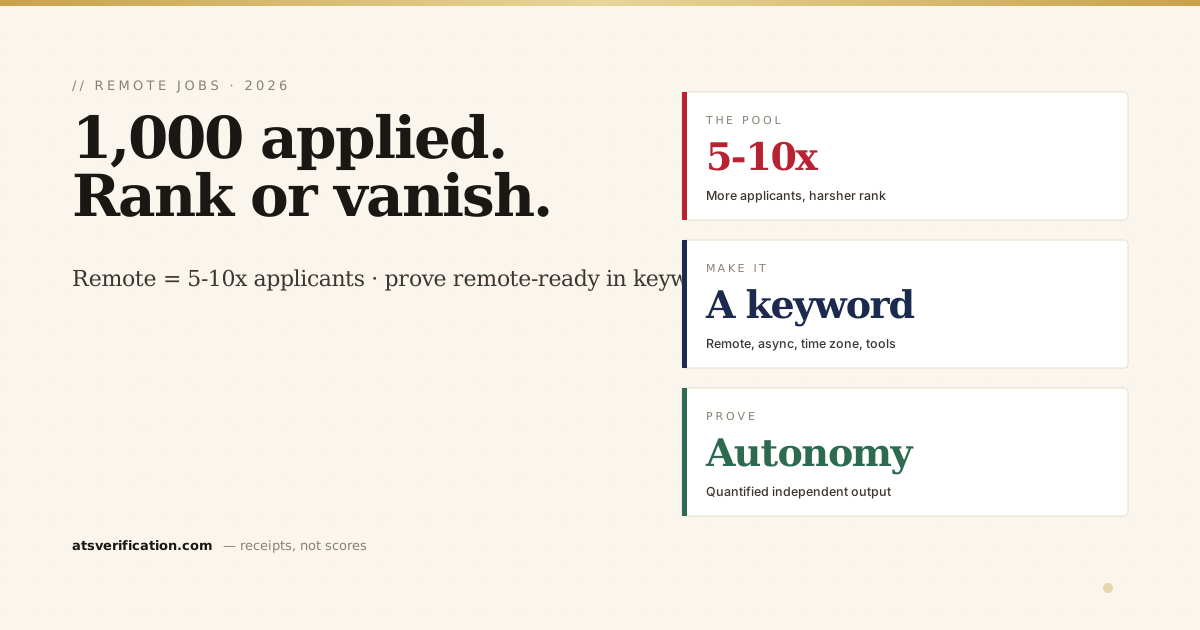
A remote job posting routinely pulls 5–10 times the applicants of an equivalent on-site role. That single fact changes everything about your resume strategy: the ATS isn't just checking whether you qualify, it's ranking you against a far larger pool, and only the top slice ever reaches a human. To survive that, your resume has to prove two things the parser can read: you can do the job, and you can do it remotely. Most remote applicants only prove the first.
- Remote = more applicants = harsher ranking. Parsing cleanly isn't enough; you need strong keyword density and explicit remote signals to rank in the top slice.
- Name remote work as a skill, not just a circumstance. "Remote," "distributed team," "async collaboration," "Slack/Zoom/Notion" are keywords filters and recruiters scan for.
- Show remote in your work history, label past remote roles "(Remote)" next to the location so the parser captures it as real experience.
- Handle location and time zone deliberately. "Remote (US, EST)" or "Remote, overlaps US/EU hours" pre-answers the recruiter's first filter.
- Self-management proof beats soft-skill clichés. Quantified output (shipped, owned, delivered independently) signals you don't need supervision.
Why remote resumes get filtered harder
When a role opens to "anywhere," the applicant pool explodes, and the ATS responds by ranking everyone and surfacing only the top candidates to the recruiter (the ranking phase of how ATS scoring works). For an on-site role with 80 applicants, a decent keyword match might land you in the reviewed pile. For a remote role with 800, "decent" gets buried. You need to be unmistakably relevant and unmistakably remote-ready, in terms the parser can extract.
Treat "remote" as a keyword, not a wish
Most applicants write a normal resume and hope the recruiter infers remote-readiness. The ATS infers nothing, it matches text. Get these into your resume where they're true:
- The word "Remote" itself, and variants the posting uses: "distributed," "work from home," "virtual," "telework."
- Remote-collaboration tools: Slack, Zoom, Microsoft Teams, Notion, Asana, Jira, Loom, whatever the job description names.
- Async/remote competencies: "asynchronous communication," "cross-time-zone collaboration," "self-directed," "documentation-first."
Pull the exact phrasing from the posting itself, the method (without keyword stuffing) is in tailoring a resume to the job description.
Show remote in your actual history
If you've worked remotely before, make the parser see it. Label the location field of each role explicitly:
| Weak (remote invisible) | Strong (remote captured) |
|---|---|
| Product Manager, Acme Corp, Austin, TX | Product Manager, Acme Corp, Remote (US, CST) |
| Support Lead, Globex | Support Lead, Globex, Remote, distributed team across 6 time zones |
Now "Remote" is structured, parseable experience, not a hope. If you've never worked remote, surface remote-style proof instead: independently owned projects, freelance/contract work, cross-office collaboration.
Location and time zone: answer the first filter
"Remote" rarely means truly anywhere, most postings carry a hidden geography ("Remote, US," "Remote, EU time zones," "Remote within 3 hours of PST"). Recruiters filter on it hard, often before reading anything else. So state yours plainly near your contact line: "Remote · based in [City, Country] · overlaps US ET / EU hours." If the role is US-only and you're abroad, that's the work-authorization conversation, handle it in the application questions, and see the US resume format guide for the conventions. For remote-work trends and which occupations are most remote-friendly, the U.S. Occupational Outlook Handbook is a solid reference.
Prove you don't need supervision
The unspoken fear in remote hiring is "will this person actually work without someone watching?" You can't answer that with adjectives ("self-motivated," "great communicator", every resume says this). Answer it with quantified, independent output:
- "Independently shipped 3 product releases while fully remote, coordinating async across 5 time zones"
- "Owned the support queue for a distributed team, cutting first-response time 40% with documentation-first workflows"
Same quantified-bullet discipline as everywhere else (see the quantification guide), but chosen to demonstrate autonomy.
Keep it parseable, the volume makes format unforgiving
With hundreds of competitors, you cannot afford a parsing failure that drops your keyword score. Single column, standard headings, real text, no tables-as-layout, the full checklist is in the ATS-friendly format guide. A beautiful two-column "remote-creative" template that scrambles in the parser is how strong remote candidates quietly lose to weaker ones who formatted plainly.
Career changers chasing remote roles have a double translation to do, both the new field's keywords and the remote signals. Worth doing both deliberately.
Verify before you join the queue of 1,000
In a huge applicant pool, you get one parse and one ranking. Make them count: run a free scan and confirm the remote keywords, your "(Remote)" role labels, location/time-zone line, and tools all extract cleanly, then check your match against the specific posting before you apply.
→ Free ATS scan, make sure your remote-readiness is something the software can actually read