"Where I've Made an Impact" reads warmer than "Experience." "What I'm Good At" feels friendlier than "Skills." And both can quietly wreck how software reads your resume, because section headings aren't decoration to a parser, they're the map it uses to file your life into the right database fields. Here's the safe list, the swaps, and the test data behind them.
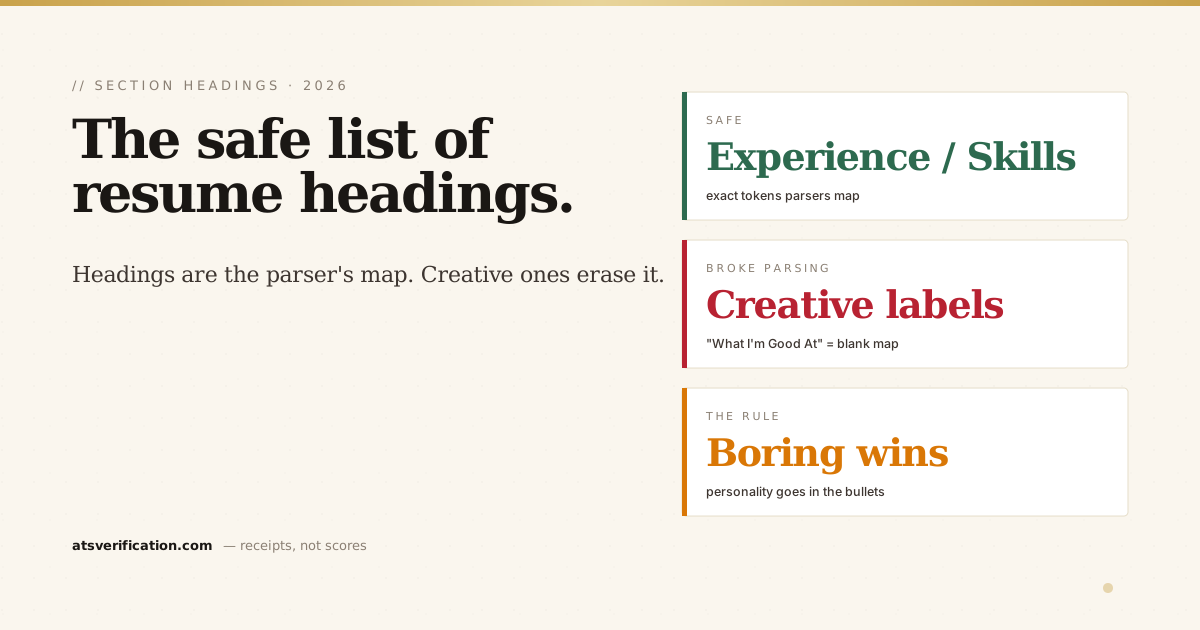
- Headings are field labels, not style choices. The parser matches your headings against known patterns to decide what's experience, what's education, and what's skills. An unrecognized heading means unrouted content.
- We tested it. In our 2026 parsing benchmark, the resume with creative headings ("A Little About Me," "Where I've Made an Impact") was flagged for missing standard sections and lost points, identical content, worse outcome.
- The safe core is four words: Summary, Experience, Education, Skills. Recognized variants exist, but these four route cleanly everywhere.
- Creativity belongs inside the sections, not on them. Your bullets can have personality; your headings are infrastructure.
- Formatting matters too: headings as real text (not images or text boxes), on their own line, consistently styled.
Why headings matter more than you think
When an ATS ingests your resume, it doesn't store the document, it builds a structured record: work history in one table, education in another, skills in a searchable list. To split your document into those buckets, the parser scans for section headings and matches them against pattern libraries (the mechanics are covered in what is an ATS and how ATS scoring works).
Match found → everything below it gets filed correctly. No match → the parser has to guess, and content can end up in the wrong field or in no field at all. Your three best achievements might live under a heading the software never identified, which means, in the recruiter's search results, they don't exist. Job seekers routinely blame keywords for this when the real culprit was the label above them.
What our test showed
In the 2026 ATS parsing benchmark we ran the identical resume through the same extraction-and-detector pipeline twice: once with standard headings, once with creative ones ("A Little About Me," "Where I've Made an Impact," "What I'm Good At," "Learning"). The standard version parsed at 100/A with zero issues. The creative version was flagged for missing standard section headers and dropped to 95/A, same words, same jobs, same skills, purely because the map was unreadable. On engines with stricter section-detection, the penalty compounds: unmapped sections can be skipped in keyword search entirely.
The safe list
| Section | Safest heading | Also recognized | Avoid |
|---|---|---|---|
| Opening pitch | Summary | Professional Summary, Profile | A Little About Me, My Story, Snapshot |
| Work history | Experience | Professional Experience, Work History, Employment History | Where I've Made an Impact, My Journey, Career Highlights Reel |
| Degrees | Education | Academic Background, Education & Qualifications | Learning, Where I Studied, Knowledge Base |
| Capabilities | Skills | Technical Skills, Core Competencies, Core Expertise | What I'm Good At, Toolbox, Superpowers |
| Credentials | Certifications | Licenses & Certifications | Badges, Achievements Unlocked |
| Side work | Projects | Selected Projects | Things I've Built, Passion Projects |
| Languages | Languages | — | Ways I Communicate |
Two useful references when tailoring content inside those sections: the skills vocabulary employers actually search for is catalogued by O*NET, and hiring-side practice around structured screening is tracked by SHRM, both are good sanity checks that your section contents match how recruiters actually filter.
Formatting rules for headings
- Real text, not graphics. A heading rendered as an image or inside a decorative text box may be invisible to extraction.
- Own line, consistent style. Bold, slightly larger, same treatment for every section, parsers also use visual consistency as a signal.
- No icons in the heading line. A 🎓 before "Education" can garble the token the pattern-matcher needs (icon bullets are a flagged failure pattern in their own right, see the most common parsing failures).
- Don't merge sections. "Education & Skills" as one heading forces a guess about everything under it. One section, one heading.
- Order still matters: Summary → Experience → Education → Skills is the expected map for experienced candidates (the reverse-chronological structure that parses best, see chronological vs functional vs combination).
The honest nuance
Standard headings won't rank you higher, they're not keywords, and they carry no scoring weight of their own. What they do is make sure everything underneath them lands in the right field so your actual keywords can score. Think of it this way: creative headings don't make you look interesting to the software, because the software has no sense of humor. Save the personality for your bullets, where a human will actually read it, ideally quantified, per quantified achievement bullets.
Check how your sections actually parsed
You don't have to guess whether your headings routed correctly. Run a free scan and see the extracted text with every detected section, if a section is missing from the parse, its heading is the first suspect. No signup, no invented match score.
→ Free ATS scan, see if your section headings route correctly