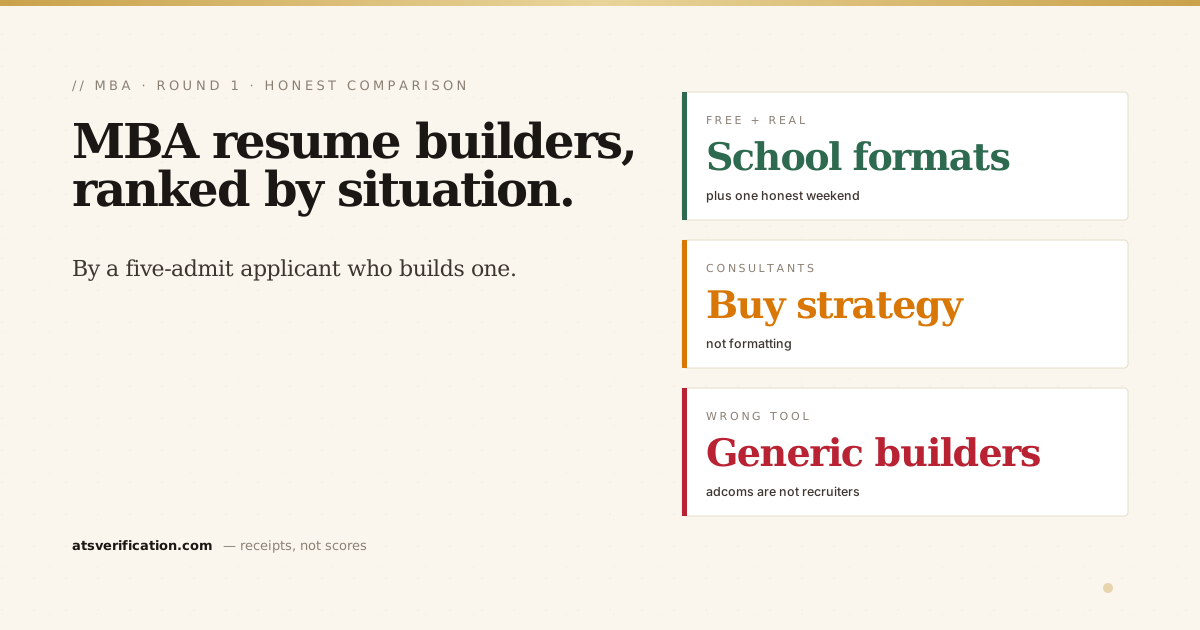
Two disclosures before we start. First, I make one of the tools in this comparison, so weigh everything here accordingly. Second, I have sat on your side of this: I applied to business schools myself, earned five admits across two cycles, and start my Executive MBA at London Business School this September. That process is why the tool exists, and it is also why I can tell you honestly when you should not pay for it.
- An MBA resume is not a job resume. One page, human-read, leadership-dense, jargon-free. Using your work resume is the most common Round 1 mistake.
- Generic resume builders are the wrong category for this document, whatever their templates look like. They build for recruiters and parsing software; adcoms are neither.
- The free option is legitimate: most target schools publish format guidance, and a careful applicant with time can DIY.
- Admissions consultants are the premium option and earn their fee on strategy, not formatting. If you hire one, hire them for positioning.
- Software sits in the middle: right when your content is strong and your format is wrong, which describes most self-prepared applications I have seen.
Why this document is its own category
An admissions committee reads your resume in about 90 seconds, on paper or PDF, with no software screening in between. That single fact inverts most resume advice. Keyword optimization is irrelevant, this is the one resume no ATS will ever read. Two pages is not thorough, it is a prioritization failure. Industry jargon does not impress, because the reader is not from your industry. What committees are reading for is trajectory and leadership: not what your job was, but what you did that somebody else in the same job would not have done. The full logic is in our MBA resume format guide, candidates arriving from ATS-heavy job searches should also read what to unlearn from ATS resumes, and the EMBA variant differs enough that it has its own guide.
Every option below should be judged against that standard: does it produce a one-page, adcom-format, leadership-dense document. Most things called "resume builders" do not even try.
Option 1: Your school's own guidance, free
Harvard, Stanford, Wharton, LBS and most top programs publish resume expectations, formats, or both, and admissions blogs like Stanford GSB's admission pages spell out what they want from the application. If you have the time and the writing ability, downloading your target school's format and rewriting your resume into it over a weekend is a legitimate, complete answer, and it costs nothing.
The honest catch: the format is the easy half. The hard half is converting "Regional Finance Manager, duties included reporting" into the leadership evidence adcoms actually read for, and doing it inside one page. That editing judgment is what every paid option below is really selling, and if you want to see it applied line by line before deciding, our MBA resume examples rewrite nine bullets before and after.
Option 2: Generic resume builders, the wrong tool
Resume.io, Kickresume, Zety and the rest are built for job applications: recruiter-facing templates, ATS keyword features, two-page defaults, visual flourishes. Fine products for their actual purpose. But none of that maps to an adcom document, and some of it actively hurts, a designed two-column template reads as noise to a committee that sees thousands of clean one-pagers from consultants' clients. If you already subscribe to one, use it for your job search, not your application.
Option 3: Admissions consultants, the premium option
Full-service admissions consulting typically runs to thousands of dollars per school, with the resume included as one deliverable among essays, strategy and interview prep. For candidates with complicated stories or aiming at ultra-selective programs, good consultants genuinely earn it, and resources like mba.com can help you understand the application landscape before deciding whether you need one.
My honest take from having been an applicant: the consultant's value concentrates in positioning and essays. The resume work is real but mechanical, and paying consultant rates for formatting alone is buying a first-class seat for a one-stop flight. If budget forces a choice, spend consultant money on strategy and handle the resume with option 1 or 4.
Option 4: MBA-specific software, where ours sits
Our MBA & EMBA Resume Builder does one narrow thing: it takes your existing resume, asks five questions about your target round, leadership moments and goals, and rebuilds the document into a one-page, school-specific format for HBS, Stanford GSB or LBS, delivered as an editable Word file in about a minute. It costs $29 for one school format, $69 for any three, one time, no subscription.
Where it is the right choice: your experience is genuinely strong, your current resume is a two-page job document, and the deadline is close. That combination describes most self-prepared Round 1 applications, and it is exactly the gap between option 1 (free but slow) and option 3 (thorough but expensive).
Where it is honestly the wrong choice: if your underlying story needs strategy, a career gap to position, a pivot to explain, an unconventional background to frame, software formats what you have, it does not rethink it. That is consultant work. And if you have a free weekend and enjoy writing, option 1 makes us unnecessary, which I can afford to say because the people who do buy tend to be three weeks from a deadline.
The comparison in one table
Judge each option on the three things that matter: does it produce the adcom format, does it improve the content, and what does it cost.
- School guidance + DIY: format yes, content only as good as your own editing, free, needs a weekend and honest self-assessment.
- Generic builders: format no, content no, subscription pricing for the wrong document entirely.
- Admissions consultants: format yes, content and strategy yes, thousands of dollars, weeks of lead time, the right call for complicated stories.
- MBA-specific software (ours): format yes, content restructured from your real material with your approval, $29 to $69 once, minutes, the right call when the story is strong and the document is not.
Whichever you choose, avoid these
The mistakes committees see every cycle, from our own users and my own applicant experience: submitting the two-page work resume unchanged. Bullets that describe duties instead of outcomes, the fix for which is the same verb-plus-number discipline as any resume, covered in quantifying achievements. Jargon your reader will not know. GPA and test scores missing when the school expects them on the resume. And spending forty hours on essays while the document half the committee opens first gets one evening. The resume is not the deciding document, but it is the first impression, and first impressions are cheap to get right.
If you are applying this Round 1: the essays deserve your weeks. The resume deserves one honest weekend, or one honest tool, and the verified September deadlines with a week-by-week finishing plan are in our Round 1 deadline guide. Good luck this cycle, genuinely, it is a strange and worthwhile process.