Every MBA resume guide, including ours, tells you the rules: one page, outcomes not duties, leadership evidence, no jargon. Almost none of them show you what a bullet looks like before and after those rules are applied, which is the only part that actually helps at 11pm with a deadline nineteen days out. So this post is examples. I applied across two cycles, finished with five admits, start my Executive MBA at London Business School next month, and now build a tool that does this conversion, so I have seen hundreds of these rewrites. The examples below are composites modelled on real resumes I have reviewed, with details changed. The patterns are exact.
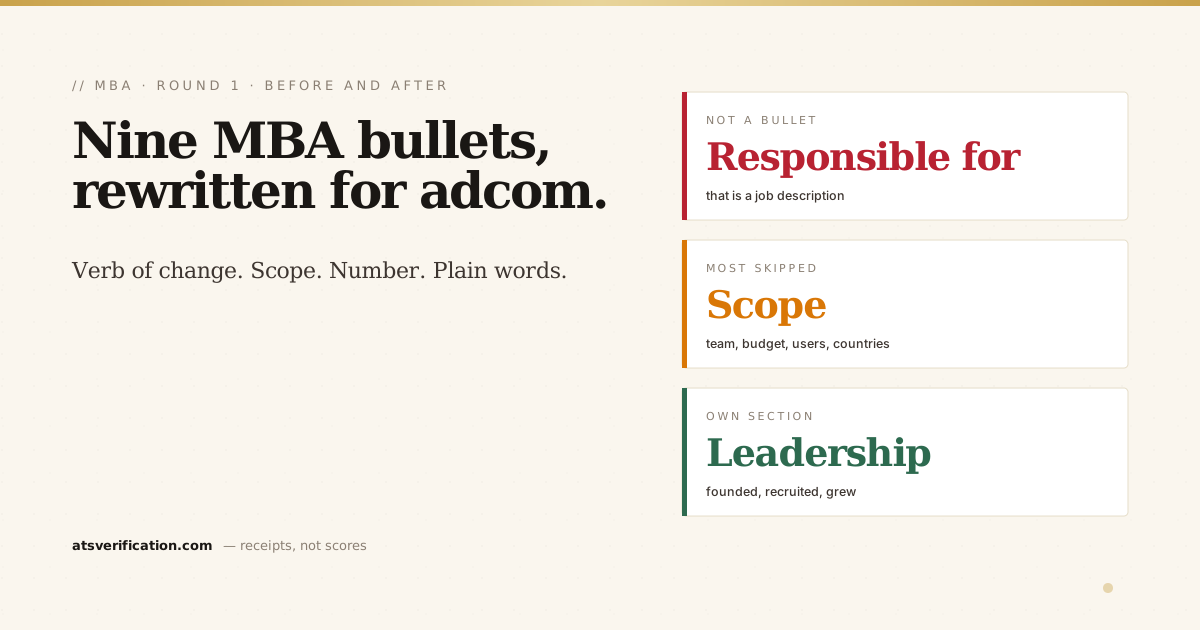
- Every strong MBA bullet has the same skeleton: action verb, the thing you changed, the scale it happened at, the number that proves it. Duties are not bullets.
- Translate, never transcribe: your industry's vocabulary is invisible to a reader from another industry. "Re-papered the ISDA" becomes "renegotiated the bank's derivatives contracts".
- Leadership is a separate section, not a vibe. HBS in particular weighs it heavily. If you led anything outside work, it gets its own lines.
- The one-page skeleton is fixed: header, education, experience, leadership and community, additional. In that order, with education on top for most applicants.
- Scope is the most skipped ingredient. Team size, budget, markets, volume. Two candidates with identical titles are separated almost entirely by scope.
The one-page skeleton
Before the bullets, the frame they sit in. Admissions readers see a few thousand resumes a cycle and expect this order, so deviating costs you the reader's attention for no gain:
- Header: name, city, email, phone, LinkedIn. No photo, no objective statement, no summary paragraph. Your essays are the summary.
- Education: degree, institution, year, GPA or classification if strong, honours, relevant professional qualifications (ACCA, CFA, PE). For most applicants this sits above experience, because adcoms read it first to calibrate everything below.
- Experience: reverse chronological, three to five bullets for recent roles, one or two for older ones, company described in a half-line if it is not a household name ("a 400-person industrial services firm").
- Leadership and community: the section most job resumes do not have and most MBA resumes under-use. Anything you led or built outside your job description.
- Additional: languages, test scores if the school wants them here, one line of genuinely interesting interests. Not "reading and travelling".
Nine bullets, before and after
Each pair shows a typical job-resume bullet and its MBA rewrite. Watch for four moves repeating: a verb that describes a change, the scope it happened at, a number, and plain language a reader from any industry can follow.
Finance
Before: "Responsible for month-end close and reporting across multiple legal entities."
After: "Led month-end close for 3 legal entities with a 7-person team; cut the close from 12 days to 6 by re-sequencing reconciliations, and restored the loss-making Qatar entity to break-even within 9 months."
The before is a job description. The after has a team (scope), a number that moved (12 to 6), a method (re-sequencing), and a business outcome (break-even) that a reader from tech or healthcare understands instantly.
Before: "Managed banking relationships and treasury operations."
After: "Renegotiated working-capital facilities with 4 banks, releasing $6M of headroom and cutting financing cost by 90 basis points, the first rate reduction the group had secured in 5 years."
Consulting
Before: "Worked on a cost transformation engagement for a retail client."
After: "Identified $14M of annual savings for a 220-store grocery chain by rebuilding its store-labour model; led the 3-person workstream and presented weekly to the client's COO, who adopted 11 of 12 recommendations."
Note "who adopted 11 of 12 recommendations". Consulting bullets often stop at the recommendation. Adcoms want to know whether anything happened.
Before: "Supported business development and proposal writing."
After: "Authored the commercial sections of 6 proposals worth $9M combined; 4 won, including the firm's first public-sector client in the region."
Technology
Before: "Developed features for the payments platform using Java and Kafka."
After: "Shipped the fraud-screening service for a payments platform processing 2M transactions a day; reduced false declines by 18%, recovering an estimated $3M in annual revenue, and mentored 2 junior engineers who were both promoted within the year."
"Java and Kafka" is gone. The reader does not care and the words cost you a line. "Mentored 2 junior engineers, both promoted" is the leadership evidence a technical bullet usually forgets to include.
Before: "Product manager for the mobile app."
After: "Owned the roadmap for a mobile app with 1.4M monthly users; launched in-app subscriptions that reached $2.1M annual run-rate in 10 months, working across 3 engineering teams in 2 countries."
Engineering and operations
Before: "Oversaw plant maintenance and safety compliance."
After: "Managed maintenance for a 300-person manufacturing plant with a $4M annual budget; introduced predictive maintenance that cut unplanned downtime 31% and delivered 600 days without a lost-time injury, the site's longest run."
Before: "Handled logistics and vendor management for the supply chain team."
After: "Consolidated 23 freight vendors to 6 across 4 countries, saving $1.8M annually, and led the 8-person team through the transition without a missed delivery."
Leadership and community
Before: "Volunteer, local nonprofit."
After: "Co-founded a weekend financial-literacy programme for low-income workers; recruited 12 volunteer tutors and grew it from 15 to 180 participants across 3 sites in 2 years."
This is the section where most applicants leave the most value on the table. "Volunteer" tells the reader nothing. Founding, recruiting, growing, those are the verbs committees are scanning for, and the numbers make them real. Leadership outside work is also the bullet type that differs most between a job resume and an MBA resume, the full logic of that difference is in what MBA candidates should unlearn from ATS resumes.
What the rewrites have in common
Go back through the nine and count: every "after" has at least two numbers, names the scale (team, budget, users, stores, countries), uses a verb of change (led, cut, renegotiated, shipped, consolidated, founded) rather than a verb of existence (responsible for, handled, supported, worked on), and contains no word that needs your industry to decode. That discipline is the same one we teach for any resume in quantifying achievements; the MBA version just applies it harder and adds the leadership lens.
School-specific emphasis, briefly: HBS weighs the leadership and community section heavily, so give it real space. Stanford GSB reads for trajectory and for what you did that someone else in the same seat would not have, so the "first in 5 years" and "site's longest run" details matter. LBS and the European schools read for international scope, so countries and cross-border teams earn their words. Research the expectations of your own targets on their pages, mba.com is the neutral starting point, and tune the emphasis, not the format.
Doing this in the time you have
Converting a two-page job resume into this format is one honest weekend of work if you do it yourself, and the verified Round 1 dates with a week-by-week plan are in our 2026 deadline guide. If you would rather buy the weekend back, this exact conversion, your real material restructured into one-page school-specific format with your approval on every bullet, is what our MBA resume builder does, and our comparison is honest about when the free route is the better choice. Either way, the examples above are the standard to hold the result to: two numbers per bullet, scope named, no jargon, leadership with its own section. Good luck this round.