A large share of professional roles in the UAE never hit a job board, they're filled by recruitment agencies working a brief for the employer. Get onto the right agency's radar and you tap a hidden stream of jobs; misunderstand how agencies work and you waste weeks (or fall for a scam). Here's how to use them properly. It pairs with our how to find a job in the UAE guide and the LinkedIn networking playbook.
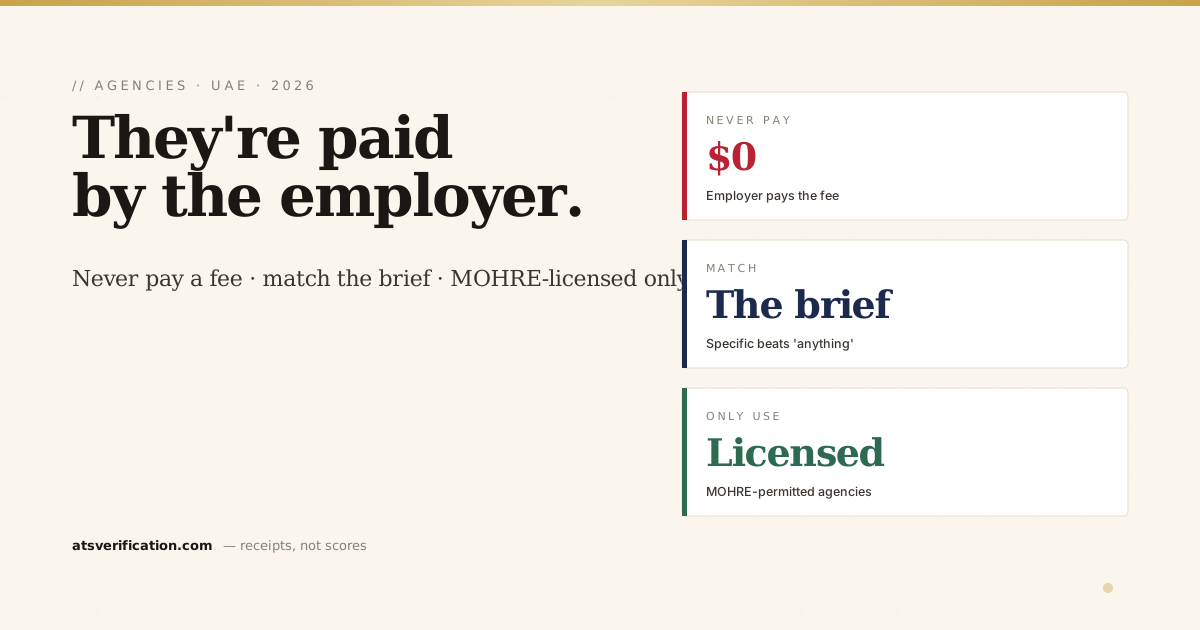
- Agencies are paid by employers, not you. A legitimate UAE agency never charges a job seeker a placement fee, being asked for money is a red flag to walk away.
- They work to a brief. A recruiter submits you only if you match an open role's spec closely, so being specific and relevant beats being broadly "open to anything."
- The big firms (Michael Page, Hays, Robert Half, Cooper Fitch, Charterhouse, Nadia, BAC) cover most professional sectors; specialist boutiques cover niches.
- Get on the radar via LinkedIn + a clean, parseable CV in their database, recruiters search those databases the same keyword way an ATS does.
- Licensed agencies only. UAE recruitment agencies must hold a MOHRE labour-recruitment permit; unlicensed "agents" charging fees are operating illegally.
How UAE recruitment agencies actually work
An employer hires an agency to fill a role and pays the agency a fee (typically a percentage of the salary) when a candidate is placed. That single fact explains everything about how to work with them:
- Their client is the employer, not you. They're motivated to put forward candidates who fit the brief tightly, because that's what gets them paid. They are not a careers-counselling service.
- You should never pay them. In the UAE, charging a job seeker for placement is prohibited, recruitment agencies must be licensed by the Ministry of Human Resources & Emiratisation (MOHRE), and a licensed agency's fee comes from the employer. Anyone asking you for a "registration," "visa processing," or "placement" fee is a red flag, walk away.
- They move on the employer's timeline. Silence usually means there's no matching brief right now, not that you've been rejected. Stay on the radar without pestering.
The major UAE recruitment agencies
| Type | Firms & focus |
|---|---|
| Global multi-sector | Michael Page, Hays, Robert Half, Robert Walters, finance, tech, sales, HR, professional services |
| Strong regional | Cooper Fitch, Charterhouse, Nadia, BAC Middle East, broad UAE coverage, deep local networks |
| Executive search | Korn Ferry, Heidrick & Struggles, senior/C-suite (these find you; you rarely approach them) |
| Specialist boutiques | Sector-specific firms in construction, healthcare, legal, hospitality, oil & gas |
Match the agency to your field. A specialist construction recruiter will do more for a quantity surveyor than a generalist will, and an executive-search firm won't engage a mid-level candidate.
How to get on a recruiter's radar
- Connect on LinkedIn with recruiters in your sector and send a short, specific note (templates in the LinkedIn networking guide). This is faster and warmer than a form on the agency website.
- Register on the agency site and upload your CV so you're in their searchable database. Recruiters search that database by keyword, so your CV needs the right terms and must parse cleanly.
- Be specific about what you want, title, salary range, sector, visa status, availability. "I'm open to anything" makes you hard to place; "Senior FP&A Analyst, AED 25–30k, available in 30 days, transferable visa" makes you easy to slot against a brief.
- Build a relationship with 2–3 recruiters, not 30. A recruiter who knows you well advocates for you; a name in a database does not.
Working with them well
- Be responsive and honest about other processes you're in, recruiters manage timelines with the employer and hate surprises.
- Take their feedback, they know what the client wants and their CV/interview tips are usually worth following.
- Don't let multiple agencies submit you to the same employer, it creates ownership disputes and can get you withdrawn from the process entirely. Track who's sent you where.
- Stay warm between roles, a quick check-in every few weeks keeps you top of mind when a matching brief lands.
The CV the recruiter actually forwards
Here's the part candidates miss: a recruiter doesn't just talk to the employer, they upload your CV into the employer's ATS, or the employer pulls it through theirs. So even an agency-submitted CV gets parsed and keyword-scored (the mechanics are in how ATS scoring works). If your CV is a two-column "designer" template that scrambles in the parser, you can undermine your own referral. Give your recruiter a clean, ATS-safe CV, run a free scan first to confirm it parses, and follow the UAE resume format rules.
If your direct applications are going silent too, the full diagnostic, all seven silent filters, is in why UAE applications get no response.
→ Free ATS scan, give your recruiter a CV that parses cleanly into the employer's system