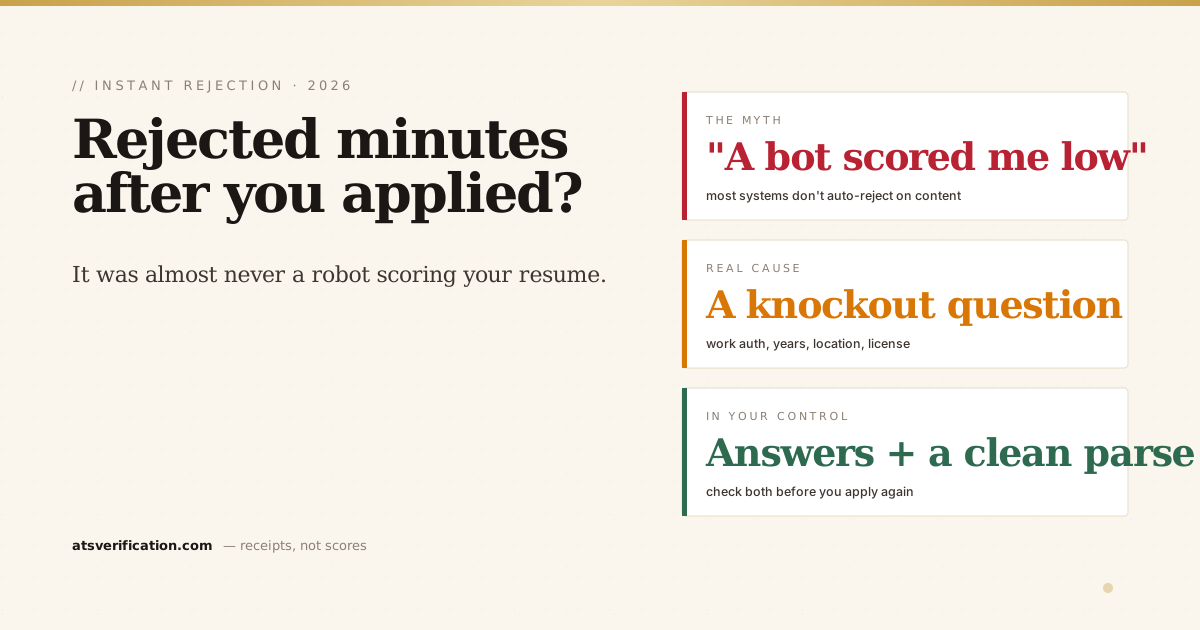
You hit submit. Ten minutes later, sometimes ten seconds later, the email lands: "we've decided to move forward with other candidates." Nobody could have read your resume that fast. So what rejected you? The honest answer surprises most people, and it's good news: in almost every case it was not a robot scoring your resume and deciding you weren't good enough. It was something much more mechanical, and much easier to fix once you know what it is.
- An instant rejection is almost never a resume "score." Most systems don't auto-reject on resume content at all, the myth of a robot rating you 40/100 and binning you is just that, a myth.
- The usual cause is a knockout question, an answer you gave in the application form (work authorization, years of experience, location, a required license) that auto-disqualified you instantly.
- The second cause is a bad parse. If the software couldn't read your file, some systems flag the application as incomplete or empty.
- The third is timing and volume, the role was already filled, the posting closed, or rejections went out in a scheduled batch.
- You can check the two things in your control, your knockout answers and whether your resume parses, before you ever apply again.
First, the myth we need to kill
The popular story is that an applicant tracking system (ATS) reads your resume, scores it against the job, and auto-rejects anyone below a cutoff, all in seconds. That story sells a lot of "beat the bots" products. It's mostly false. Most ATS platforms do not auto-reject candidates based on resume content, and the ones that rank do it to help a recruiter sort a list, not to fire off instant rejection emails (more on that in how ATS scoring actually works and ATS myths debunked). So if a rejection arrived in minutes, look away from your resume's "quality" and toward the three things below.
Cause 1: A knockout question disqualified you instantly
This is the big one. During the application you answered a set of screening questions. Some of them are configured as knockout (also called disqualifying) questions: if your answer doesn't match what the role requires, the system rejects you automatically, immediately, before a human ever looks. Common knockouts in US applications:
- Work authorization, "Are you legally authorized to work in the US?" and "Will you now or in the future require sponsorship?" A sponsorship-required answer on a role that doesn't sponsor is an instant knockout.
- Years of experience, "Do you have at least 5 years of X?" Answer "no" (or a number below the threshold) and you're out.
- Location and relocation, a role that isn't remote and you're in a different state, or "are you willing to relocate?" answered no.
- Required license or certification, RN license, CPA, CDL, security clearance, a specific degree.
- Compensation, a desired-salary field above the band, or a "yes" to a range you can't accept.
- Shift or schedule, unable to work weekends or nights on a role that requires them.
None of this is about how good you are. It's a filter the employer set up on purpose to cut a pile of hundreds down to a manageable few. The fix isn't to lie, it's to read the questions carefully, only apply to roles you actually qualify for on the hard requirements, and be precise. If a question asks for years of experience and you have the experience but phrased it oddly, answer the number honestly and directly.
Cause 2: The software couldn't read your resume
The second instant-rejection cause is a parsing failure. If your file couldn't be read, some application flows treat the submission as incomplete or the resume as empty, and a few auto-close it. Even when they don't reject you outright, a resume that parsed into garbage means you won't appear when a recruiter searches the database, which produces the same silence a bit later (see why your resume isn't getting interviews). The usual culprits:
- A two-column layout that scrambles your work history when read across the page (why two columns break).
- Your name and contact stuck in the page header, which many parsers skip (why the ATS can't read your name and headers and footers).
- A scanned or image-based PDF, or a design exported from a graphics tool, that contains no real text to extract.
- Tables that flatten your skills or dates into glued-together nonsense.
Unlike a knockout, this one is invisible to you unless you check, the resume looks perfect to your eyes. That's the whole reason we built a scanner that shows the extracted text instead of a made-up grade.
Cause 3: Timing, volume, and batch rejections
Sometimes it genuinely isn't you at all:
- The role was already filled or had an internal candidate, but the posting stayed live to satisfy a policy. Applications get auto-declined.
- The posting hit its applicant cap and closed, rejecting late arrivals.
- Rejections went out in a scheduled batch. The "minutes later" timing can be coincidence, the recruiter cleared a queue and your fresh application caught the same sweep.
- You'd applied before and were marked as previously reviewed for a similar req.
You can't control these, and they're a good reason not to read a fast rejection as a verdict on your worth.
What to actually do next
- Reread the knockout questions on the last role you were rejected from. Be honest about which hard requirement you missed. Apply to roles you clear on the non-negotiables. (This bites hardest on one-tap flows, see why LinkedIn Easy Apply applications disappear.)
- Answer screening questions precisely, exact years, correct authorization status, real license names.
- Confirm your resume parses. Run the free copy-paste test, or a free ATS scan that shows the exact text extracted from your file, no invented score, no signup.
- Fix the format if it broke, one column, real text, standard headings (the full method).
- Then tailor honestly to each posting's real requirements (how to tailor without keyword stuffing).
According to the Indeed Career Guide, most large US employers screen applications with software, and nearly all Fortune 500 companies use an ATS (see do Fortune 500 companies use an ATS). But "screen with software" is not the same as "a robot judged your resume." Get the two things you control right, your answers and your parse, and the instant rejections mostly stop.