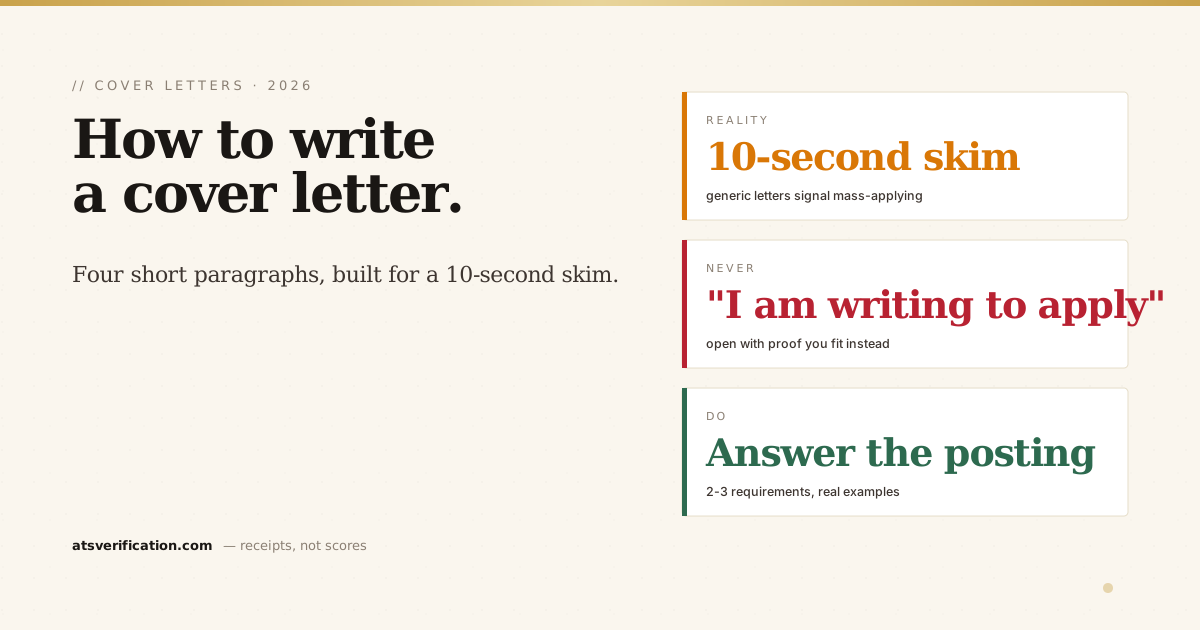
I have sat on the hiring side of the table in finance for years, and I will tell you what actually happens to cover letters. Most get a 10 second skim. Some never get opened at all. That is not a reason to skip writing one. It is a reason to write a very specific kind of letter: short, aimed at the posting, and readable in one pass. Here is the formula I use and the mistakes I see most.
- Write for a skimming human. Four short paragraphs, always under one page. Three sentences can be enough.
- Answer the posting, not the genre. Pick two or three requirements from the job ad and answer each with a real example and a number.
- Never open with "I am writing to apply". The reader knows. Open with proof you fit.
- One honest company-specific line beats a paragraph of flattery that could be pasted anywhere.
- Keep the formatting as clean as your resume. Single column, plain text, no graphics. Some systems parse and store the letter too.
What happens to your cover letter, honestly
When I was screening applications, the resume decided whether I cared. The cover letter decided something smaller but real: whether the person could communicate, and whether they had actually read our posting. A generic letter hurt candidates more than no letter, because it showed they were mass-applying. A sharp, specific letter moved borderline candidates up the pile. That matches what hiring research keeps finding, including Harvard Business Review's advice: be brief, be specific to the role, and cut everything the reader already knows.
One more honest mechanic. Many applicant tracking systems parse and store your letter alongside the resume, and recruiters can search that text. The letter is judged by humans, but it still has to survive the machine, which is why the formatting rules from your resume apply here too. I tested that in do ATS read cover letters.
The four paragraph formula
Paragraph 1: the role, and proof you fit it
Do not open with "I am writing to express my interest in the position of". The reader knows why you are writing. Open with the role and your single strongest, most relevant result:
"I am a regional finance manager with eight years running multi-entity reporting, which is the core of your Group Finance Manager role. At my current company I direct a USD 100M portfolio across three legal entities."
One or two sentences. Role named, strongest proof attached, done.
Paragraph 2: answer two or three requirements from the posting
This is the whole game. Open the job ad, pick the two or three requirements that matter most, and answer each one with a real example. Mirror the posting's exact words honestly, because those are also the terms recruiters search. If the ad says "month-end close", write "month-end close", not "periodic financial reporting". The same mirroring logic that works on your resume works here, and I covered it in how to tailor your resume to a job description.
Paragraph 3: one honest line about the company
One or two sentences that could not be pasted into any other letter. A product you have used. A market they lead. A problem they are hiring to solve that you have faced yourself. If you cannot write one honest sentence about the company, that tells you something about the application.
Paragraph 4: close simply
"I would welcome the chance to talk about how I can help with [the core job]. Thank you for your time." Then your name. No "I look forward to hearing from you at your earliest convenience". Nobody talks like that.
The mistakes I saw over and over
- Repeating the resume. The resume proves what you did. The letter connects it to their posting. If a sentence just restates a resume bullet, cut it.
- The life story opening. "Ever since I was a child I have been passionate about supply chains." No.
- Flattery paragraphs. "Your prestigious organization's innovative culture." Delete. One specific honest line instead.
- A full page when three sentences would do. If the posting asks for a short note, or you are writing in the email body, three sentences is a complete letter: the role plus your best number, the requirement you best match, and "my resume is attached".
- Fancy formatting. Columns, graphics, and decorative fonts add nothing for the human and can scramble in the parse. Same rules as the resume: single column, plain text. The full formatting logic is in how to pass the ATS.
Start from a template, then make it yours
I put the four paragraph formula into four free Word templates, with the guidance written inside each paragraph: standard professional, entry-level, career change, and a three sentence email version. They are direct downloads with no email gate: free ATS-safe cover letter templates. Pair the letter with a resume that parses cleanly, from our free resume templates or a free ATS scan of your current one, and when the letter is drafted, run it through the free cover letter checker to catch the generic phrases and missing keywords before you send it.
Want to see the formula in action? I wrote six complete letters using it, one per common situation, in cover letter examples that get read.
The letter will not rescue a weak application. But when two resumes look similar, the letter that answers the posting in four tight paragraphs is the one that gets the call. I have made that call myself.