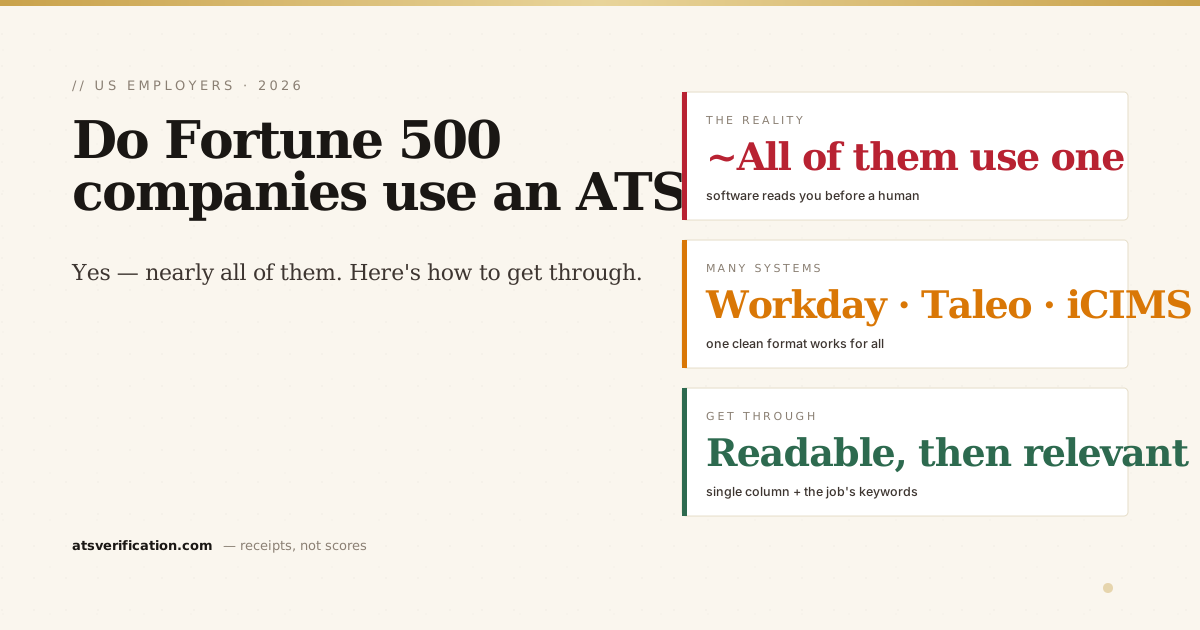
Short answer: yes, almost all of them. If you're applying to large US companies, you should assume that software reads your resume before any human does, at virtually every Fortune 500 employer. That single fact changes how you should write a resume for the US market. Here's which systems the big companies use, what "an ATS reads it first" actually means for your application, and the concrete way to get through.
- Effectively all Fortune 500 companies use an ATS. Screening resumes with software before a recruiter reads them is the standard at large US employers.
- They don't all use the same one. Workday, Taleo, SAP SuccessFactors, iCIMS, Greenhouse, and others are common, and they parse a little differently.
- Your resume is parsed and ranked first. If the software can't read your file cleanly, a recruiter may never see you, no matter how strong you are.
- The winning format is the same across all of them: single column, plain-text name, standard headings, real text, no tables or graphics.
- Then match the specific job's keywords honestly, and verify the parse before you apply.
Do Fortune 500 companies really use an ATS?
Yes. Applicant tracking systems are standard infrastructure at large US employers, research has repeatedly found that essentially all Fortune 500 companies use one. At the volume a big company receives, often hundreds or thousands of applicants per opening, human-only screening simply isn't possible. So your resume is first parsed into a database, where recruiters search and filter it (the mechanics are in how ATS scoring works). This isn't a fringe scenario for US job seekers; it's the default.
Which systems the big companies use
They don't all run the same platform, and each parses a little differently, but a handful dominate US enterprise hiring:
- Workday, extremely common at large US corporations; see why Workday rejects resumes.
- Oracle Taleo, one of the oldest systems still in wide use, often described as strict about formatting; see how to get past Taleo.
- SAP SuccessFactors, common at large SAP-stack companies; see how to get past SuccessFactors.
- iCIMS, a major US enterprise platform built for high-volume hiring; see how to get past iCIMS.
- Greenhouse and Lever, favored by tech companies and startups; see how to get past Lever and Greenhouse vs Workday parsing.
- SmartRecruiters, a modern enterprise ATS at large global employers; see how to get past SmartRecruiters.
- Ashby, increasingly common at well-funded tech startups; see how to get past Ashby.
The good news: you don't need a different resume for each. The formatting that survives one survives all of them, because they share the same basic job, extracting text from your file.
What "an ATS reads it first" means for you
It means readability comes before everything else. Your resume is converted to plain text and filed into fields a recruiter searches. If that conversion breaks, a two-column layout scrambling your history, your name glued into one token, skills lost in a table, you can be filtered out before a person ever looks, regardless of how qualified you are. The resume that looks most impressive to you is not necessarily the one the software reads best, which is the whole trap.
How to get through, at any of them
- Single column, top to bottom. No sidebars or layout tables (why two columns break).
- Plain-text name and contact in the body of page one, not a header or image (why the ATS can't read your name).
- Standard headings, Summary, Experience, Education, Skills.
- Real, selectable text in a clean PDF or .docx, never a scanned image.
- Skills and keywords that mirror the specific posting, placed in real accomplishments (how to list skills).
That's the same playbook as how to pass the ATS, because whichever Fortune 500 system you're facing, the fundamentals don't change. And if you found the role on Indeed, it's worth knowing whether you're applying inside Indeed or being handed to the employer's own ATS, see does Indeed use an ATS.
Verify before you apply
You can't tell whether your resume parses cleanly by looking at it. Before you send it to a big employer, check what the software actually extracts: the free copy-paste test (paste into Notepad) gives you a quick read, and a free ATS scan shows the exact text pulled from your file, with no invented "match score," because no real ATS produces one (are ATS checkers accurate). At companies this competitive, a clean parse is the price of admission, so make sure yours is clean before you apply.