If you've applied to a big US retailer, health system, bank, or logistics company, there's a good chance iCIMS was the software between you and the recruiter. It's one of the largest applicant tracking platforms in US enterprise hiring, built for companies that receive huge volumes of applications. That volume is exactly why the parse matters so much: when thousands of resumes come in for a role, the ones the software can't read cleanly quietly fall out of the running. Here's how iCIMS handles your resume and how to format one that gets through.
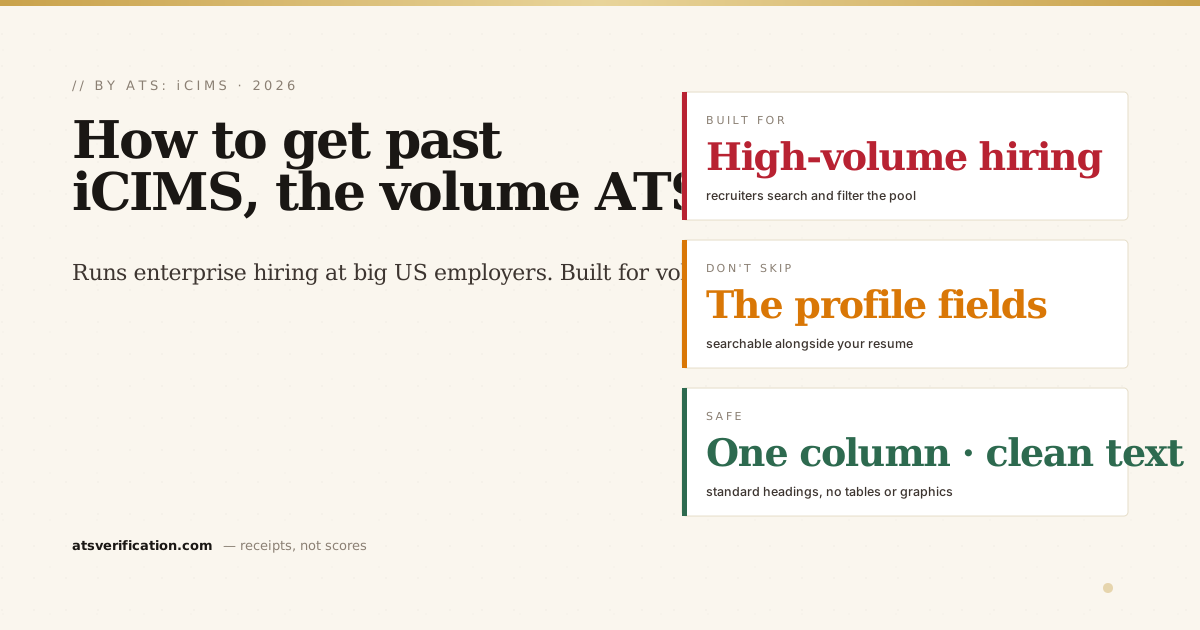
- iCIMS is built for volume. Large US employers use it to parse, store, and search enormous applicant pools, so being machine-readable is essential, not optional.
- Your resume becomes a searchable profile. iCIMS extracts your file into fields recruiters search and filter, so clean extraction directly affects whether you surface.
- Keep it plain: single column, standard headings, real text, no tables, graphics, or header-only contact details.
- Complete any profile fields it asks for accurately, they're searchable alongside your resume.
- Match the specific posting's keywords so the search surfaces you from a large pool.
What iCIMS does with your resume
Like any ATS, iCIMS parses your file into structured text and builds a searchable candidate record (the general mechanics are in what an ATS is and how it reads your resume, and the ranking side in how ATS scoring works). Because iCIMS is used for high-volume roles, recruiters lean heavily on searching and filtering that database, so if your name, titles, dates, or skills didn't extract cleanly, you can be invisible to the exact search that would have found you. The parse isn't a technicality here; it's the difference between being in the pool and not.
What breaks in iCIMS (and every other ATS)
- Two-column layouts, read across the page and scramble your history (why two columns break).
- Tables for skills or dates, can flatten into glued tokens (do ATS read tables).
- Header/footer-only contact details, may be skipped (do ATS read headers and footers).
- Graphics, icons, skill bars, and images of text, carry no readable content.
- Creative section headings, use the standard labels so content maps to the right fields.
The format that gets through iCIMS
- Single column, top to bottom.
- Plain-text name and contact in the body of page one.
- Standard headings: Summary, Experience, Education, Skills.
- Real, selectable text in a clean PDF or .docx, never a scanned image.
- Skills listed as plain text, mirroring the posting's terms (how to list skills).
This is the same format that works for Taleo, Workday, and every other system, because they all share the same core job of extracting text. You don't need a different resume for each; keep one clean master and tailor the keywords per role. For the full playbook, see how to pass the ATS.
Then be findable in the pool
At high-volume iCIMS employers, being readable gets you in; being relevant gets you found. Mirror the specific job's exact skills and tools in your bullets and skills section, honestly. Since nearly all large employers run an ATS, and iCIMS is one of the biggest, getting both the format and the keywords right is what separates you from the pile (more context in do Fortune 500 companies use an ATS).
Check what iCIMS would see
You can't tell whether your resume parses cleanly by looking at it. Verify it before you apply: the free copy-paste test gives you a quick read, and a free ATS scan shows the exact text pulled from your file, with no invented score and no signup. For more on the platform, see our iCIMS ATS guide.