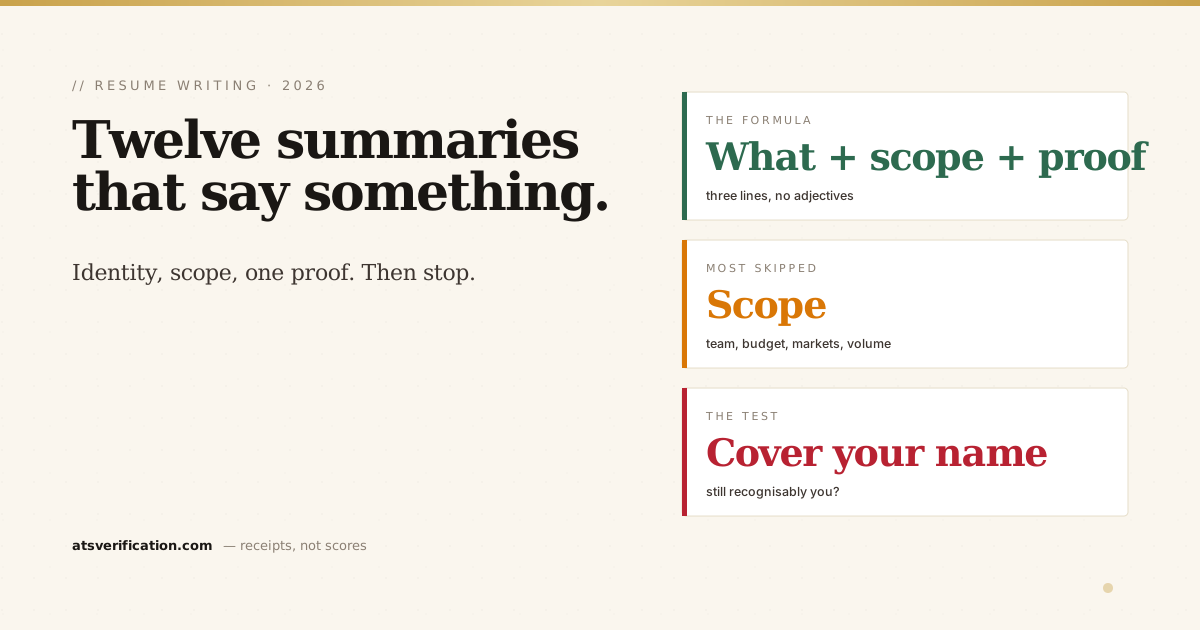
The summary is the most wasted three lines on most resumes. I have read hundreds from the hiring side, and the pattern almost never varies: four adjectives, one cliché about being results-driven, and nothing a reader could not have guessed. Which is a shame, because it sits in the most valuable space on the page. Here is the formula I use, twelve examples across different situations, and the honest advice about when to delete it entirely.
- Three lines, three jobs: what you are, the scope you operate at, and your single strongest proof.
- If it could sit on someone else's resume unchanged, it is not a summary. It is filler occupying prime space.
- Adjectives persuade nobody. Hardworking, passionate, detail-oriented and results-driven are claimed by every candidate, so they carry no information.
- Numbers belong here, even though they also appear below. The summary is where a skimmer decides whether to read the rest.
- Delete it if you have nothing specific to say. A missing summary costs you nothing; a generic one costs you the top of the page.
The formula
Every good summary I have written or read does three things in about three lines:
- What you are. Your professional identity in the words the target job uses. Not "seasoned professional" but "regional finance manager" or "backend engineer".
- The scope you operate at. This is the part almost everyone skips, and it is what separates candidates who look similar on paper. Team size, budget, number of markets, transaction volume, portfolio value. Scope is how a reader places you on a ladder.
- One proof. Your strongest quantified result, stated plainly. One. Not a list.
That is it. No objective statement about what you are seeking, because the application already says that. No adjectives about your work ethic, because the achievements below will demonstrate it or they will not.
Twelve examples
Finance
"Regional finance manager, eight years across the UAE and Oman, currently directing reporting for three legal entities and an 18 million dollar operating budget. Cut month-end close from eleven days to six in my first year."
Why it works: identity, scope and proof in two sentences, with the scope doing the heaviest lifting. Three legal entities tells a reader more about the complexity of this job than any adjective could.
Software engineering
"Backend engineer, six years in Python and Go, currently maintaining an order pipeline handling 30,000 requests a minute at 99.95% uptime. Led the extraction of billing from our monolith, cutting release cycles from weekly to daily."
Why it works: the throughput number is the scope, and the monolith extraction is the kind of specific project other engineers immediately understand.
Sales
"Enterprise account executive selling into financial services, average deal size 120,000 dollars and a 14 month cycle. Closed 142% of quota last year, and the two years before that."
Why it works: deal size and cycle length place the candidate precisely. "And the two years before that" quietly answers the question every sales manager asks about a single good year.
Project management
"Project manager in commercial construction, running three concurrent fit-out projects worth 40 million dirhams with crews of up to 90. Delivered the last four handovers on schedule."
Marketing
"Performance marketing manager, owning a 2 million dollar annual paid budget across search and paid social for a D2C brand. Reduced blended acquisition cost 31% while holding revenue flat through a market downturn."
Why it works: the qualifier "while holding revenue flat" turns a routine efficiency claim into evidence of judgment, and it is the sort of honest detail an interviewer will want to explore.
Human resources
"HR business partner supporting 400 employees across three countries, owning the full cycle from workforce planning to exit. Cut time-to-hire from 62 days to 38 by rebuilding the interview process."
Data and analytics
"Data analyst in retail, building the reporting layer used by the commercial team for weekly trading decisions across 140 stores. Automated a manual reporting pack that had consumed two days every week."
Operations
"Operations manager in e-commerce fulfilment, directing four sites and 120 staff shipping 40,000 orders a day. Reduced cost per order 23% in 18 months."
Career changer
"Secondary mathematics teacher moving into corporate learning and development. Eight years designing and delivering over 1,000 hours of instruction, with exam pass rates above district average five years running."
Why it works: the pivot is stated in the first line rather than hidden, which stops the reader puzzling over it, and the evidence is translated into language the new field recognises. More on this in career change resumes.
Returning after a break
"Financial controller returning to full-time work after two years as a primary carer. Eleven years in manufacturing finance before that, most recently owning a 60 million dollar cost base and a team of nine."
Why it works: it answers the gap in one clause, without apology or over-explanation, then moves straight to scope. A reader who was going to wonder now does not have to.
Recent graduate
"Finance graduate, first class, with a six month internship in audit at a Big Four firm and a final-year valuation project graded in the top three of a cohort of 60. Looking for a graduate analyst role."
Why it works: graduates are the one group who should state the target role, because their history does not imply it. Coursework is described like work, with a result attached.
Senior leadership
"Finance director for a 200 million dollar regional business, leading 24 people across three markets and reporting to the group CFO. Led the carve-out and integration of two acquisitions in the last four years."
Why it works: at this level, reporting line and transaction experience are the scope signals that matter more than any process improvement.
The words that make a summary worthless
These appear on nearly every resume I have screened, which is precisely the problem. If every candidate claims it, it distinguishes nobody:
- Hardworking, dedicated, passionate, motivated
- Results-driven, results-oriented, proven track record
- Detail-oriented (particularly awkward on a resume with a typo)
- Team player with excellent communication skills
- Dynamic professional, seasoned professional
- Thinks outside the box
The test is simple. Cover your name and hand the summary to a friend. If they cannot tell it is yours, it is describing a category rather than a person. The fix is never a better adjective, it is a number. There is a fuller treatment of that in how to quantify achievements, and on the verbs that do earn their place in action verbs that actually help.
Summary, objective, or profile?
The labels cause more confusion than they deserve.
A summary looks backwards at what you have done, and it is what almost everyone with experience should write. An objective looks forwards at what you want, which is only useful when your history does not make the target obvious: graduates, career changers, and people relocating to a new market. A profile is the same thing as a summary, and in UK and Gulf conventions it is often labelled a personal statement. Whichever word you use, put it directly under your contact details, keep it to three or four lines, and use a standard heading so parsing software recognises the section, which is covered in section headings that parse.
When to delete it entirely
This is the part most guides will not tell you, because a guide about summaries has an interest in you writing one.
If you cannot state a specific scope and a specific result, the summary is costing you the most valuable space on the page and giving nothing back. Delete it, start the experience section higher, and let the achievements speak. I have done this on my own resume for some applications. Nobody has ever asked me where my summary went.
Two situations where I would keep it regardless: when something needs explaining before the reader reaches it, like a career pivot, a gap, or a move to a different country; and at senior level, where the scope line genuinely places you and saves the reader assembling it from three roles.
One mechanical warning
Summaries are frequently the casualty of pretty templates. They get placed in a sidebar, a coloured box, or a text frame, all of which are structures parsers handle badly: sidebar text gets read into the middle of your work history, and text inside a box is sometimes skipped entirely. So the best summary you have ever written can arrive in a recruiter's system spliced into your second job, or missing.
Keep it as plain text, full width, directly under your contact details. Then check what a parser actually extracted with a free scan before you send it, or start from a template that already parses cleanly. The full formatting logic is in how to write a resume.