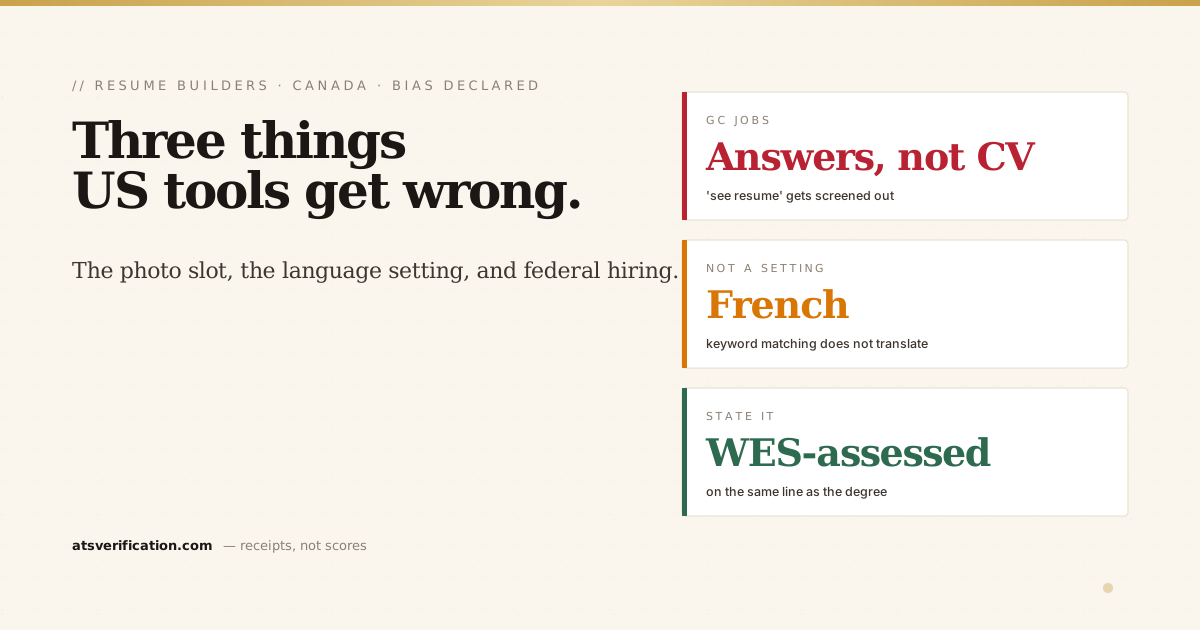
Declaring it upfront: I build a resume parser and sell a paid rebuild, so this comparison comes from someone with a stake in it. The reason I think it is still worth reading is that Canada gets treated as a rounding error on American advice, and it is not. Three things differ enough to change which tool you should use, and one of them means that for a whole category of Canadian jobs, no resume builder helps you at all.
- Federal jobs do not work like this. GC Jobs screens you on an online application against merit criteria, not on an uploaded resume.
- Language is a live requirement, not a nice-to-have. Quebec and bilingual federal roles need a real French CV, not a translated English one.
- No photo, no age, no marital status, no SIN. Human rights legislation makes these unwelcome, and several international templates include a photo slot by default.
- Spelling is a hybrid. Canadian English mixes British and American forms, and keyword matching is literal.
- 41.8% of files I scan have content trapped in a table. Fix that before choosing any tool.
What actually differs about a Canadian resume
The exclusions. No photo, no date of birth or age, no marital or family status, no nationality, and never your Social Insurance Number. Provincial and federal human rights legislation makes these categories awkward for employers to hold, and many recruiters are trained to discard or redact resumes containing them. This matters more than it does for Americans in one specific way: a lot of newcomers to Canada arrive from countries where a photo and a date of birth are completely standard, and international template galleries include a photo slot by default. Delete it. The parsing side of that is in photos and ATS.
Length. Two pages is normal and unremarkable in Canada, closer to the UK than the US one-page convention. A tool that hard-caps you at one page is applying an American rule.
Spelling. Canadian English is a genuine hybrid: "labour", "centre", "cheque" and "licence" follow British forms, while "organize", "analyze" and "realize" usually take the American z. Since keyword matching is literal string matching, this is not cosmetic. The practical answer is to mirror whatever the job posting itself uses, because that is the vocabulary being searched. Set your document language to English (Canada) so autocorrect stops fighting you.
The full conventions are in the Canadian resume format guide.
The federal government does not read resumes
This is the Canadian equivalent of the point I make about the NHS in the UK, and it applies to one of the country's largest employers.
Federal public service hiring runs through GC Jobs. You complete an online application answering screening questions against the essential and asset qualifications in the poster, in your own words, with concrete examples. That written application is what a screening board assesses. A resume may be attached but it is not the thing being scored, and answers that simply say "see resume" are commonly screened out.
Language is a formal element of the same process. Federal positions carry a linguistic profile, often expressed as levels for reading, writing and oral interaction, and bilingual imperative roles require you to demonstrate them. That is a real qualification, not a preference.
So if you are targeting federal work, spending money on a resume builder is solving the wrong problem. Write the screening question answers properly, one qualification at a time, with a specific example for each. Provincial governments and many municipalities run similar competency-based processes.
French is not a translation setting
For Quebec, and for bilingual roles anywhere in Canada, an English CV run through a translator is visibly an English CV run through a translator.
Two practical points. First, a French CV in Quebec is its own document with its own conventions, and the vocabulary the employer's system searches for is French vocabulary. Keyword matching does not translate. Second, accented characters are worth a specific check: run the finished file through the plain-text test and confirm that é, è, ç and î survive as themselves rather than as question marks or boxes. Smart-quote and encoding damage shows up in 8.2% of the files I scan, and accented characters sit in the same family of failure.
If you are applying in Quebec in French, a tool with genuine French language support beats a better-known English one.
Foreign credentials, stated plainly
A large share of Canadian job seekers earned their qualifications elsewhere, and the resume convention here is more specific than most guides admit.
Name the credential as it was awarded, name the institution and country, and where you have had an assessment done, say so on the same line:
Bachelor of Commerce, University of Delhi, India, 2016
(WES-assessed as equivalent to a Canadian bachelor's degree, 2024)
That single parenthetical answers a question a recruiter would otherwise have to guess at. If you hold a regulated profession credential — engineering, accounting, nursing, teaching — state your current standing with the provincial regulator honestly, including if you are in progress. "In progress" is a real answer and it is far better than silence discovered later.
The related point about "Canadian experience": name Canadian employers where you have them, including contract, part-time and volunteer roles with recognisable organisations, because that is a signal recruiters look for whether or not they should.
What to judge a tool on
Same criteria I hold my own product to:
- Does it show you the extracted text rather than a score out of 100? No real ATS produces one.
- Single column, no tables, no side rail?
- Can you set English (Canada) or French, properly?
- Does it allow two pages?
- Does it export DOCX as well as PDF?
- Can you remove the photo slot?
- One payment, or a subscription for a task with an end?
The options, including the free one
Free and genuinely adequate for many. Word or Google Docs, single column, standard headings, language set to English (Canada) or French, exported to PDF and DOCX. Then the copy-paste test. I would tell a friend to do this before paying anyone.
General-purpose builders. Resume.io, Kickresume, Enhancv, Zety and similar work fine in Canada, with the standard caveat that their galleries are full of two-column templates that scramble. Choose the plainest. I ran several through multiple parsers in the AI resume builder comparison and the template mattered more than the brand every single time.
Settlement and newcomer services. If you are new to Canada, provincially funded settlement agencies and employment centres offer free resume help from people who know local employer expectations and the credential question specifically. This is genuinely good and genuinely free, and it is chronically underused because people assume free means low quality.
Canadian resume writers. Worth it when the problem is positioning rather than formatting, particularly for career changers and internationally trained professionals. Be wary of anyone selling an ATS score.
What I build. A parser-first scanner that shows the extracted text and names each failure, plus a paid rebuild into a single-column Word document. One payment, no subscription, one price worldwide. It handles structure. It does not write your French CV and it does not help with GC Jobs screening questions.
The check that comes first
Open your resume, select all, copy, paste into a plain text file.
Name alone and intact on line one? Across 4,966 scanned files, 26.3% have a name the software cannot isolate, and multi-part names from outside the Anglo first-last pattern fail more often than average. Job titles still beside their own dates? Skills still separate words? Accented characters still themselves?
If that survived, your formatting is not the problem and no subscription will change your results. If it did not, that is what every employer's database has been storing.
The figures come from a live counter that recounts on each page load. It read 4,966 files the day I wrote this.
→ Run the free scan and see what a Canadian employer's system extracts