Declaring the bias first, because this is a comparison written by someone who sells one of these things. I build a resume parser and a paid rebuild tool. You should read what follows knowing that, and you should notice that the most useful advice in it costs nothing. The reason I am writing it is that almost every "best CV builder" list aimed at British readers is a rewritten American article, and the American assumptions inside it will actively damage a UK CV.
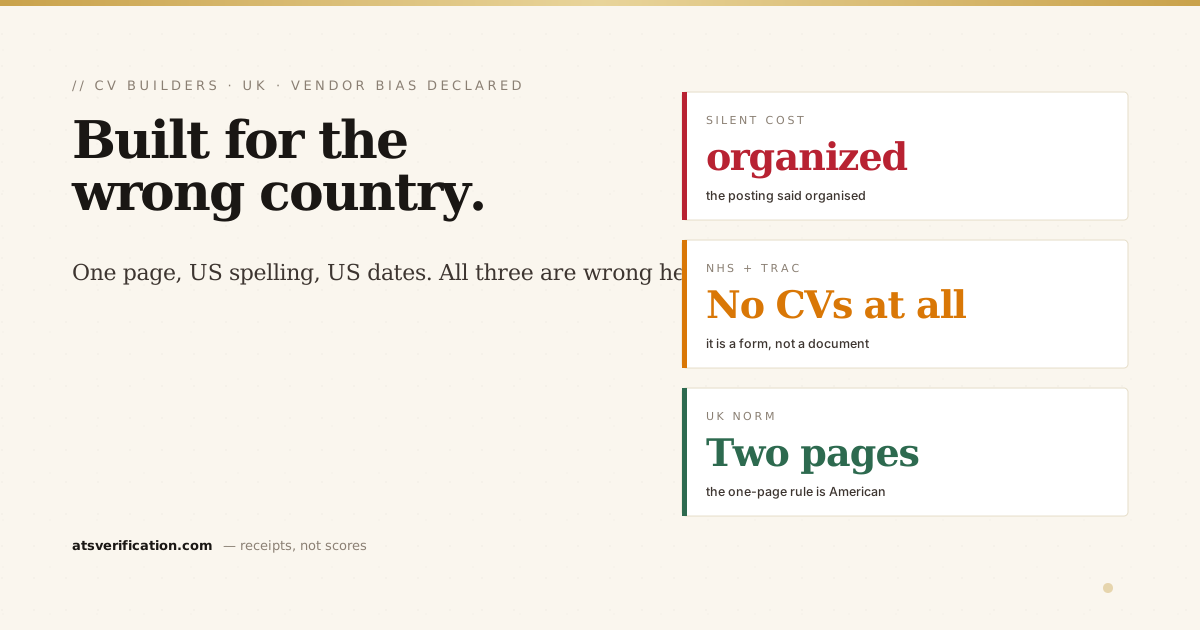
- Two pages is the UK norm. A tool that forces one page is applying an American rule to a British document.
- US spelling silently costs you keyword matches. A UK posting says "organised". A US-built tool writes "organized". Matching is literal.
- The NHS does not accept CVs at all. The UK's largest employer uses an application form, so no builder helps you there.
- Check the date format. American tools default to MM/DD, which a UK reader misreads and some parsers misparse.
- 41.8% of the CVs I scan have content trapped in a table. That is the failure to fix before choosing any tool.
What actually differs about a UK CV
Start here, because these are the things an American tool gets wrong by default, and no amount of AI polish inside the tool will correct them.
It is a CV, and it runs to two pages. Two pages is standard for anyone past their first job, and three is acceptable for senior or academic roles. The one-page rule is a US convention. A builder that hard-caps you at one page is not making your CV tighter, it is making it wrong, and it will force you to cut the detail a British recruiter expects to see. The general length question is in one page versus two.
A personal statement goes at the top. Three or four lines, first person or implied first person, saying what you do and what you are looking for. This is a genuine UK convention with no exact American equivalent, and several US tools have no field for it at all.
British spelling, throughout. This is the one that costs interviews silently and almost nobody mentions it. Keyword matching in an ATS is literal string matching. A UK job description says "organised", "specialised", "programme", "analyse", "centre", "licence" as a noun. If your CV says "organized", "specialized", "program", "analyze", "center", "license", those are different strings and they do not match.
American resume builders default to American English and many have no locale setting. You can write beautiful bullets in a tool and lose the keyword match on every one of them. If you are using a US-built tool, change the language on the document itself and read the output word by word.
Dates in day-month-year. An American tool that writes 03/04/2021 means 4 March to its designers and reads as 3 April to a British recruiter. Sidestep it entirely by writing the month in letters: "Mar 2021 to Present". Ambiguous dates turn up in 8.9% of the files I scan and the fix is covered in the date format guide.
No photo, no date of birth, no marital status, no nationality. British practice matches American practice here and for the same reason, and a photo also creates a parsing problem in its own right, covered in photos and ATS. Several European-oriented templates include a photo slot by default. Delete it.
The full set of conventions is in the UK CV format guide.
The NHS problem, which no builder solves
Here is the thing most "best CV builder UK" articles never mention, and it applies to well over a million jobs.
The NHS does not accept CVs. Trust recruitment mostly runs through Trac or the NHS Jobs service, and the guidance is explicit: applicants complete an application form, CVs will not be considered, and you are specifically told not to paste your CV into the supporting information box.
What screens you instead is the supporting statement, written against the person specification. The person specification lists essential and desirable criteria. The shortlisting panel scores you against those criteria, usually literally, one by one. So the winning approach is to take the person specification, work through each essential criterion in order, and give evidence for each one. It is closer to answering an exam paper than writing a pitch.
No CV builder helps with that. If most of your applications are NHS, local authority, or another public body running a competency form, buying a CV tool is solving a problem you do not have. Write the supporting statement properly instead.
The same structural point applies in a milder form to a lot of UK public sector and graduate scheme applications, which are form-first with competency questions rather than CV-first.
So what should a UK CV tool actually do
For the private sector jobs where a CV does get uploaded and parsed, here is what I would judge a tool on. This list is deliberately the same one I would apply to my own product.
- Does it show you the extracted text? Not a score out of 100, which no real ATS produces, but the actual text a parser pulls out of your file. Everything else is opinion.
- Does it produce a single-column document with no tables? Tables and grids flatten in 41.8% of the CVs I scan, which is the most common failure by a wide margin.
- Does it let you set British English? If not, you are fighting the tool on every bullet.
- Does it allow two pages without complaint?
- Does it output DOCX, not just PDF? Plenty of UK employers and agencies still ask for Word.
- Is it a one-off payment or a subscription? Updating a CV is a task with an end. Subscriptions for it are a business model, not a requirement.
The honest options, including the free one
The free route is real and I will not pretend otherwise. Word or Google Docs, single column, standard headings, British English set in the language settings, exported to PDF. Then paste it into a plain text file and read what comes out, which is the copy-paste test and takes thirty seconds. For a large number of people that is genuinely enough, and it is what I would tell a friend to do first.
General-purpose builders. Resume.io, Kickresume, Enhancv, Zety and similar are polished and fast, and most are built to American conventions with template galleries that lean heavily on two-column layouts. If you use one, pick the plainest single-column template in the gallery, not the one that looks best in the preview. I tested a set of these against multiple parsers in the AI resume builder comparison, and the template mattered more than the brand every time.
Tailoring and keyword tools. Jobscan and Teal compare your CV against a job description. Useful for the vocabulary gap, subscription-priced, and they will not tell you whether your file parses.
UK CV writing services. A good human writer is worth real money if your problem is positioning rather than formatting, which for career changers and senior candidates it often is. Expect a few hundred pounds. Be wary of anyone promising ATS scores.
What I build. A parser-first scanner that shows you the extracted text and names each failure, with a paid rebuild into an ATS-safe Word document. One payment, no subscription, one price worldwide. It does formatting and structure. It does not write your career story for you and it does not help with NHS forms.
The thirty-second check that comes before any of this
Whatever you use, do this before you pay anyone anything.
Open your CV, select all, copy, paste into Notepad. Then read it.
Is your name alone and intact on the first line? Across 4,966 scanned files, 26.3% have a name the software cannot isolate. Are your job titles still sitting beside their own dates? Did your skills stay as separate words rather than fusing into one long string? Is your personal statement still at the top rather than somewhere in the middle?
If that all survived, your formatting is fine and any remaining problem is what the CV says, not how it is built. If it came out scrambled, no builder subscription fixes the file you already sent to forty employers.
Every figure here comes from a live counter that recounts on each page load. It read 4,966 CVs and resumes the day I wrote this, and it includes the numbers that do not flatter us.
→ Run the free scan and read your CV the way a UK employer's software reads it