The bias first: I sell a resume parser and a paid rebuild, so read this knowing that. The reason I wanted to write it anyway is that there is a genuinely strange fact sitting in the middle of European job hunting, and almost nobody says it out loud. The European Union publishes an official CV format. It is free, it is recommended by careers services across the continent, and its layout is built on exactly the thing that breaks applicant tracking systems more often than anything else.
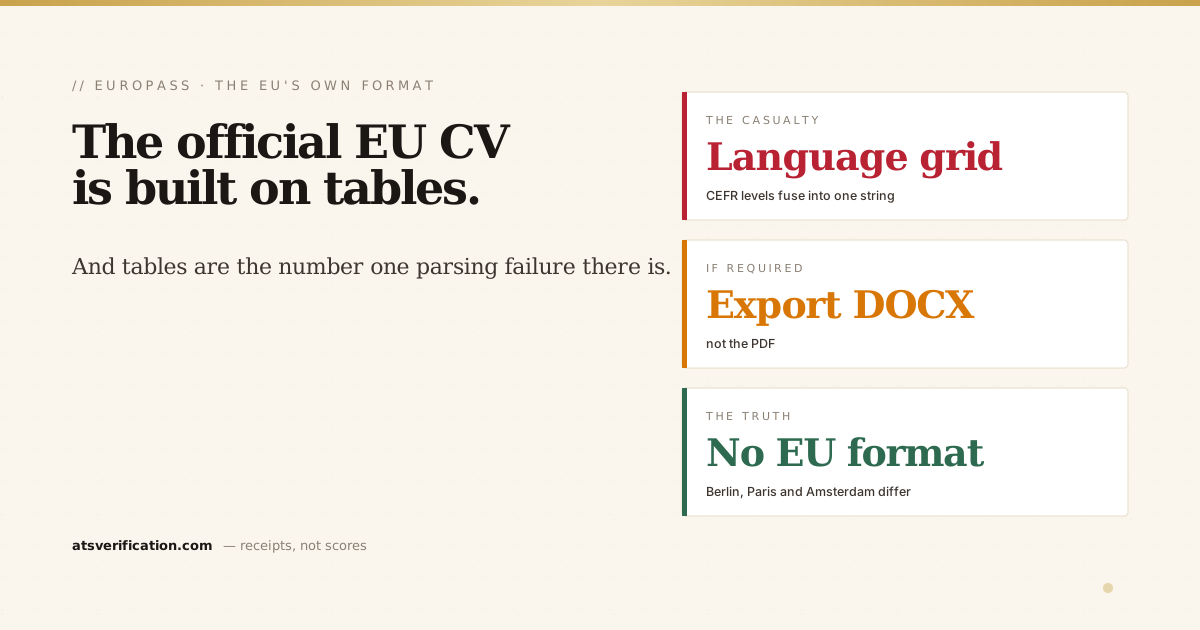
- Europass is table-based. The language self-assessment grid especially, and tables are the number one parsing failure at 41.8% of files I scan.
- There is no European CV. Germany, France, the Netherlands and Spain expect different documents. A tool selling you "the EU format" is selling a fiction.
- Photo conventions are splitting. Still common in Germany and Austria, effectively gone in the UK, Ireland and increasingly the Netherlands.
- Export DOCX where you can. The Word export of a Europass CV survives extraction better than the PDF.
- Pick the plainest template in any builder, not the best-looking one. The template matters more than the brand.
The Europass problem
Europass is the European Commission's CV tool. It is free, it is genuinely well-intentioned, and it does one thing extremely well: it makes qualifications legible across borders, which is a real problem it was built to solve.
What it was not designed around is machine parsing, because it predates the era when a piece of software reads your CV before a person does. The generated document leans on tables. The language self-assessment section is a grid — listening, reading, spoken interaction, spoken production, writing, each with a CEFR level. Several sections use side-by-side blocks with icon-labelled fields.
Put that through a parser and the same thing happens that happens to every grid. Reading order is reconstructed from position on the page, that reconstruction is guesswork, and a grid gets read across instead of down. Your language levels fuse into one unreadable string. Sometimes the side-by-side blocks interleave with the main body.
Across 4,966 files I have scanned, 41.8% had content trapped in a table or grid that flattens into unreadable text. It is the single most common failure in the dataset. The mechanics are in what happens to tables.
I want to be fair to it, because there is a version of this claim that is overstated. A Europass CV is not a blank page to a parser. The text is there and much of it extracts. What degrades is the structured part, and the structured part is exactly what an employer filters on. So the honest statement is narrower and more useful than "Europass fails ATS": the prose survives, the grids do not, and your language levels and skills are usually the casualty.
What to do if you must submit Europass. Some public sector roles, EU institutions and academic programmes specifically request it. In that case, submit it and stop worrying, because the requirement is the requirement. Where the employer accepts either, export the Word version rather than the PDF, since the DOCX carries labelled structure that a parser can use rather than making it guess from coordinates. And keep a separate, plain, single-column CV for every private sector application.
There is no European CV
The second thing wrong with most "best CV builder Europe" articles is the premise. Europe is not one hiring market, and the differences are large enough to matter.
Germany and Austria. The Lebenslauf is traditionally tabular and reverse chronological, often with a photo, and a full application pack may include certificates and references. That tabular convention is a parsing hazard in the same way Europass is. Larger German employers run SAP SuccessFactors frequently, which is unsurprising given where SAP is from, and there is a guide to it at the SuccessFactors page. Photos remain common despite the AGG anti-discrimination law making them legally awkward for employers.
France. One to two pages, a photo is still fairly common though declining, and the CV is expected alongside a proper lettre de motivation which is read more seriously than an American cover letter.
Netherlands and Nordics. Closest to the Anglo model. Two pages, generally no photo, plain and direct. The Netherlands in particular has moved firmly away from photos.
Spain and Italy. Photos still common, and in Italy applications have historically carried an explicit data-processing consent line.
Ireland and the UK. No photo, two pages, and the UK has its own set of conventions covered in the UK guide and the UK CV format guide.
The practical consequence: any tool that offers you "the European CV template" as a single option does not understand the market it claims to serve. What you actually want is a plain single-column document you adapt per country, mostly by deciding on the photo and the length.
The country-by-country document rules are in CV versus resume by country.
The photo question, answered practically
Two separate problems live inside this and they get conflated.
The convention problem. A photo is still normal in Germany, Austria, Spain and much of Italy. It is not normal in the UK, Ireland or the Netherlands, and it is declining in France. Follow the local norm, and when applying to a multinational's central hiring team rather than a local office, lean towards no photo.
The parsing problem, which is the same everywhere. A photo is an image. It extracts as nothing, which is fine in itself. What causes damage is that photos usually sit inside a header block or a positioned box alongside your name and contact details, and that whole block is then either skipped or read out of order. That is why a photo correlates with the name-extraction failure that shows up in 26.3% of the files I scan. There is more in photos and ATS and when the ATS cannot read your name.
If you include a photo, keep it as a plain inline image with your name as ordinary text on its own line beneath, not inside the same graphical block.
What to judge a tool on
The same criteria I would apply to my own product:
- Does it show you the extracted text rather than a score out of 100? No real ATS produces such a score.
- Does it output a single-column document with no tables?
- Can you set the document language properly? Keyword matching is literal, so a German posting's vocabulary needs a German CV, not a translated English one.
- Does it export DOCX, not only PDF?
- Can you turn the photo slot off?
- One payment or a subscription?
The options, honestly
Free, and genuinely sufficient for many people. Word or Google Docs, single column, standard headings, document language set to the language you are applying in, exported to PDF and DOCX. Then run the copy-paste test. If you are applying inside one country in that country's language, this is often all you need.
Europass. Free and correct when specifically requested. Export DOCX. Keep a plain version for everything else.
General-purpose builders. Resume.io, Kickresume, Enhancv, Zety and similar have European locales and multi-language support, which is a real advantage here. Their weakness is template galleries full of two-column designs. Pick the plainest one. I put several through multiple parsers in the AI resume builder comparison; the template was a bigger factor than the brand every time.
Local specialists. In Germany especially there are services built around the Lebenslauf and the full Bewerbung pack. If you are applying in German to German employers, someone who knows that convention is worth more than a generic international tool.
What I build. A parser-first scanner that shows the extracted text and names each failure, plus a paid rebuild into a single-column Word document. One payment, no subscription, same price everywhere. It is language-agnostic on structure but it does not write in German or French for you, and it will not tell you whether to include a photo in Munich.
Before you pay for anything
Open your CV, select all, copy, paste into a plain text file, and read it.
If you are on Europass, look specifically at the language section. If your CEFR levels have fused into one string, or your listening level is now attached to the wrong skill, you have just seen the exact reason to keep a second version.
Then check the basics: name alone on the first line, job titles beside their own dates, skills as separate readable words.
Every percentage here comes from a live counter that recounts on each page load. It read 4,966 files the day I wrote this.
→ Run the free scan and see what survives extraction from your European CV