An Australian resume sits closer to the British CV than the American one-pager, but it has its own rules that trip up newcomers and overseas applicants. It can run longer, it leans on "key selection criteria" for government and big-employer roles, and like everywhere else, the large Australian employers run your resume through an ATS before a human ever opens it. Here is what actually matters for Australia in 2026, whether you are a local, a graduate, or arriving on a visa.
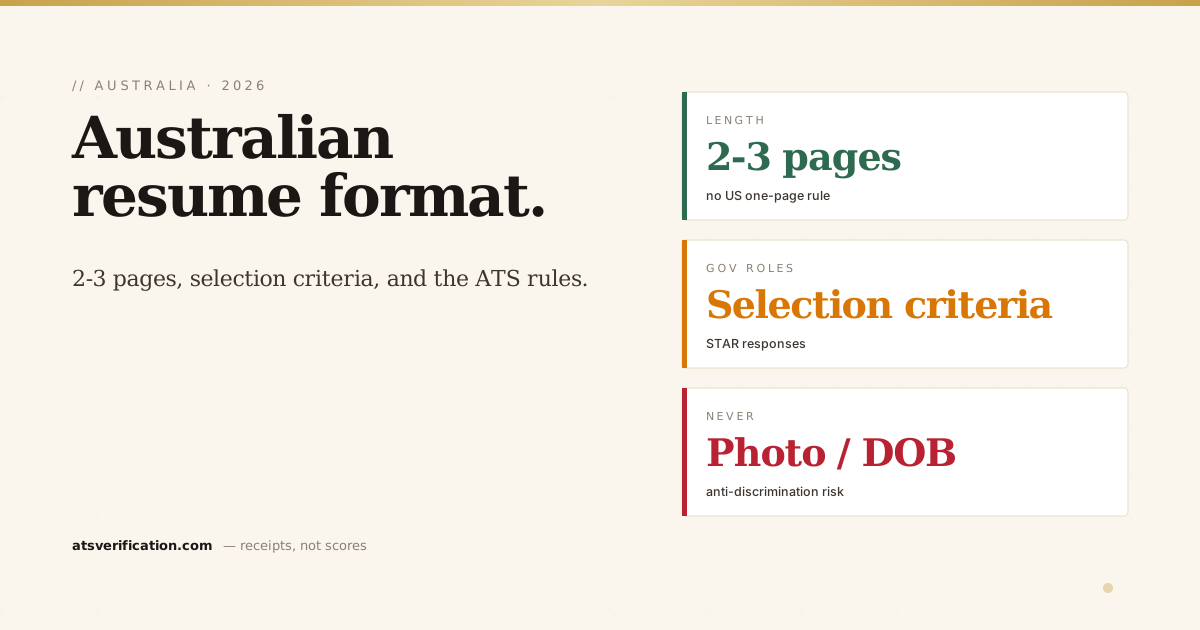
- 2 to 3 pages is normal. Australia is far more relaxed than the US one-page rule. Two pages is standard; three is fine for senior or government roles.
- No photo, no date of birth, no marital status. Anti-discrimination norms make these a liability, and recruiters discard resumes that include them.
- Australian spelling. "Organise," "centre," "specialise," "colour." ATS keyword matching is literal, so mirror the spelling the job ad uses.
- Key selection criteria are an Australian thing. Government (APS) and many large roles ask you to address criteria with STAR examples, often in a separate document.
- Big employers run an ATS (Workday, PageUp, SAP SuccessFactors, Taleo). A two-column "designer" resume scrambles in the parser. Clean structure first, content second.
What makes an Australian resume different
If you are coming from the US, the biggest change is length and tone. If you are coming from the UK, it is close, but Australia uses "resume" and "CV" almost interchangeably for most jobs. (For the full country-by-country comparison, see CV vs resume rules by country.)
| Element | Australian expectation | Why |
|---|---|---|
| Length | 2-3 pages | Australia expects detail; the strict US one-page bias does not apply |
| Photo / age / marital status | Never | Anti-discrimination risk; recruiters often discard resumes with them |
| Spelling | Australian English | "Organise," "centre," "specialise", match the ad's vocabulary |
| Work rights | State if not a citizen/PR | Employers screen for visa status; "Australian citizen" or "full working rights" pre-empts a filter |
| Selection criteria | Address them (STAR) | Required for APS/government and many large roles |
| Referees | Optional; "available on request" | Common in Australia, but listing two is fine for senior roles |
The anti-discrimination point is grounded in law: the Fair Work Ombudsman sets out protections against discrimination on age, marital status and similar grounds, which is exactly why Australian recruiters treat a photo or birthdate as a risk rather than a courtesy.
The standard Australian resume structure (ATS-safe order)
- Header: Name, city + state, phone, email, LinkedIn, in the document body, never the Word header/footer (parsers skip those).
- Professional Summary: 3-4 lines, title-matched to the role, with your strongest quantified claim.
- Key Skills: A clearly-labelled flat list of the capabilities the ad names, this is what recruiter searches hit.
- Experience: Reverse-chronological. Company, title, location, dates (MM/YYYY), 3-6 accomplishment bullets per recent role.
- Education & Certifications: Degree, institution, year. Note Australian-equivalency if your qualification is from overseas.
- Optional: Volunteer work, professional memberships, referees.
Single column. No tables, text boxes, or two-column sidebars, the classic parsing killers (here are the 10 most common ATS parsing failures).
Key selection criteria: the Australian curveball
This is the part overseas applicants miss. Australian government roles (the APS and state equivalents) and many large organisations ask you to address key selection criteria, short written responses proving you meet each requirement, usually with a STAR example (Situation, Task, Action, Result). These often go in a separate document, not the resume itself.
Treat each criterion like a mini accomplishment bullet with evidence: name the situation, what you did, and the measurable result. The same outcome-led writing wins on the resume too, our 40+ before/after quantification examples show the pattern for every role family.
Accomplishments, quantified
Australian recruiters read for outcomes, not duties. "Responsible for reporting" reads as filler; "Cut monthly close from 9 days to 5 by automating reconciliations" reads as evidence. Numbers, percentages, dollar figures, they carry the weight on the resume and in your selection-criteria responses alike.
Keywords: mirror the ad
Match the language of the specific job ad, mirrored into your title line, summary and key-skills section. Study real Australian postings on SEEK (the dominant local job board) to see the exact terms employers and their software expect for your occupation, then reflect them honestly in your resume.
For migrants and overseas applicants
- State your work rights. "Australian citizen," "permanent resident," or "valid working visa with full rights" up near your contact details pre-empts the most common filter.
- Translate your qualifications. Note Australian equivalency where helpful ("Bachelor of Commerce, assessed as comparable to an Australian bachelor's degree").
- Add local context fast, Australian volunteer work, a local certification, or a short course signals you are established and reduces the "no local experience" objection.
The ATS layer in Australia
Australia's large employers, the big four banks, the miners and resources giants, the supermarkets, the universities, and the entire public sector, run Applicant Tracking Systems. Workday, PageUp (an Australian-born ATS used widely across local government and enterprise), SAP SuccessFactors and Oracle Taleo are all common. Your resume is parsed and keyword-matched before a human opens it. Keep the layout single-column and standard per the ATS-friendly format guide, and if you are unsure which checker to trust, here is what makes the best ATS resume checker. (Applying elsewhere too? See the UK CV format guide, the Canadian resume guide, and the US resume format guide.)
Check the layer you can't see
A resume can follow every Australian convention above and still parse wrong because of one table or a header-embedded contact line. Run a free scan to see exactly what Australian employers' software extracts from your resume, name, titles, dates, skills, field by field, before you apply. Run your 7-point ATS-friendly self-check alongside it.
→ Free ATS scan, see your resume the way Australian employers' software sees it