I should say first what I am and what I am not. I have never served. I run this site, and in November 2026 I built a federal resume checker for it, which meant reading the Office of Personnel Management's hiring rules line by line. When I then looked at what veterans are told about federal resumes, I found advice on resume sites that the official pages do not support: that veterans are exempt from the two-page limit, that rank converts to a grade, that preference points apply to every job. So this guide does one narrow thing. It tells you what the government's own pages say about a veteran's federal resume in 2026, with a link to each one, and it says so plainly where they are silent.
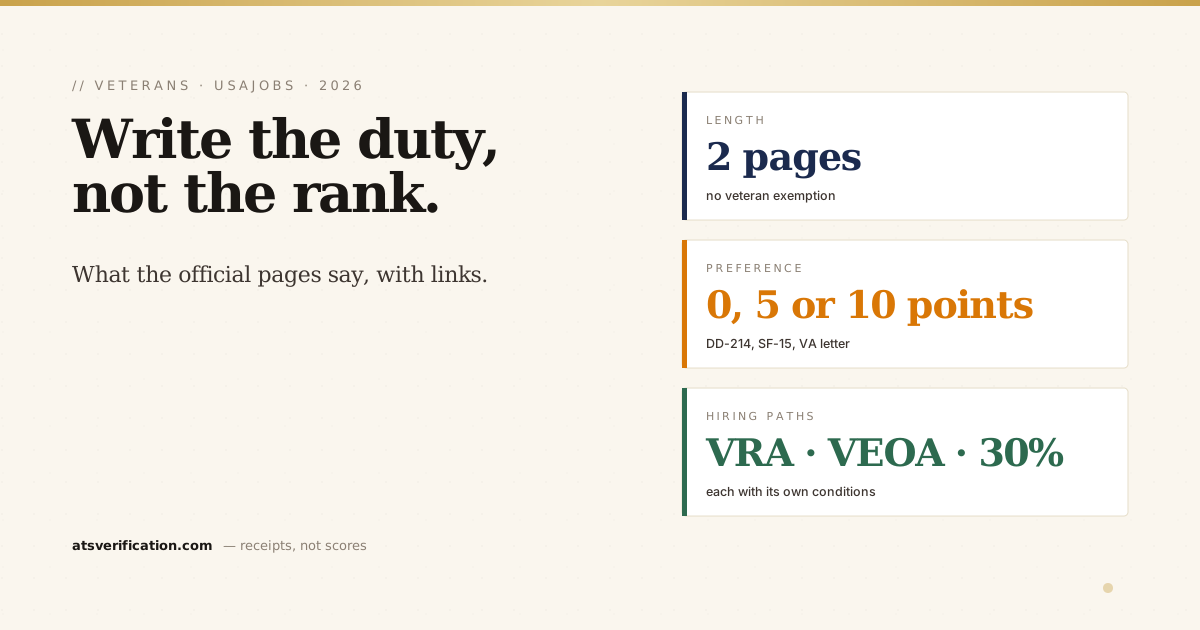
- The two-page limit applies to you. I found no exemption for veterans or for any veterans' hiring path.
- Write duties, not rank. OPM tells agencies to credit military experience by the duties performed, and USAJOBS tells you to avoid acronyms.
- Preference is a separate claim with its own papers: a DD-214, plus an SF-15 and a VA letter for 10-point preference.
- Preference does not guarantee a job and does not apply to promotions or transfers inside an agency.
- There are three main hiring paths for veterans (VRA, VEOA and 30 percent or more disabled), each with its own conditions.
The two-page rule has no veteran exemption
Since 27 September 2025 a federal resume can be two pages at most. OPM's guidance to agencies says the limit "applies to all competitive service and excepted service announcements under Title 5, internal and external, posted on USAJOBS or another platform." It also says that if the only resume you send is longer, you are "ineligible for further consideration." I looked for an exception for veterans and did not find one.
That is hard on a long military career, and it changes what the resume is for. You cannot list every assignment. Pick the assignments that prove the experience the announcement asks for, and let the rest go. I explain the rule and its few exceptions in the federal resume and USAJOBS guide.
Your DD-214, SF-15, VA letter and transcripts are uploaded as separate documents. Official pages always describe the limit as a limit on the resume, and the Merit Hiring Plan FAQ speaks of a two-page resume "and any other supporting documentation required by the hiring agency." I could not find one sentence that says outright that supporting documents are not counted, so read the "required documents" part of each announcement.
What every period of service needs on the page
USAJOBS asks for the same four things for each job, military or not: the employer, the job title, start and end dates with month and year, and the number of hours you worked per week. Its resume help page lists them. Treat each assignment that matters as its own job, with its own dates.
I found no special rule for hours per week during military service, so give a plain number. Full-time active duty is at least 40. Hours matter because part-time work is credited in proportion, which is why Guard and Reserve service needs an honest figure too.
Our free federal resume checker reads your file and tells you whether it is two pages or less and whether each job shows month and year dates and hours per week.
Write the duty, not the rank
Two official sentences settle how to describe military work. The USAJOBS help page says: "Use plain language. Avoid using acronyms and terms that are not easily understood. The hiring agency will not make assumptions about what's in your resume." And OPM's qualification policies tell human resources staff to credit military experience by the duties performed and not by rank.
So a specialist will not work out what a platoon sergeant or a petty officer first class did. If the page does not say it, it does not count. Write what you were responsible for, for how many people, with what equipment or budget, and what came of it.
I also could not find any official table that converts a military rank into a GS grade. Sites that publish one are giving an opinion. The test a specialist applies is different: most announcements ask for one year of specialized experience equal to the next lower grade, and the announcement describes that experience in a paragraph. Your job is to show that paragraph in your own service.
For the vocabulary, the Department of Labor sponsors two free tools. The O*NET Military Crosswalk takes your occupation code and returns civilian occupations with similar work, and My Next Move for Veterans does the same in simpler form. Use them to find the words civilians use. My military to civilian resume guide goes through the translation step by step.
Veterans' preference: what it is and what it is not
OPM's page for veteran job seekers is the source for this section. It names three kinds of preference: sole survivorship (0 points), non-disabled (5 points) and disabled (10 points).
| Code | Who | Points |
|---|---|---|
| CPS | Disability rating of 30% or more | 10 |
| CP | Disability rating of at least 10% but less than 30% | 10 |
| XP | Disability rating of less than 10% | 10 |
| TP | Preference eligibles with no disability rating | 5 |
| SSP | Sole survivorship preference | 0 |
Who qualifies depends on when and how you served, the character of your discharge and, for retirees, your rank at retirement. The OPM page gives the exact periods, and I will not paraphrase them here because the details decide real cases.
Two limits are worth knowing before you count on it. In OPM's words, preference "does not guarantee veterans a job and it does not apply to internal agency actions such as promotions, transfers, reassignments and reinstatements." It helps you compete for a new appointment. It does not move you up inside an agency you already work for.
The papers to attach
- DD-214. A copy that shows your dates of service and a discharge under honorable conditions. OPM calls the "member 4" copy preferable. Some announcements require it, so read each one.
- SF-15. Needed if you claim 10-point preference.
- A VA letter. For a disability-based claim, USAJOBS asks for a letter on VA letterhead with your overall combined service-connected disability rating. Its documents page lists what goes with each claim.
- If you are still serving. You can apply before you have a DD-214. The law lets you send a written certification from your service that you are expected to be discharged or released under honorable conditions within 120 days. The agency will ask for the DD-214 before it appoints you.
Three hiring paths made for veterans
These are separate from preference points. OPM is direct about them: "Veterans are not entitled to appointment under any of these authorities." They are ways an agency may hire you, sometimes without the usual competition.
| Path | Who it is for | What you get |
|---|---|---|
| Veterans Recruitment Appointment (VRA) | Disabled veterans, veterans with a campaign badge or an Armed Forces Service Medal, and veterans within three years of discharge | An appointment at any grade up to GS-11 or equivalent. After two years of satisfactory service you are converted to the competitive service. |
| Veterans Employment Opportunities Act (VEOA) | Preference eligibles, and veterans who substantially completed three or more years of active service under honorable conditions | The right to compete for jobs an agency advertises to candidates outside its own workforce under merit promotion. No points are added. |
| 30 percent or more disabled veteran | Veterans with a service-connected disability rating of 30% or more | A temporary or term appointment with no grade limit. The agency may later convert it to a permanent one. |
Each USAJOBS announcement says who it is open to and how the agency is filling the job. Read that part first, because these paths apply only where the announcement offers them, and each one asks for its own proof.
How you are ranked in 2026
This changed recently, and a lot of older advice is now wrong. Under a rule that took effect on 7 November 2025, an agency chooses one of two methods for each announcement.
- Rule of many. Candidates get a score. OPM's fact sheet on the rule of many and veterans' preference says the 5 or 10 points "are then added to passing scores, and applicants are listed on the certificate in score order." Ties are broken by preference.
- Category rating. Candidates are sorted into quality groups. No points are added. Preference eligibles are listed ahead of others in the same group.
Under the rule of many, veterans with a disability rating of 10% or more go to the top of the list, with one exception: scientific and professional jobs at GS-9 and above.
Two more changes affect every applicant. Agencies no longer rate and rank you on a questionnaire where you score yourself, and they must use at least one technical or alternative assessment before they send a list of candidates to the manager. And the short essay questions some announcements include are optional for you: OPM's Merit Hiring Plan FAQ says the answers "are not scored or rated" and that skipping them does not disqualify you.
Before you apply
Three checks. Count the pages in the file you will actually upload. Read each period of service as a stranger would and replace anything only the military would understand. Then check that every job has a month and year at both ends and a number of hours, which our free checker does in about half a minute.
If you want to see finished two-page federal resumes, we made examples for six common job series, and builder or upload explains how to get yours into USAJOBS. And if you are also applying to companies, that is a different document with different rules: the US resume format guide covers it, and our free scan shows you what company hiring software reads from your file.