The GPA question gets answered badly in both directions. One camp says always include it, the other says never, and both are stating a preference as if it were a rule. There is actual data on this, it moved a lot in the last six years, and the answer depends on three things you can check in about a minute. I also run a resume parser, so I can tell you the part nobody covers: the way people format the GPA line breaks more applications than the number itself ever does.
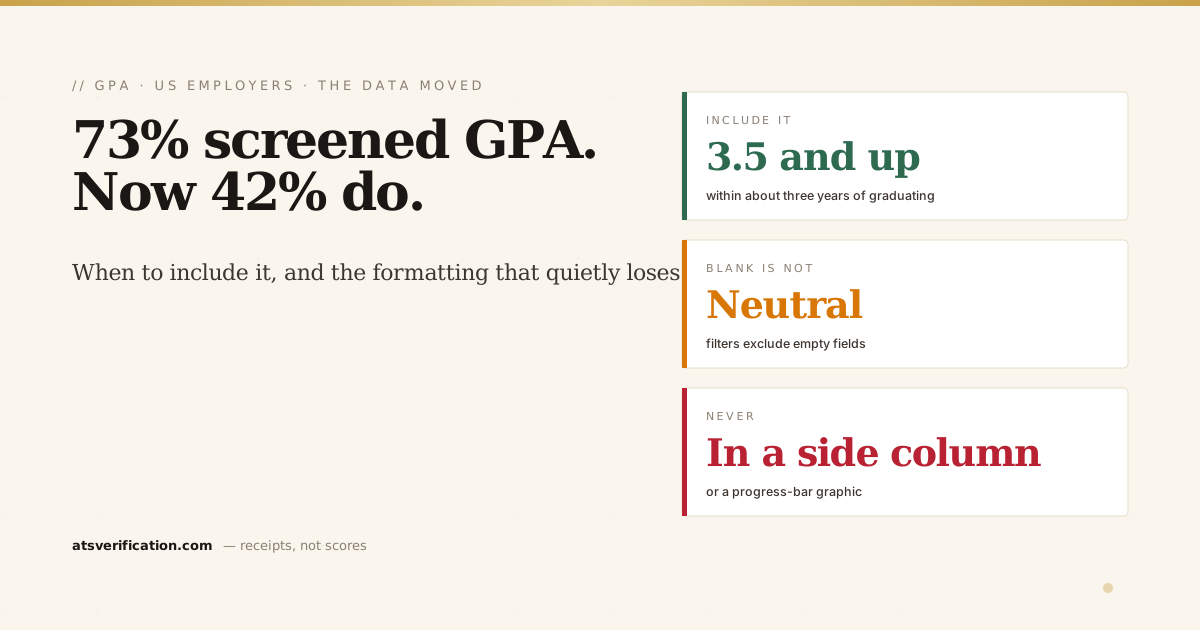
- 42 percent of employers plan to screen GPA in 2026, down from 73 percent in 2019. The majority no longer filter on it, but a large minority still does.
- Include it if it is 3.5 or above and you graduated within about three years. Below 3.0, leave it off and let the rest of the resume carry you.
- Blank is not neutral on platforms with a filter. On Handshake a minimum-GPA search simply does not return an empty field.
- Label it. A bare "3.7" floating under a degree is ambiguous to a parser. "GPA: 3.7/4.0" is not.
- Never put it in a side column or a table cell. That is the single most common parsing failure I see, in 41.8 percent of scanned resumes.
What employers actually do with GPA now
The National Association of Colleges and Employers surveys American employers on this every year, and the trend is one of the clearest in college recruiting. In the NACE Job Outlook 2026 Spring Update, 42 percent of employers said they plan to screen candidates by GPA. In 2019 that figure was 73 percent.
Both halves of that sentence matter. GPA screening has collapsed, and it has not disappeared. Roughly two in five employers still use it, and they skew towards the places that get the most applications per seat: large banks, consulting firms, big technology programs and rotational graduate schemes.
What replaced it is more interesting. Among employers who do not screen on GPA, the qualifications they weigh most are academic major at around 94 percent, industry experience at about 81 percent, an industry internship at about 79 percent, and an internship with their own organisation at about 74 percent.
Read that as a ranking of what to spend your effort on. Your major is fixed. Your GPA is mostly fixed. An internship is the one lever still moving, which is why the recruiting timeline deserves more of your attention than this question does.
The decision, in three checks
Check one, the number. 3.5 and above, include it. 3.0 to 3.49, include it when the posting asks for a minimum you clear, or when you are applying to a smaller employer where a human reads everything, and leave it off otherwise. Below 3.0, leave it off. Nobody has ever been rejected for omitting a GPA, and a weak one gives a screener a reason before they reach your bullets.
Check two, how long ago you graduated. GPA is a proxy for people who have nothing better to show. Once you have two or three years of real work, it stops helping and starts looking like you could not find anything more recent to be proud of. Take it off with your graduation year still on the page.
Check three, whether the posting asks. If a job posting states a minimum GPA, it is a filter and you must answer it. If an application form has a GPA field, that field is searchable and sortable regardless of what your resume says. Leaving a required field blank on a form is a different act from leaving it off a document.
The blank field trap
This is the part that surprises students. On a resume, omitting your GPA is a neutral act. On a platform with a structured GPA field, it is not.
Handshake employers can filter student searches by an overall and departmental GPA range, and can set a minimum GPA on a posting. A profile with no GPA is not treated as "unknown, worth a look". It falls out of the result set. You will never see a rejection, because there was no application. There is more on how those filters work in the Handshake guide.
So the honest position is this. If your GPA is weak, keeping it off your resume is sensible and keeping it out of a filterable field costs you appearances in searches you might have survived. There is no answer that wins both. My own view: below 3.0, take the exclusion and put your energy into internships and projects, because a 2.7 in a filter you technically passed still loses to a 3.6 in the same list.
Major GPA, and the honest version of it
A major GPA of 3.7 alongside an overall of 3.1 is a real and common situation, usually meaning someone found their subject after a rough first year. You are allowed to show it. You are not allowed to show only the flattering one and label it as if it were the other.
GPA: 3.1/4.0 (Major GPA: 3.7/4.0)Both numbers, both labelled. If you show only the major GPA, label it "Major GPA" every time it appears. Writing "GPA: 3.7" when your transcript says 3.1 is the kind of thing that gets caught at offer stage when the transcript arrives, and that is a far worse day than not getting the interview.
The same rule covers an upward trend. "GPA: 3.2/4.0 (3.8 final two years)" is honest, specific and often more persuasive than a flat 3.5, because it tells a story about someone who figured it out.
Latin honors, Dean's List and the rest
These are American conventions and they confuse international applicants constantly, so, plainly:
- Latin honors are cum laude, magna cum laude and summa cum laude, in ascending order. Conventionally lowercase and italicised. They belong on the degree line or the line directly under it, not in a separate awards section three inches away from the degree they describe.
- Dean's List means something only with a count. "Dean's List" alone could be one semester. "Dean's List, 5 of 6 semesters" is a fact.
- Honor societies such as Phi Beta Kappa carry weight with people who know them and mean nothing to those who do not. One line, no explanation.
- Scholarships are worth listing when they were competitive and you can say so briefly. "Merit scholarship, awarded to 12 of 400 applicants" does work that "Recipient, University Scholarship" does not.
Here is the whole education block, correctly assembled:
EDUCATION

University of Somewhere, City, ST
Bachelor of Science in Finance, magna cum laude, May 2027 (expected)
GPA: 3.7/4.0 | Dean's List, 5 of 6 semesters
Relevant Coursework: Corporate Finance, Financial Modeling,
Econometrics, Financial Accounting II
Where this actually goes wrong: the formatting
I have put 4,737 resumes through a parser. GPA problems in the extracted text are almost never about the number. They are about where it was sitting.
The side column. The most popular student templates put education, GPA and skills in a narrow left rail. A parser reconstructs reading order from position on the page, so it tends to read that whole rail as one block and then the main body as another. Your GPA detaches from your degree, and sometimes lands next to an unrelated heading. Two-column layouts scramble in 10.9 percent of the files I scan, and content stuck in a table or grid flattens in 41.8 percent, which is the single most common failure in the dataset. The mechanics are in two-column resumes and tables on resumes.
The unlabelled number. "3.7/4.0" on its own line under a degree is ambiguous. Write "GPA: 3.7/4.0". The label is the thing a keyword search and a human skim both look for.
The graphic. Some templates draw GPA as a progress bar, a ring or a set of filled dots. That is an image. It extracts as nothing at all, which means a resume that displays a 3.9 to a human transmits no GPA whatsoever to the software. Same problem as a skills chart, and the same fix: write the number.
The coursework grid. Relevant coursework arranged in three neat columns is the classic student space-saver, and it is exactly the layout that reads across instead of down. "Corporate Finance Statistics Marketing" becomes one glued line, and a recruiter searching for "econometrics" misses you. Write it as one comma-separated sentence at full width. It fits more than the grid does anyway.
The slash. Rare but real: "3.7/4.0" occasionally tokenises as one string, so a search for "3.7" does not match. Not worth losing sleep over, and a reason to also write the number somewhere in prose if it is genuinely a selling point, for instance in your summary line.
What to write instead when you leave it off
An education block with no GPA should not look empty. Fill the space with things that are true:
- Relevant coursework, as a plain comma-separated line.
- A capstone, thesis or research project with a one-line outcome.
- Any teaching assistantship, lab role or tutoring, which is work experience and belongs in experience if it was paid.
- Hours worked per week if you were funding your own degree. "Worked 25 hours per week throughout" reframes a 3.0 without ever mentioning it.
And then move the weight of the resume to the parts that survive scrutiny. Quantified bullets do more for you than any number after "GPA", and quantifying achievements is the piece to read next. If you have no formal experience yet, the fresh graduate guide covers what fills the gap, and the general American conventions are in the US resume format guide.
The thirty-second verification
Open your resume, select all, copy, paste it into Notepad or TextEdit. Find your education block. Is the GPA still directly under the degree it belongs to? Is it still labelled? Did your coursework stay as separate readable items?
If yes, the number is doing its job. If it drifted somewhere else in the text, that is what a recruiter's database now contains, and no amount of arguing about whether to include a GPA matters when the software could not attach it to a degree.
The percentages here come from a live counter that recounts on every page load. It read 4,737 resumes the day I wrote this, and it will read something different when you check.
→ Run the free scan and see whether your education block survives extraction