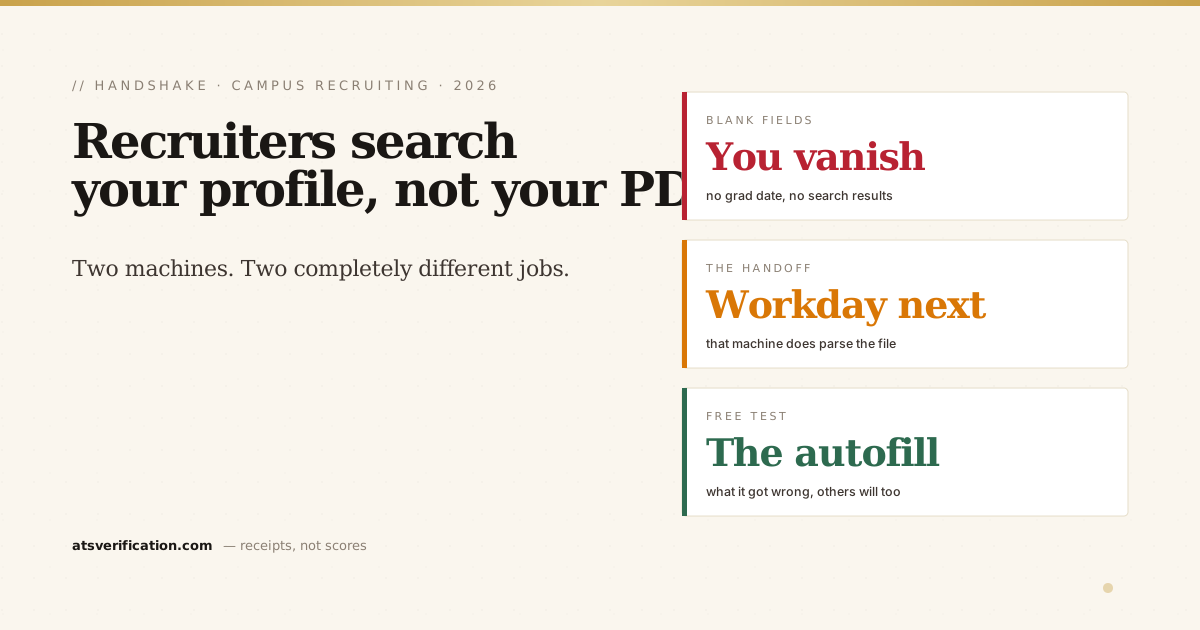
I did not go to college in the United States, so I will not pretend to know what your career center told you. What I have is a resume parser and 4,737 real files that have been through it, a good number of them student resumes, and one pattern that keeps coming back from American students: they upload a resume to Handshake, apply to thirty postings, hear nothing, and assume the resume is the problem. Sometimes it is. Often it is not, because Handshake does not work the way an applicant tracking system works, and almost nobody explains the difference.
- Handshake is a marketplace, not an ATS. When employers search for students, they filter on structured profile fields, not on the text inside your uploaded PDF.
- Empty fields make you invisible. No graduation date, no GPA, no skills means you fall out of every filtered search that uses them, and you never find out.
- There is a second machine. Many Handshake listings hand you off to the employer's own Workday or Greenhouse, and that one does parse your file.
- The autofill is a free parser test. If Handshake ever filled your profile from your resume and got it wrong, that is a preview of what every other parser will do with the same file.
- Check your visibility settings. Since 29 May 2026, resumes uploaded to My Documents are employer-visible by default.
Two machines, two completely different jobs
Handshake reaches roughly 25 million people, more than 1,600 educational institutions and about a million employers, according to its own about page. For American students it is effectively the front door to campus recruiting.
But it is doing something different from Workday or Greenhouse. An applicant tracking system receives a file, parses it into fields, and stores the result. Handshake stores a profile you filled in yourself, and lets employers search across profiles.
That distinction sounds academic until you look at what recruiters can actually filter on. Per Handshake's own help documentation, employers searching for students can narrow by class level, major group, individual majors, a graduation date range, an overall and departmental GPA range, and the career interests and skills students have added to their profiles. When they post a job they can set qualifications including work authorization, skills, school year, latest graduation date, major groups and minimum GPA.
Read that list again and notice what is missing. None of it comes from your resume. Every single filter reads a field you typed into a form.
The empty field problem
This is the failure I would fix first, because it costs nothing and it is completely invisible.
If a recruiter searches for finance majors graduating between December 2026 and June 2027 with a GPA of 3.2 or above, the search returns profiles where all three fields are populated and match. A profile with a blank graduation date is not "maybe". It is not returned. You are not rejected, you are absent, and there is no notification for absent.
So, in order:
- Graduation date. Non-negotiable. Nearly every internship and new-grad search bounds on it.
- Major, and the right major group. The group is what most searches use, so check yours is mapped to something sensible rather than left generic.
- Skills. These are searchable tokens. Add the actual named tools and methods, spelled the way the industry spells them. The same logic as listing skills on a resume, except here they are database entries rather than words in a document.
- Work authorization. Employers filter on it directly, and the options include open to sponsorship, open to OPT and open to CPT. If you are an international student this field decides which searches you appear in before anyone reads a word you wrote. That deserves its own treatment, which is in the work authorization and sponsorship guide.
- GPA. The honest one. Leaving it blank keeps you out of every minimum-GPA search, and entering a weak one puts you in some searches you will lose. There is a real trade-off here and I have written it out properly in should you put your GPA on a resume.
The second machine, which does read your PDF
Plenty of Handshake postings are not really Handshake applications. You click apply and land on the employer's own careers site, which is running Workday, Greenhouse, iCIMS or Lever. Now your file is being parsed, and every formatting rule I write about applies in full.
Here is what my parser sees across all 4,737 resumes it has read:
- 41.8 percent have content trapped in a table or grid that flattens into unreadable text.
- 26.5 percent have a name the parser cannot isolate.
- 16.6 percent use decorative or icon bullets that extract as junk characters.
- 10.9 percent use a two-column layout that scrambles reading order.
Student resumes are over-represented in the table failures, and I think I know why. The template that fits a lot of activities into one page usually does it with columns, and the layout that looks organised to a human is the layout that reads across instead of down. There is a full explanation in two-column resumes and ATS and in what happens to tables.
If the posting sent you to Workday specifically, read the twelve patterns Workday chokes on first, because Workday makes you review the parsed output and most students click through it without looking at what it got wrong.
The autofill is the cheapest parser test you will ever get
Handshake has offered a "Build Profile from Resume" option that reads your uploaded file and fills profile sections from it, and it asks you to review and approve the result before anything goes live. Availability has moved around across schools and releases, so you may or may not see the button.
If you do see it, use it deliberately. Whatever it pulls out is a parse of your file. If your name came through as your name, your degree landed in education and your jobs landed as jobs, your file has structure a machine can find. If it produced nonsense, mislabelled your internship or missed half your experience, do not just fix the profile by hand and move on. Fix the resume, because every other parser that touches that file will make the same mistakes, and none of them will ask you to review the result.
That review-and-approve step is the whole idea behind the copy-paste test, which works on any file in thirty seconds without needing an account.
Visibility, and one privacy point worth thirty seconds
Handshake changed the default on 29 May 2026 so that resumes uploaded through My Documents are employer-visible unless you say otherwise, and profiles can be set to community or employer visibility. More visibility genuinely helps: recruiters do reach out to students they find rather than students who applied.
Just know what you are publishing. A visible resume is a document strangers can download. Put your city and state, not your street address, which is what the address guide recommends for every American resume anyway. Keep your phone and email on it, because a recruiter who cannot contact you outside the platform often will not bother.
The format that survives both machines
One column, full width, no text boxes, no side rail. This is the entire skeleton:
FIRST LAST
City, ST • (555) 555-5555 • name@school.edu • linkedin.com/in/handle

EDUCATION
University of Somewhere, City, ST
Bachelor of Science in Finance, Expected May 2027
GPA: 3.6/4.0 | Dean's List, 3 semesters
Relevant Coursework: Corporate Finance, Financial Modeling,
Statistics, Accounting I and II

EXPERIENCE
Finance Intern                              Jun 2026 to Aug 2026
Regional Bank, City, ST
• Bullet with a number in it
• Bullet with a number in it

Barista                                     Sep 2025 to May 2026
Campus Dining Services, City, ST
• Bullet with a number in it

LEADERSHIP AND ACTIVITIES
Treasurer, Finance Club                     Aug 2025 to Present
• Bullet with a number in it

SKILLS
Excel (advanced), Python, SQL, Tableau, Bloomberg Terminal
Coursework as a plain comma-separated line, not a three-column grid. Job title and dates on the same line with a tab stop, employer underneath, which is the grouping parsers rely on and is covered in the experience section guide. One page, because at this stage you have one page of material and length is not the variable that matters.
The wider American conventions, no photo, no date of birth, accomplishments rather than duties, are in the US resume format guide, and if you have no internships yet, the fresh graduate guide covers what goes in the gap.
Timing beats formatting
One last thing, and for interns it may matter more than anything above. American summer recruiting runs almost a year ahead. Large tech and banking programs open from July, and September and October are peak. A perfect resume submitted in February for a summer that recruited in September is a perfect resume that arrives after the seats are gone. The dates by industry are in the summer internship timeline.
The five-minute audit
Open Handshake and do this in order. Fill graduation date, major, skills and work authorization. Decide on GPA and act on the decision. Check your profile and resume visibility settings and set them on purpose rather than by default. Then take the resume you uploaded, select all, copy it into a blank text file, and read what comes out.
If your name is intact, your dates are still beside their jobs and your coursework has not fused into one long word, the file is fine and your problem was the profile fields. If it comes out scrambled, the profile fields were never the problem.
Every percentage in this piece comes from a live counter that recounts on each page load. It read 4,737 resumes the day I wrote this.
→ Run the free scan and see the text a recruiter's system extracts from your file