I need to be clear about what this is before you read it. I am not an immigration attorney and this is not immigration advice. Your Designated School Official and the official government pages are the only sources worth trusting on your status, and the rules genuinely do change mid-cycle. What I can tell you about is the machinery: how American application forms handle work authorization, why the answer you give there decides more than your resume does, and the one line worth putting on the page. That part does not change, and almost nobody explains it to international students until they have already lost fifty applications to it.
- Two questions do the filtering, and neither reads your resume. They are form fields, answered before anything is parsed.
- For most F-1 students the honest answers are yes and yes. You are authorized now, and you will require sponsorship later. Those are not contradictory.
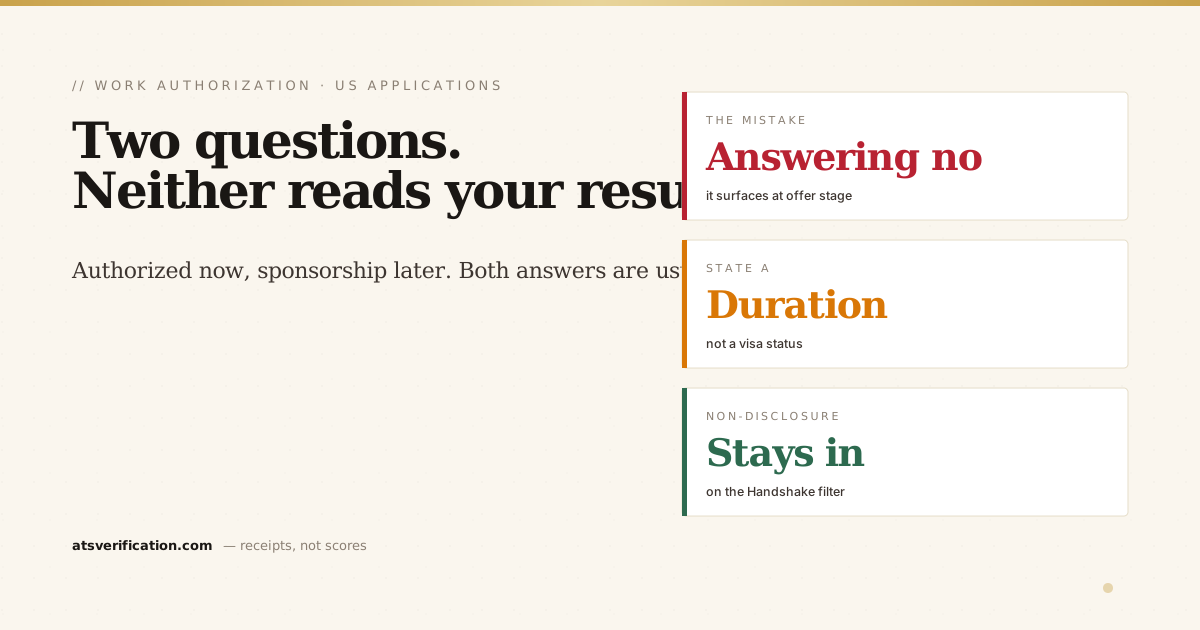
- Answering "no" to the sponsorship question because you are on OPT is the classic mistake. It surfaces at offer stage, which is a far worse moment.
- Handshake filters on work authorization directly. Employers set a requirement and the field decides whether you appear at all.
- Never put visa status, passport number, nationality, date of birth or a photo on a US resume. One plain authorization line is the most that belongs there.
The two questions
Nearly every US application form, whether it is Workday, Greenhouse, iCIMS or a small company's own page, asks some version of these:
- Are you legally authorized to work in the United States?
- Will you now, or in the future, require sponsorship for employment visa status?
They are two different questions about two different moments, and the confusion between them costs international students more applications than any formatting problem I write about.
Question one is about right now. If you hold valid CPT or OPT authorization for the period in question, you are authorized to work.
Question two is about the future. It asks whether the employer will at some point have to file something on your behalf so you can keep working. For an F-1 student whose OPT will eventually run out, the answer is yes.
So the honest pair of answers for most international students is yes, and yes. Those two answers together are not a contradiction and they do not look like one to anyone who reads applications for a living.
Why "no" to the second question is the expensive mistake
I understand the temptation completely. You are on OPT, you can work for the next two or three years without the employer filing anything, and the sponsorship question feels like it is about someone else. So you answer no, get through the filter, and interview.
Then the offer comes, the background and onboarding paperwork starts, your I-9 and status are discussed properly, and it emerges that sponsorship will be required after all. Now a company that was happy to hire you has an inconsistency on record from your own application. Some employers absorb it. Some withdraw. Either way you have converted a manageable filter into a trust problem at the worst possible moment.
The filter is legal, the employers using it know exactly what they are doing, and the honest answer keeps you eligible everywhere that was ever going to hire you.
Read the posting language, it is precise
American postings use a small set of phrases and they mean specific things:
- "Must be authorized to work in the US without sponsorship now or in the future." A hard filter. If you will need sponsorship, this posting is closed to you. Do not spend an application on it.
- "We are unable to sponsor or take over sponsorship of an employment visa at this time." Same meaning, softer wording, and note "at this time", which means next year may differ.
- "Candidates must have unrestricted work authorization." Usually the same filter.
- "Visa sponsorship available" or "we sponsor eligible candidates." Apply.
- Nothing at all about it. Apply, and answer the form questions honestly. Silence is not a no.
Being ruthless about the first three is the single biggest efficiency gain available to an international student. Fifty applications into postings that state a hard no is fifty applications that were never going to be read, and it is time you could spend on employers who file petitions every year.
The Handshake field, which runs before any of this
On Handshake, work authorization is not just a question at the end of an application. It is a filter employers use to build the candidate list in the first place. The work authorization options include open to US visa sponsorship, open to Optional Practical Training, open to Curricular Practical Training, and no US work authorization required.
One detail worth knowing: Handshake's documentation notes that when an employer sets a work authorization qualification, candidates who meet the requirement or who choose not to disclose are included. So non-disclosure is not the same as being excluded, which is a genuinely useful piece of information and one of the few places where saying nothing keeps a door open rather than closing it.
The rest of the Handshake filter set, graduation date, major group, GPA range and skills, works the same way and is covered in the Handshake guide. Those fields decide whether you appear in a search at all, long before a resume is read.
The one line worth putting on the resume
Most of the time the resume should say nothing about this, because the form already asks. There is one situation where a line earns its place: when your authorization means the employer needs to do nothing for a long time, and you want that visible before anyone assumes otherwise.
The useful version is a duration, not a status:
Work authorization: eligible for 36 months of F-1 OPT
(12 months plus 24-month STEM extension)
Post-completion OPT allows up to 12 months of full-time work, and students in eligible STEM fields may apply for a 24-month extension, for up to 36 months in total. Those durations come from the Department of Homeland Security's STEM OPT hub, which along with USCIS and your DSO is where you should confirm anything that applies to you personally.
Three years of runway is a real answer to a real hiring concern, and it is worth one line. "F-1 visa holder" on its own is not, because it gives a recruiter a category to worry about with no number attached to it.
Where the line goes: plain text, full page width, either directly under your contact details or as the last line of the resume. Not in a header or footer, where text is invisible to some parsers, which is covered in headers and footers. Not in a side column, which parsers detach from the main body. Not in a text box.
What must never go on a US resume
This is where resume conventions from India, China, Pakistan, Nigeria, Brazil and much of Europe collide with American practice, and the American version is stricter than almost anywhere else.
Leave off your photo, date of birth, age, marital status, gender, nationality, passport number, visa number and religion. United States anti-discrimination practice means many recruiters are trained to discard or redact resumes containing them, and a photo also creates a parsing problem in its own right, covered in photos and ATS. The full set of American conventions is in the US resume format guide, and if you are applying from India specifically there is a version written for that transition in the India to US guide.
One more, gently: a US phone number and a US city and state on your resume remove a small doubt at no cost. If you are already studying in the States, use your campus city, not your home country address.
The employers who actually sponsor
Sponsorship policy shifts with the political weather, and the last two years have been unusually noisy, including litigation over H-1B fees that is still moving. I am not going to write a number here that will be wrong by the time you read it.
What is durable is the shape of the market. Large technology firms, consultancies, banks, pharmaceutical companies, engineering firms and universities file petitions every year and have processes for it. Small businesses, most local employers and a lot of the public sector do not, and it is usually a capability question rather than a preference. Anyone who filed for someone in your role last year can probably do it again.
Two practical moves. First, ask your international student office which employers have hired students from your school on OPT recently, because that list exists and it is better than any guess. Second, target the employers where an internship converts, since converting an intern is the cheapest possible path to a sponsored hire and conversion rates are at a five-year high. The timing for that is in the internship timeline, and the recruiting calendar starts far earlier than most international students expect.
Then make sure the file itself parses
All of the above is wasted if the resume behind it does not extract. Across 4,737 resumes scanned, 41.8 percent have content trapped in a table or grid, 26.5 percent have a name the software cannot isolate, and 16.6 percent use decorative bullets that come through as junk. Names are worth special attention here, because parsers are trained mostly on Western name patterns and a longer or multi-part name is more likely to be split, truncated or read as two fields. That failure and its fixes are in when the ATS cannot read your name.
Take your resume, select all, copy it, paste it into a blank text file, and read what comes out. Your name, your dates, your authorization line. If all three survived, the machinery is on your side for once.
The percentages come from a live counter that recounts on every page load. For anything about your own status, ask your DSO.
→ Run the free scan and see exactly what a US employer's system extracts from your file