American internship recruiting has a feature that catches almost every student once, and it has nothing to do with how good your resume is. The seats for next summer are largely filled before this year's leaves turn. If you are reading this in late August 2026 and you want an internship in Summer 2027, you are not early. You are roughly on time, and for some industries you are already a little late.
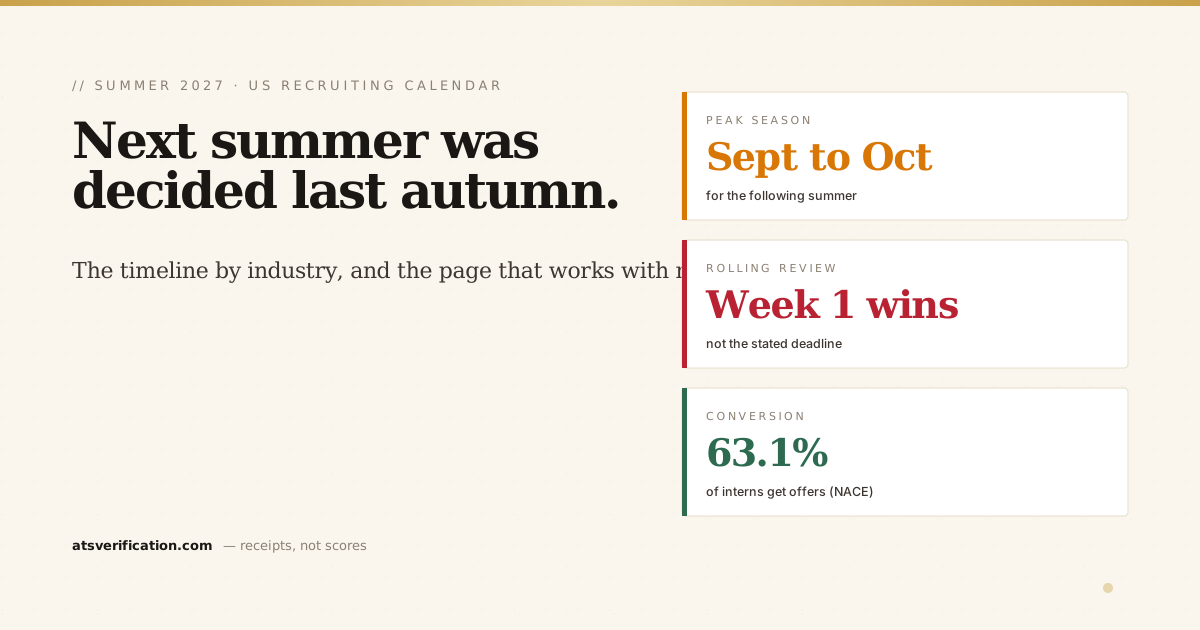
- Summer 2027 recruiting is open now. Large tech and banking programs began posting in July and August 2026, and September to October is peak.
- Most large programs review on a rolling basis. Applying in week one of a posting beats a better resume in week six.
- The internship is the highest-leverage thing on a student resume. Intern conversion to full-time offers is at a five-year high.
- You do not need an internship to write an internship resume. Campus jobs, research, coursework projects and club leadership all count when written with numbers.
- One column, no grids. Table and grid layouts flatten in 41.8 percent of the resumes I scan, and student templates are the worst offenders.
The timeline, by industry
These windows shift a few weeks each cycle, but the shape holds every year:
| Industry | Applications open | Realistic deadline |
|---|---|---|
| Investment banking, sales and trading | Jul to Aug 2026 | Sept to Oct 2026 |
| Management consulting | Aug 2026 | Sept to Nov 2026 |
| Big tech and quant | Jul to Sept 2026 | Sept to Dec 2026 |
| Big 4 audit, tax and advisory | Aug to Sept 2026 | Oct to Nov 2026 |
| Fortune 500 rotational programs | Sept to Oct 2026 | Nov 2026 to Jan 2027 |
| Government and federal | Varies, often Oct to Jan | Posting-specific, hard close |
| Startups, nonprofits, local employers | Jan to Apr 2027 | Rolling, right up to May |
That last row is the one to hold on to if the calendar above has already made you anxious. Smaller employers hire on a normal human timescale, in the spring, for the summer that is actually approaching. They are also where a lot of people get their genuinely useful first internship, because you do real work instead of a curated project.
The federal route runs on its own rules entirely, including a document format that inverts almost every convention on this page. That is covered separately in the USAJOBS guide.
Rolling review is the actual mechanic
Large programs almost never wait for a deadline and then compare everyone. They open, they review as applications arrive, and they schedule interviews continuously. By the stated deadline a meaningful share of the class is already through.
The practical consequence is uncomfortable but simple. A good resume submitted in week one outperforms a better resume submitted in week six, at the same company, for the same role. So the correct sequence is to fix the resume once, properly, in August, and then apply fast for three months, rather than polishing through October and applying in November.
If you take one thing from this article, take that.
Why the internship matters more than the grade
The National Association of Colleges and Employers tracks what happens to interns, and the number is striking: intern conversion to full-time offers reached its highest mark in five years, at 63.1 percent for the 2024 to 2025 intern class. NACE also reported that employers expected to hire nearly 4 percent more interns this year.
Put next to the collapse in GPA screening, from 73 percent of employers in 2019 to 42 percent in 2026, the picture is clear. The internship is where the leverage went. Nearly two thirds of interns convert, and for employers who no longer screen on GPA, an internship with their own organisation ranks near the top of what they weigh. The GPA question still has a right answer, which is in the GPA guide, it just is not the answer worth most of your time.
The resume, when you have never had an internship
This is the real question behind the search, and the honest answer is that you have more material than you think. You are not missing experience. You are missing the habit of writing what you did in the form an employer reads.
Four sources, in rough order of usefulness:
Paid work of any kind. Retail, food service, campus dining, lifeguarding, warehouse, tutoring. Do not hide it and do not apologise for it. A student who worked twenty hours a week through a semester has demonstrated something a project cannot. Write it as a job, with a title, an employer, dates and bullets that carry numbers.
Research and teaching roles. Lab assistant, research assistant, TA, grader, writing centre tutor. If it was paid or for credit, it is experience. Name the professor's lab or the course.
Coursework projects, when they produced something. A capstone, a build, a model, a dataset, a study. One project written properly beats five listed by name. Say what it was, what you used, and what came out.
Leadership and activities. The section Americans undersell most, so it gets its own heading below.
Clubs, Greek life and campus leadership
Students ask constantly whether fraternity and sorority involvement belongs on a resume. The answer is yes, when it was a role with responsibility, and it should be written as a role rather than as a membership.
"Member, Sigma Chi" tells a recruiter one thing about you, and it is not a professional thing. "Treasurer, Sigma Chi, managed a $48,000 annual budget across 9 committees and cut vendor costs 14 percent" is a finance bullet that happens to have taken place in a fraternity. Same for a sorority recruitment chair who ran a two-week operation for 200 people, a philanthropy chair who raised a specific sum, or a house manager who handled a lease and a maintenance budget.
The same conversion works everywhere on campus. Club treasurer is budget ownership. Event chair is project management. Student government is stakeholder work. Section leader in a marching band is people management. Division I athlete is twenty-plus hours a week of scheduled commitment, and recruiters know exactly what that costs.
Two cautions. Keep the section proportionate, roughly two to four entries, not twelve. And be aware that anything identifying a religious or political organisation is information a recruiter cannot legally use and some would rather not see. It is your call, and there is no wrong answer, but make it a decision rather than an accident.
LEADERSHIP AND ACTIVITIES

Treasurer, Sigma Chi Fraternity          Aug 2025 to Present
• Managed a $48,000 annual budget across 9 committees; cut
  vendor costs 14% by re-tendering three contracts
• Built the chapter's first monthly reporting pack, adopted
  by the following two treasurers

Volunteer Tax Preparer, VITA Program     Jan 2026 to Apr 2026
• Prepared 41 federal returns for low-income filers; IRS
  certified at the Advanced level
Bullets, in the only format that works
Every bullet is a verb, a thing, and a number. If a bullet has no number in it, ask what you counted, what changed, how many people, how long it took, or how much money moved. Something in there is countable.
Weak: Responsible for social media for the club.
Better: Grew the club's Instagram from 340 to 1,900 followers in one semester by posting three times a week, lifting event attendance from about 20 to 65.
Weak: Worked as a barista.
Better: Served roughly 200 customers per shift during peak hours; trained 4 new hires on the espresso station and closing procedure.
The long version of that method is in quantifying achievements, and if you want a structure to hang each bullet on, STAR versus XYZ compares the two that actually work.
The page itself
One page. One column, full width. No side rail, no icons, no headshot, no skills bars. Education first while you are a student, experience second, leadership third, skills last.
FIRST LAST
City, ST • (555) 555-5555 • name@school.edu • linkedin.com/in/handle

EDUCATION
University of Somewhere, City, ST
Bachelor of Science in Finance, Expected May 2028
GPA: 3.6/4.0 | Dean's List, 2 semesters
Relevant Coursework: Corporate Finance, Financial Modeling,
Statistics, Financial Accounting

EXPERIENCE
Barista and Shift Lead                    Sep 2025 to Present
Campus Dining Services, City, ST
• Bullet with a number
• Bullet with a number

Research Assistant                        Jan 2026 to May 2026
Department of Economics, University of Somewhere
• Bullet with a number

LEADERSHIP AND ACTIVITIES
Treasurer, Finance Club                   Aug 2025 to Present
• Bullet with a number

SKILLS
Excel (advanced), Python, SQL, Tableau, Bloomberg Terminal
Coursework as one comma-separated line, never a three-column grid. Job title and dates on the same line with a tab stop, employer underneath, which is the grouping every parser depends on and is explained in the experience section guide.
Why so plain? Because of what I see in the files. Across 4,737 scanned resumes, 41.8 percent have content trapped in a table or grid that flattens into unreadable text, 26.5 percent have a name the parser cannot isolate, and 16.6 percent use decorative bullets that come through as junk characters. Student resumes lean heavily on the templates that cause exactly these problems, because a grid is how you make a thin resume look full. It looks full to you and reads as noise to the software.
The three things that are not your resume
The application form. Most large employers ask you to review the parsed version of your resume before submitting. Read that screen. It is the only time a company will show you what its system extracted, and if your jobs came through mangled you can fix them right there. Workday in particular is worth understanding before you meet it thirty times this autumn: the twelve patterns it chokes on.
Your profile fields. On Handshake, employers search students by major, graduation date range, GPA range, skills and work authorization. Those filters read fields you typed, not your resume. A blank graduation date means you do not appear at all. Details in the Handshake guide, and international students should also read the work authorization guide, because that filter runs before anyone reads anything.
The cover letter. For internships it matters more than it does later, because there is less on the resume to go on. Three short paragraphs. There is an internship example among the cover letter examples.
What to do this week
- Rebuild the resume once, in one column, with numbers in every bullet. One evening.
- Copy it into a plain text file and check your name, dates and coursework survived.
- Fill every field on your Handshake profile, especially graduation date.
- Build a list of twenty target employers and check which have already opened.
- Apply within the first week of every posting that opens from here to December.
Then stop editing. The resume is not the variable any more. Volume and timing are.
The parsing percentages come from a live counter that recounts on every page load, and there is more on the student and new-grad case at the internships page.
→ Run the free scan before you send the first application, not after the fortieth