Almost every piece of resume advice on the internet, including most of mine, assumes you are applying into Workday or Greenhouse. Public school teachers are not. K-12 districts run a completely different family of software, it behaves in the opposite way, and the practical consequences are large enough that following general ATS advice will have you optimising the wrong document. I build a resume parser, so I spend my time on how files are read. This is the one profession where I have to start by telling you the file is not the main event.
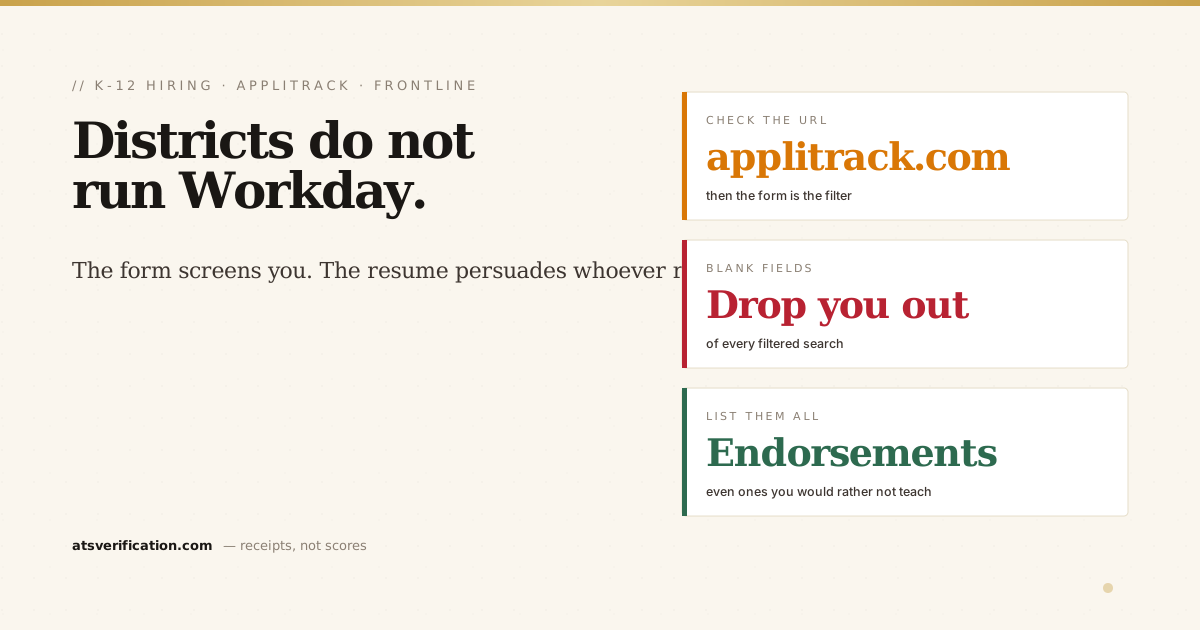
- Check the URL. If the application lives on applitrack.com, you are in Frontline's system and the long form is what screens you, not your resume.
- The form fields are the searchable record. Certification, endorsements, grade bands and subjects entered there are what an administrator filters on.
- Fill every optional field. Blank fields do not read as neutral, they drop you out of filtered searches.
- Your references are part of the application, not a follow-up. Many districts email reference surveys automatically, and a slow referee stalls your file.
- The resume still has a job. A human reads it, so it must carry outcomes and numbers, and it must survive being attached and read on a phone.
How to tell which system you are in
Look at the address bar. If it reads something like applitrack.com/yourdistrict/onlineapp/, you are in Frontline Recruiting & Hiring, the product still widely known by its old name, AppliTrack. It is used by districts across the country and it is the system most American teachers meet.
You may also encounter TalentEd, SearchSoft, or a state-run job board that feeds into one of these. Some large urban districts have moved to enterprise platforms such as Workday, and a handful use PowerSchool's hiring products. The behaviour I am describing holds for the AppliTrack family, which is the majority case.
The defining feature is that it is form-first. You complete a long structured application — sometimes forty or fifty fields across several pages — covering your certification, endorsements, grade levels, subject areas, experience, education, references and a set of written responses. Your resume is attached to that.
Why that inverts the usual advice
In an enterprise ATS, the resume is parsed into fields and the parse is where things break. That is the failure I write about constantly: 41.7% of the resumes I scan have content flattened out of a table, 26.6% have a name the software cannot isolate.
In a form-first system, you type the fields yourself. Nothing is being inferred from your layout. Which means the classic parsing catastrophe mostly cannot happen to you, and the classic advice about single columns and plain headings matters less than it does for everyone else.
What replaces it is a different failure, and it is quieter. An administrator with 200 applications for one third-grade opening filters the pool: certified in this state, endorsed in this subject, this grade band, available this start date. That filter runs on the fields you typed. Anything you left blank is not treated as unknown. It is simply not returned.
So the highest-value thirty minutes you will spend on a teaching application is not on the resume. It is on completing every field in the form, including the optional ones, accurately.
Certification, endorsements and the reciprocity question
Teacher licensure is state by state, and the form will ask precisely. Have the details in front of you before you start: the issuing state, the certificate type and level, your endorsement areas, the grade bands each endorsement covers, the certificate number, and the expiry date.
Two things worth being deliberate about.
Endorsements are the filter. "Certified teacher" is not a search. "Endorsed in secondary mathematics, grades 7 to 12" is. List every endorsement you hold, even ones outside the role you are applying for, because a district short on coverage in a second subject will find you on that basis. Teachers routinely leave off endorsements they do not want to teach in, and it costs them interviews.
Moving states is answerable. If you are certified elsewhere, do not leave the certification section vague and hope it comes up later. Most states have reciprocity arrangements, and the interstate framework maintained by NASDTEC is the usual reference point. Say what you hold, say the state, and say plainly where you are in the process of obtaining the local credential. A district that wants you will often help; a district that discovers the gap after an interview usually will not.
The written responses are read
Most district applications include several short essay boxes. Classroom management philosophy, approach to differentiated instruction, why this district, experience with diverse learners. People rush them because they feel like paperwork.
They are not paperwork. In a pool where everyone is certified and everyone is endorsed, these are frequently the only thing distinguishing applicants at the screening stage, and administrators do read them. Write them once, properly, in a document you keep. Adapt per district rather than pasting. Two or three specific classroom examples beat a paragraph of philosophy every time.
References are part of the application, not a later step
This surprises people coming from the private sector. Many district systems email your listed references a structured survey the moment you submit, and your file is often not considered complete until those come back.
Which means a referee who takes three weeks to respond has effectively removed you from the first round, and you will never be told. Ask your references first, warn them the email is coming and what it will look like, and pick people who reply promptly over people with impressive titles who do not.
The resume still matters, for a different reason
Once you clear the filter, a principal or a hiring committee reads your resume. It is doing persuasion work, not parsing work, and most teacher resumes are weak at exactly that because they describe duties rather than outcomes.
Weak: Taught 5th grade math and language arts.
Better: Taught 5th grade math and ELA to 28 students across two sections; raised the proportion of students at or above grade level in math from 61% to 78% over one academic year.
The units that do work in education: class size, number of sections or preps, grade bands, growth or proficiency movement, attendance or behaviour metrics, number of IEPs or 504 plans managed, colleagues mentored, curriculum written and adopted, and any programme you started that outlived you. The general method is in quantifying achievements, and STAR versus XYZ gives you a structure to hang each one on.
Keep it to one or two pages, single column, plain headings. Not because the parser demands it here, but because a principal is often reading it on a phone between classes, and a three-column design with a photo is genuinely harder to read on a small screen. The length question is covered in one page versus two.
When the resume does get parsed
Three situations where the usual rules come back into force, and you should treat your file exactly as any other applicant would.
Large urban districts on enterprise platforms. Some have moved to Workday or similar, where your file is parsed and you may be shown a preview of the extraction. Read that screen. The mechanics are in the twelve Workday patterns.
Private, charter and international schools. These often use ordinary enterprise ATS platforms or plain email, and a mangled PDF costs you the same way it costs anyone.
Any application that asks you to upload and then autofills. If the form populates itself from your file, it has just parsed it, and whatever it got wrong is what would have been stored. Fix the fields, then go and fix the file.
For all three, the general American conventions apply and are in the US resume format guide. If you are moving from teaching into something else, the career change guide covers translating classroom experience.
Timing, which is more rigid than most fields
K-12 hiring runs on the school calendar. The main season is late winter through spring for the following school year, as resignations and retirements land and budgets are set. There is a second, more chaotic window in late summer when late departures and enrolment shifts create sudden vacancies.
The practical implication: an application submitted in March for August is normal, and an application submitted in August for August is a scramble in which speed matters more than polish. If you are reading this in late summer with no position, set up alerts on the district portals directly rather than a general job board, because vacancies at that point are filled in days.
The order to do this in
- Complete every field in the district form, including optional ones, with your certification details to hand.
- List every endorsement you hold, not just the ones matching the posting.
- Warn your references before you submit, and choose people who reply quickly.
- Write the essay responses once, properly, and adapt them per district.
- Attach a one or two page single-column resume with numbers in the bullets.
- If the system autofills anything from your file, read what it extracted.
There is a plain single-column starting point on the teacher resume template page, and the copy-paste test takes thirty seconds if you want to confirm your file is readable before attaching it.
The parsing figures in this piece come from a live counter that recounts on every page load. It read 4,801 resumes the day I wrote this.
→ Run the free scan before you attach the file to a district application