Nursing resumes fail differently from everyone else's. In most professions the software is trying to work out what you did. In nursing it is first trying to answer three yes-or-no questions: are you licensed, is that license valid where this job is, and do you hold the certifications this unit requires. Those answers live in three or four short lines near the top of your resume, and those lines are the ones most likely to be mangled by the way people format them. I run a resume parser, I have put 4,801 resumes through it, and this is the pattern I would fix first on any RN resume.
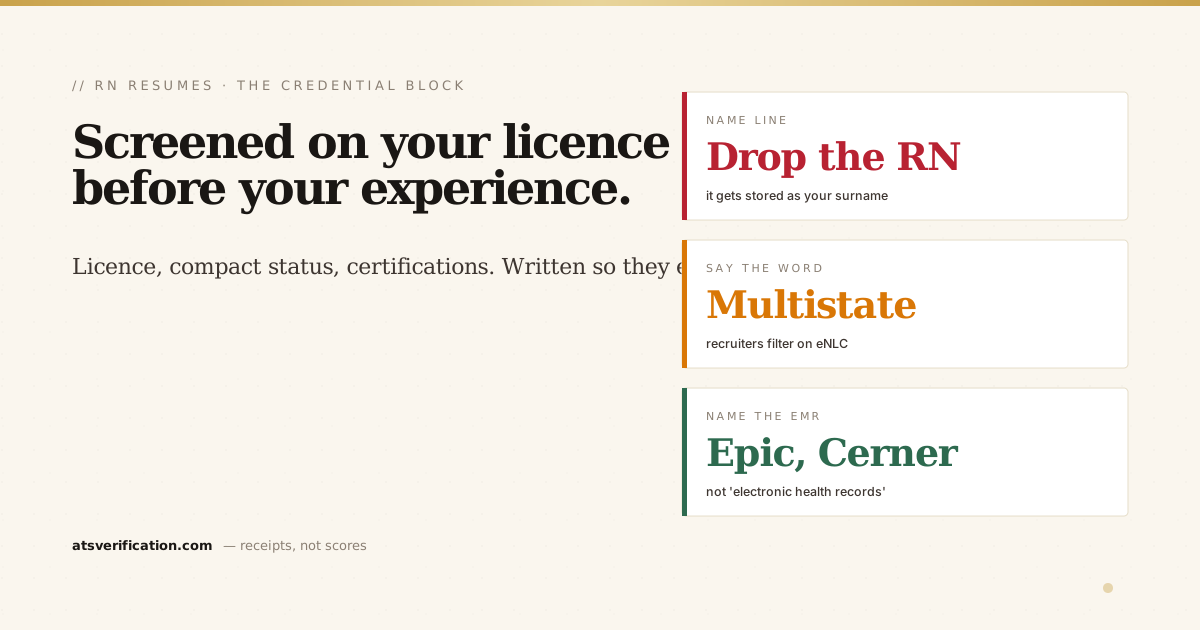
- Your license line is screened before your experience. Write it as plain text with the state, the type and the number, on its own line.
- Spell out compact status. "Multistate (eNLC)" is searchable. Assuming the recruiter will infer it from your home state is not.
- Certifications need both forms. Write "Advanced Cardiovascular Life Support (ACLS)" once, because some postings search the acronym and some the full name.
- Name your EMR. Epic runs 43.7% of US acute care hospitals and Oracle Health runs 21.9%, and "electronic health records" does not match either.
- Skills grids are the top failure. 41.7% of the resumes I scan have content flattened out of a table, and nursing templates lean on them heavily.
Why the credential block matters more here than anywhere else
A hospital receiving 300 applications for a med-surg opening is not reading 300 resumes. It is filtering on license type, license state, compact eligibility, specialty and required certifications, then reading what survives. Those filters run against fields extracted from your file or typed into the application form.
This is different from most professions, where the screening criteria are fuzzy and a recruiter forms an impression. Here the first pass is closer to a compliance check, and a compliance check has no tolerance for ambiguity. If the parser cannot find "RN" and a state, you are not a maybe. You are missing a required field.
So the credential block is not a formality you put at the bottom under "Additional". It is the most functionally important text on the page, and it should sit directly under your contact details.
The license line, written so it survives
Plain text, full page width, its own line:
LICENSURE AND CERTIFICATIONS

Registered Nurse (RN), Texas, License #123456, active through 07/2028
Multistate license (eNLC) — eligible to practice in all compact states
Basic Life Support (BLS), American Heart Association, exp. 03/2027
Advanced Cardiovascular Life Support (ACLS), AHA, exp. 03/2027
Certified Medical-Surgical Registered Nurse (CMSRN), exp. 11/2027
Four things are doing work there.
"Registered Nurse (RN)" written both ways. Job postings are inconsistent. Some search "RN", some "Registered Nurse". Writing it once in the long form with the acronym in brackets satisfies both, and it is the same principle that applies to every certification below it.
The state, spelled out. Not "TX". Some parsers normalise two-letter state codes and some do not, and a recruiter filtering for Texas-licensed candidates is searching the word.
The expiry date in an unambiguous format. A certification with no date reads as unverifiable. Write the month and year. Avoid the compressed forms that cause the 8.7% ambiguous-date failure rate in my data, which is covered in the date format guide.
The compact line, stated explicitly. This is the one people leave out.
Compact licensure, and why you should say it in words
The Nurse Licensure Compact, administered by NCSBN, now covers more than 40 jurisdictions. A multistate license issued in your home compact state lets you practise in the others without applying separately.
For a hospital in a compact state, that is a meaningful hiring advantage: it removes a delay from the start date. For a travel or per diem role it is close to a requirement.
And it is invisible unless you write it. A recruiter filtering for compact-eligible candidates is not going to look at "RN, Missouri" and mentally cross-reference the NLC roster. Put the word "multistate" and the abbreviation "eNLC" on the page. Two words, and they are searchable.
If your home state is not in the compact, say what you do hold, and say plainly whether you have applied for licensure by endorsement in the target state. Being upfront about a four-week endorsement timeline is far better than a recruiter discovering it after an interview.
Certifications: write both forms, once
Nursing is unusually acronym-dense, and the postings are not consistent about which form they use. The safe pattern is the full name with the acronym in brackets, exactly once, in the credential block.
- Basic Life Support (BLS)
- Advanced Cardiovascular Life Support (ACLS)
- Pediatric Advanced Life Support (PALS)
- Neonatal Resuscitation Program (NRP)
- Trauma Nursing Core Course (TNCC)
- Certified Critical Care Registered Nurse (CCRN)
- Certified Emergency Nurse (CEN)
Two things to avoid. Do not stack them into a two or three column grid to save space, which is the single most common failure in my data and is explained in what happens to tables. And do not put them in a coloured sidebar, which detaches from the document body for the reasons in the two-column guide.
Name the EMR. It is a keyword, not a detail.
Charting system experience genuinely shortens onboarding, and hospitals screen for it. According to KLAS research reported this year, Epic holds around 43.7% of US acute care hospitals and 56.9% of beds, with Oracle Health at about 21.9%. Between them that is roughly two thirds of the acute care market.
Which means the word on the posting is almost always "Epic" or "Cerner", not "electronic health records". Write the product name:
Systems: Epic (Rover, MyChart), Cerner PowerChart, Pyxis, Alaris,
Meditech
If you have used more than one, say so. A nurse who has charted in both Epic and Cerner is genuinely easier to place.
The experience section, in the units of the job
Nursing experience is quantifiable in a way most professions envy, and most RN resumes leave the numbers out. Every bullet should carry a scale.
Weak: Provided patient care on a busy medical-surgical unit.
Better: Delivered direct care on a 36-bed medical-surgical unit at a 1:5 nurse-to-patient ratio, precepting 4 new graduate nurses over 18 months.
The units that do work here: bed count, nurse-to-patient ratio, acuity level, patient volume per shift, number of nurses precepted, committee or council roles, and any measurable quality outcome such as a fall rate, a CAUTI or CLABSI reduction, or an HCAHPS movement you contributed to. The general method is in quantifying achievements.
Structure each role the standard way, title and dates on one line with the facility underneath, which is what lets a parser group a job correctly. Include the facility type and bed size, because "Regional Medical Center, 420 beds, Level II trauma" tells a hiring manager more than the name alone. The grouping mechanics are in the experience section guide.
What is actually breaking these files
Across 4,801 scanned resumes, 81.1% have at least one extraction failure. The nursing-specific version of that list:
- 41.7% have content trapped in a table or grid. On RN resumes this is almost always the certification block or the skills list, laid out in columns to fit.
- 26.6% have a name the parser cannot isolate. A common cause here is credentials on the name line. "Jane Doe, RN, BSN" is frequently stored with "RN BSN" as part of the surname. Put your name alone on line one and the credentials on the line below, or in the credential block. This is the same family of failure described in when the ATS cannot read your name.
- 16.7% use decorative bullets that extract as junk characters. The medical-cross and heartbeat glyphs some nursing templates use are exactly this.
- 10.8% use a two-column layout that scrambles reading order, which on a nursing resume usually means the licence block lands interleaved with the job history.
Which system you are applying into
Large hospital systems mostly run enterprise ATS platforms rather than anything healthcare-specific. Workday and Oracle Taleo are both common, and iCIMS shows up frequently in health systems too. Workday will show you the parsed version of your resume before you submit, which is the single best free diagnostic available: read that screen rather than clicking through it. There is more in the Workday guide, the Taleo guide and the iCIMS guide.
Travel nursing agencies are a different animal. Many use their own submission portals where a recruiter re-keys your details, which means your resume is being read by a human first. That does not license you to use a two-column template, because the hospital at the other end still receives a parsed profile.
The check, before you send anything
Open your resume, select all, copy, paste into a plain text file. Then read only the top third and ask:
- Is my name alone and intact on the first line?
- Can I see "Registered Nurse", a state, and a license number as readable text?
- Did every certification survive with its acronym and its expiry date attached?
- Is "Epic" or "Cerner" present as a word?
If those four are true, the compliance pass will find what it needs. If your certifications came out as one glued string, that is what the recruiter's database now contains. More on the method in the copy-paste test, and there is a plain single-column starting point on the nurse resume template page.
The percentages here come from a live counter that recounts on every page load. It read 4,801 resumes the day I wrote this.
→ Run the free scan and check your license block survives extraction