I read finance resumes from two directions. I spent four years in audit at KPMG and I now run finance for a region, which means I hire the people whose resumes I used to be. I also built a resume parser, so I see what happens to the file before either of us reads it. Two things are wrong with most accounting resumes in 2026. One is a credential line that has not caught up with a rule change that happened underneath it. The other is a translation failure that costs public accountants their first industry job.
- The 150-hour rule is no longer universal. More than 40 states have enacted alternative pathways, typically a bachelor's degree plus an extra year of experience.
- Name the state on your credential line. With pathways diverging, "CPA" alone now carries less information than it did two years ago.
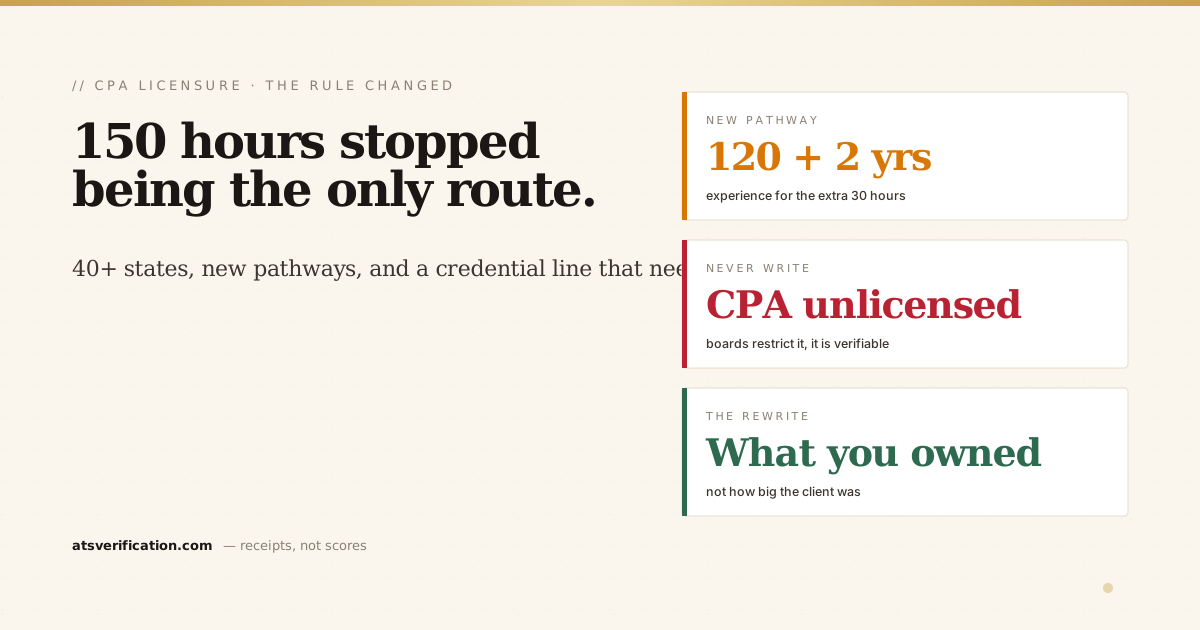
- Do not write "CPA" until you are licensed. State boards restrict the title. "CPA candidate, 3 of 4 sections passed" is honest and still searchable.
- Translate public accounting into business outcomes. "Audited a $2B manufacturer" tells a hiring manager nothing about what you can do for them on Monday.
- Name your ERP. SAP, Oracle, NetSuite and Workday Financials are searched as words. "ERP systems" is not.
The rule that changed under everyone
For about twenty-five years, the answer to "how do I become a CPA" was 150 credit hours, the exam, and an experience requirement. That was uniform enough that resumes could just say "CPA" and everyone knew what stood behind it.
That is no longer true. Responding to a sustained shortage of accountants entering the profession, states have been enacting alternative routes to licensure, and by 2026 more than forty have legislation on the books. The common shape is a bachelor's degree, roughly 120 credit hours, plus an additional year of qualifying experience in place of the extra thirty hours. The AICPA and NASBA have supported a multi-pathway model, and NASBA has moved toward individual-based mobility to keep licenses portable across state lines.
Two caveats that matter for how you write your resume. Adoption and effective dates vary state by state, so check your own board rather than a summary. And a handful of states have been slower to accept the new routes for reciprocity purposes, which means a license earned under a 120-hour pathway may face additional requirements if you later move somewhere strict.
What that means for the credential line
Because pathways now differ, the state has become part of the information. Write it:
Certified Public Accountant (CPA), licensed in Illinois, #123456Full name with the acronym in brackets, because postings search both forms. State named. Number included, because it is verifiable and costs you nothing.
If you hold licenses in more than one state, list them. If you are licensed in one state and working in another under practice privileges, say so plainly rather than leaving a recruiter to wonder.
If you are not licensed yet, be precise about it
This is the part I would push hardest on, because it is both an integrity question and a practical one.
The CPA title is restricted by state boards. Describing yourself as a CPA before you are licensed is not a rounding error, and in an industry that hires on trustworthiness it is the worst possible thing to be caught on. It also surfaces reliably, because licenses are publicly verifiable in seconds.
The honest versions are all still searchable, which is the good news:
CPA candidate — 3 of 4 sections passed (FAR, REG, AUD), remaining
section scheduled November 2026

CPA exam eligible — 150 credit hours completed, sitting from Q1 2027

CPA eligible under Ohio's alternative pathway — bachelor's plus
2 years qualifying experience, application submitted
Every one of those contains the string "CPA", which is what a keyword search matches on. You lose nothing by being accurate, and specificity about which sections you have passed is genuinely useful information to a hiring manager planning your workload around a study schedule.
The same applies to CMA, CIA, EA, ACCA and CFA. Write the stage you are actually at. "CFA Level II candidate" is a real credential-in-progress and reads well. "CFA" when you have passed Level I does not, and finance people notice.
The translation problem, which costs more than the credential
Here is the pattern I see constantly on resumes from public accounting, and it is the single biggest reason good auditors struggle to move into industry.
The resume describes the engagement. It does not describe the work.
Weak: Performed audit procedures for a $2B publicly traded manufacturing client.
That sentence tells me the client was large. It tells me nothing about what you can do. Every associate on that engagement could write the identical line, and hundreds have.
Better: Led revenue and inventory testing for a $2B manufacturer across 6 sites, rebuilding the cut-off testing approach and identifying a $4.1M misstatement in work-in-progress that had passed two prior cycles.
What changed is that the second version is about you. Scope, ownership, a decision you made, and an outcome. When I hire from public accounting, that is the only thing I am reading for: can this person own something.
The translation table that works, roughly:
- "Audited" becomes what you tested, at what scale, and what you found or fixed.
- Client size becomes portfolio scope: number of entities, revenue, sites, jurisdictions.
- Busy season becomes capacity: number of concurrent engagements, team size supervised, deadlines held.
- Technical memos become judgement: the standard applied and the position you took.
- "Assisted with" becomes what you actually did, or gets deleted.
The general method is in quantifying achievements, and STAR versus XYZ gives you a repeatable bullet shape. If you are making the public-to-industry move specifically, the career change guide covers reframing without overclaiming.
Name your systems, exactly
Finance job postings name products. "ERP systems" matches nothing.
Systems: SAP S/4HANA, Oracle NetSuite, Workday Financials,
Blackline, OneStream, Advanced Excel (Power Query, Power Pivot),
Alteryx, SQL
Write the ones you have genuinely used. Include the module or component where it is meaningful, because "SAP" and "SAP S/4HANA" are different claims, and a controller reading it can tell.
Lay them out as one line per category at full page width. Not in a grid, which is the most common parsing failure I see and is explained in how to list skills. Not with proficiency bars, which are drawn shapes that extract as nothing at all.
Timing, if you are recruiting from campus or from public
Public accounting recruits early and on a fixed calendar. Big 4 and large regional firms open internship and full-time campus recruiting in late summer through autumn for roles starting the following year, which is broadly the same window as the rest of American campus hiring and is laid out by industry in the internship timeline.
Experienced hires move on a different rhythm. The window after busy season, roughly May through August for calendar-year audit and again in the autumn, is when public accountants leave and when industry roles are budgeted to catch them. If you are planning an exit, having the resume ready before that window rather than during it is worth more than any wording change.
What the parser does to a finance resume
The content above only matters if the file survives extraction. Across 4,801 resumes scanned, 81.1% had at least one failure, and finance resumes are not exempt:
- 41.7% have content trapped in a table or grid. On accounting resumes this is usually the systems list or a client portfolio laid out in columns.
- 26.6% have a name the parser cannot isolate, and credentials on the name line are a frequent cause. "John Smith, CPA" is regularly stored with "CPA" attached to the surname, so a search for your actual name misses you. Put your name alone on line one and the credential underneath. See when the ATS cannot read your name.
- 18.1% have em dashes glued to adjacent words, which on a finance resume most often hits a date range or a dollar figure.
- 8.7% have ambiguous dates. Write Mon YYYY to Mon YYYY, per the date guide.
Structure each role with the title and dates on one line and the firm underneath, which is what lets a parser group a job. For promotions within a firm, which is the normal shape of a public accounting career, give each title its own date range or the parser will read associate through manager as one long job and your progression disappears. That specific mechanic is in the experience section guide.
The wider American conventions, including what to leave off, are in the US resume format guide, and there is a plain single-column starting point on the accountant template page. If you are targeting a controller or FP&A move rather than practice, the finance professionals guide goes further on that side.
The check
Copy your resume into a plain text file and read the top ten lines. Your name alone. Your credential line with the state on it. Your systems as separate readable words.
Then read one experience bullet at random and ask whether a stranger could tell what you personally did. If the answer is that you were present on a large engagement, rewrite it. That is the bullet costing you the interview, not the formatting.
The parsing figures come from a live counter that recounts on every page load. It read 4,801 resumes the day I wrote this.
→ Run the free scan and see whether your credential line survives extraction