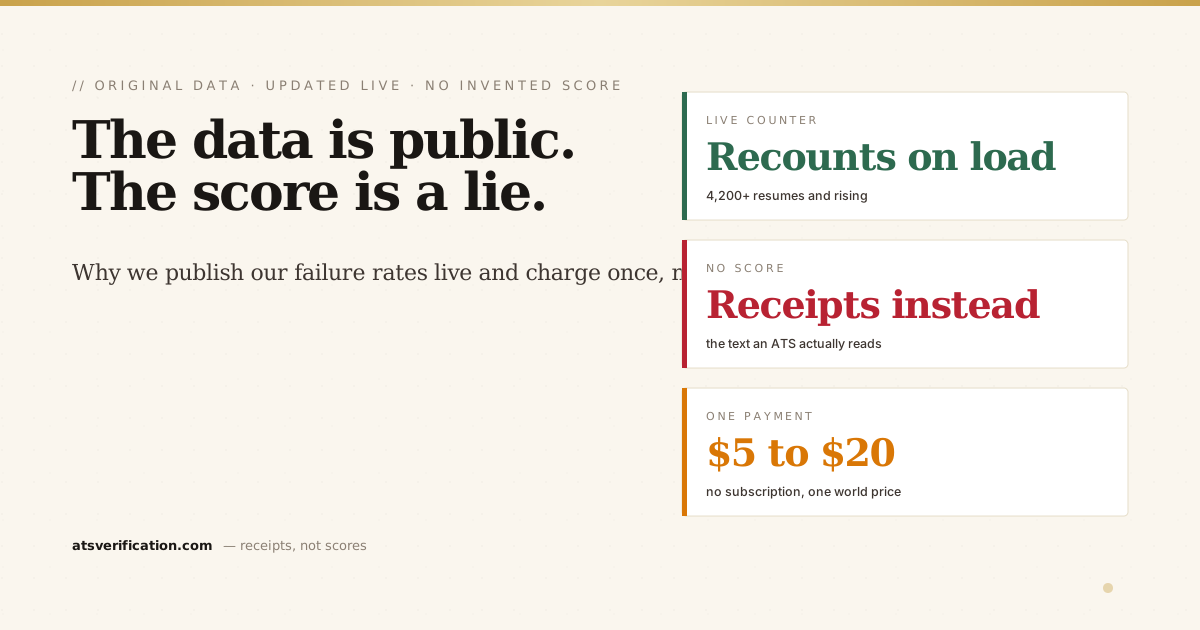
I built this in my evenings while working a finance job, so I never had the budget to compete on marketing. The only thing I could compete on was being straight with people. That turned out to mean three unusual decisions: publish the failure data live where anyone can audit it, refuse to show a match score because no applicant tracking system produces one, and charge once instead of monthly. Here is the reasoning behind each, including what they cost me.
- The data report recounts itself on every page load. Not a study, not a sample of files I chose, and not a number I typed into a slide. It moves while you read it.
- We show the extracted text, never a score. No real ATS grades your resume 0 to 100, so a tool that shows you one is selling a feeling.
- One payment, no subscription, one price worldwide. $5, $9, $14, or $20 for ten tailored versions. Nothing renews and nobody is charged more because of the country their IP address is in.
- Honesty has a measurable cost. Of every 1,000 people who run a free scan, roughly one or two ever pay. I publish that too.
- The free scan stays free. Every problem it finds comes with the instruction to fix it yourself in Word, at no charge, forever.
Nearly everything written about ATS is opinion
When I started reading about applicant tracking systems, almost everything I found fell into two groups. Opinion pieces by people who had never seen parser output, and vendor blog posts built on a handful of test files the vendor made themselves. Both are easy to write. Neither tells you how often a thing actually goes wrong in real resumes written by real people.
So I counted. Every resume that goes through the scanner increments an anonymous tally: which failures were detected, nothing else, no file kept, no name, no content. The ATS Data Report reads those counters when the page loads. Refresh it and the number changes, because someone uploaded a resume while you were reading. As I write this it says 4,210 resumes. By the time you read it, it will say something else.
I do not know of another checker that does this. I would genuinely like to be wrong about that, because the category would be better if more people published their failure rates instead of their marketing claims.
The part where I show you the awkward number
That page carries two different denominators, and rather than smooth it over, here is why.
The individual failure rates, like 41.5% for a skills table flattening into one glued word, are counted out of every scan tracked, currently 4,210. The headline figure, that around 82% of resumes have at least one detected issue, comes out of a smaller sample, currently 1,897, because the clean-rate counter started later than the per-issue counters. The page labels it n=1,897 next to the percentage rather than quietly borrowing the bigger number.
A tidier page would show one big number everywhere. It would also be wrong. If I am asking you to trust a figure about your own job search, you should be able to see exactly what it was measured on, including when that is less impressive than it could look. The full counting method is on the methodology page.
When I posted this data to r/resumes, it reached over a thousand upvotes and 177 comments, and a fair number of those comments were people telling me I was wrong, or that the parsers were at fault rather than the applicants. I answered them one by one and published the twelve most common questions in the follow-up, including the ones where the commenter had the better argument.
Why there is no score
The single most requested feature I get is a match score out of 100. I will not add it.
No applicant tracking system hands your resume a grade. The first gate is pass or fail: can the software turn your file into text, and can it work out which piece is your name, your last job title, your dates. After that, a recruiter searches a database for keywords. There is no 87 out of 100 anywhere in that pipeline, so any number a checker shows you was invented by the checker. It feels like information and it is decoration. We wrote up how the real mechanics work in how ATS scoring actually works, and why scoring tools disagree with each other in are ATS checkers accurate.
What you get instead is the extracted text, shown next to your original, with every detected failure named and a one-line fix for each. Receipts, not scores. It is less satisfying than a number going up, and it is the only thing on the page you can act on.
What honesty costs, in numbers
Refusing the score costs conversions, because a score is a very good hook. Publishing the data costs the ability to claim whatever is convenient. And the free scan being genuinely useful costs the most of all: of every 1,000 people who run one, roughly one or two ever buy anything. Most people read their findings, fix the file themselves in Word, and never come back. That is the product working as intended, and it is a terrible funnel.
I have also tested paid advertising on several channels and it produced essentially nothing, because the economics of a $5 to $20 one-time product cannot support a paid click. Everything that works is slow: writing what I know, answering questions in public, and people telling other people.
Why the price is what it is
The scan is free. The rebuild is $5. Add AI-written bullets and it is $9. Add a version tuned to a specific job description and it is $14. The Job Search Pass, which is a rewrite plus ten job-tailored versions, is $20, which works out at $2 per application.
Three deliberate constraints sit behind those numbers.
- Nothing renews. There is no subscription and no account to cancel. Most tools in this category bill monthly, and a job search lasts months, so the real cost of a subscription is rarely the number on the pricing page. You pay us once and we are done.
- One price for everyone. We do not adjust the price based on the country you are browsing from. I built the machinery for regional pricing, ran it for a day, and switched it off. Charging one person more than another for identical work because of their IP address is not something I wanted to defend, and the cheaper price was not the reason people hesitated anyway.
- A refund that requires no explanation. Thirty days, one email, no questions. If a promise like that is expensive, the product is the problem.
I am also not going to pretend $5 is nothing. For a student in Karachi or Lagos it is real money, which is why the next section matters more to me than the pricing does.
If you are a student or a new graduate
The market you are entering is genuinely harder than the one described in most careers advice. A single graduate opening can attract thousands of applications within days, and almost none of them are read by a person before software has ranked them. You are competing for a recruiter's attention against a database query, and nobody teaches this.
So here is the honest advice, and none of it requires paying me.
- Run the free scan and read the findings. Every issue comes with instructions to fix it yourself in Word. That is not a trial or a teaser. It is the whole diagnosis.
- Do the free tests. Copy your PDF into Notepad and read what comes out; that is close to what the parser receives. The copy-paste test explains what to look for. Better still, start an application on a real careers site and read the fields it autofills from your resume before you submit. That preview is the employer's own parser showing you its work.
- Fix the structure before you polish the words. One column, plain text, standard headings, dates on the same line as the job title. Most of what breaks is a template decision, not a writing problem, and it takes about twenty minutes to undo.
- Start from the graduate guides. ATS resumes for fresh graduates and the recent graduates page cover the version of this with no work history to lean on.
If you do all of that and your file still comes out scrambled, the rebuild is there for $5, and if it does not help, ask for your money back and you will get it. If you cannot spare the $5, use the instructions. I would rather you got the job.
How to check any of this
Everything above is falsifiable, which is the point.
- The failure data is on the data report, live, no login, no signup. Check it today and again next month.
- The counting method and the extraction libraries are described on the methodology page; the text layer is read with the same open-source engine that real systems rely on.
- The absence of a score is visible in about ten seconds: run a free scan and see that no number is offered.
- Whether we are safe to upload to is answered, with the retention policy, in is it safe to upload your resume to a checker. Files are deleted 60 seconds after scanning.
- Who I actually am is on the about page, with my real name on it.
→ Run the free scan, see the text an ATS reads, and decide for yourself whether the paid part is worth $5