In November 2026 I built a federal resume checker for this site. To write its rules I went through the Office of Personnel Management's guidance sentence by sentence, and I made six example federal resumes to test it. Doing that taught me something I had not planned to learn: almost everything that makes a federal resume correct makes a private-sector resume worse. If you are leaving government, the document that got you hired there will work against you at a company, and the reasons are specific enough to fix in an afternoon.
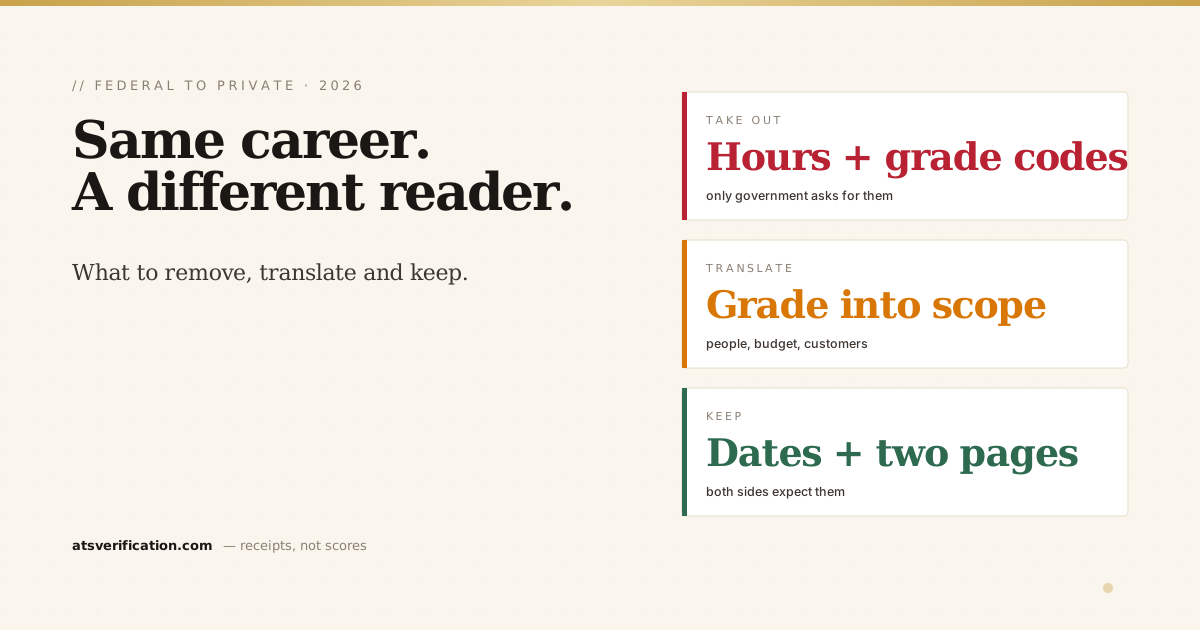
- Remove what only government asks for: hours per week, series and grade codes, announcement numbers and supervisor details.
- A grade means nothing to a recruiter. Replace it with scope: how many people, how much money, how many customers or cases.
- Federal descriptions prove you met a requirement. Company bullets show a result. Same work, different sentence.
- Keep the dates and keep two pages. Since September 2025 your federal resume is already two pages, so length is no longer the problem.
- A company's software ranks you on the wording of its job posting. Government wording will not match it until you rewrite it.
Why the same resume fails on the other side
A federal resume is written for a human resources specialist who has to confirm that you meet a written standard. OPM's applicant guidance lists what that person needs for every job: the title and employer, the series and grade for federal positions, start and end dates, hours per week, and a short description that shows you can do the work at the level the announcement asks for. I wrote those into our federal resume checker as rules, because a specialist cannot credit experience they cannot measure.
A company reads for something else. Nobody there has a written standard to check you against. A recruiter gives the page a short look to decide whether you have done this kind of job at this kind of size, and before that, software has usually ranked your file against the words in the job posting. I explain how that ranking works in how ATS scoring works. Neither the recruiter nor the software knows what a GS-13 is.
What to take out
- Hours per week. Government needs it to count your experience. A company reads "40 hours per week" as an odd thing to say.
- Series and grade codes. "GS-0343-12" is noise outside government. Keep the job title, drop the code.
- Announcement numbers, pay plans and step. None of it helps a reader who has never seen USAJOBS.
- Supervisor names and phone numbers. OPM's current guidance no longer lists them even for federal resumes. A company will ask for references later.
- Salary. Leave it off. In the private sector it weakens your position before you have spoken to anyone.
- Citizenship and veterans' preference lines. They are part of a federal application, and they do nothing on a company resume. If you are a veteran, say so in the experience itself.
What to translate
The grade becomes scope. A grade tells a federal reader how senior you were. Outside, seniority is read from numbers: the size of the team, the budget you were trusted with, how many offices, customers or cases your work covered. I looked for an official table that turns a GS grade into a company job title and did not find one, so do not write "equivalent to Senior Manager". Show the scope and let the reader place you.
The title becomes one a company uses. "Management and Program Analyst" is a real federal title that few companies advertise. Look at the postings you want and see what they call the same work: operations analyst, program manager, business analyst. Two official tools help you find those names. The Equal Employment Opportunity Commission publishes a table that matches every federal job series to a standard occupation code, and the Department of Labor's O*NET crosswalk turns that code into the occupation as companies describe it. Neither was built for job hunting, but together they work. Keep your true title on the page and make the matching words appear in your summary and bullets. Changing the title itself to something you never held is a mistake, because a background check will show the real one.
Acronyms become plain words. Every agency has its own. Spell out anything a stranger would not know, and drop internal system names unless the posting asks for them. A commercial tool such as SAP, Salesforce or Power BI is worth naming. An in-house system that exists only at your agency is not.
Duties become results. This is the largest change. Federal descriptions are written to prove you performed a duty at a level. Company bullets are written to show what changed because you did it. My guide to putting numbers on your achievements covers how to find a number when you think you have none.
One job, before and after
This example is invented for illustration. It is not a real person.
| Federal version | Private-sector version |
|---|---|
| Management and Program Analyst, GS-0343-12 Example Agency, Denver, CO 03/2021 to 09/2025, 40 hours per week Served as lead analyst for bureau performance reporting. Analyzed program data and prepared quarterly reports for senior leadership. Coordinated with six program offices to collect and validate measures. |
Management and Program Analyst Example Agency, Denver, CO Mar 2021 to Sep 2025 Led quarterly performance reporting for a $40M program across six offices. Cut report preparation from 15 working days to 9 by replacing manual collection with one shared template. Briefed senior leadership each quarter; two of the measures I introduced are still in use. |
Nothing in the right-hand column is new work. The code and the hours are gone, the budget and the six offices have moved to the front, and each line now ends in something that changed.
What to keep
- Month and year dates. Companies and their software expect them too.
- Two pages. Federal resumes have been limited to two pages since 27 September 2025, as I cover in the federal resume and USAJOBS guide. That is also the upper limit most companies want: the Department of Labor's CareerOneStop resume guide says "Resume length should be 1-2 pages." OPM itself said the two-page limit would "make it easier for job seekers to move between the private and Federal sectors." With a few years of experience, one page is often enough, and this guide helps you choose.
- Your clearance, if you hold one. For defense and government contractors it can be the most valuable line on the page. State the level and whether it is active. Say nothing about the work it covered.
- Education, licenses and certifications. These read the same on both sides.
Add what a company expects
Many federal resumes have no summary, because the specialist is checking requirements and does not need one. A company reader does. Three lines at the top that say what you are, the scale you worked at and one result give a recruiter the answer they are scanning for. I collected twelve that work in resume summary examples.
Then match each posting. Take the five or six skills the posting repeats and make sure the ones you truly have appear in your bullets in the same words. That is how you get past the ranking software without stuffing, and this guide shows the method. For layout, follow the US resume format rules: one column, standard headings, no tables around your experience.
One rule to check before you interview
Federal ethics law follows you out of the door. The Office of Government Ethics sets out the main post-government employment restrictions in a legal advisory and is clear that none of them stops a former employee "from accepting employment with any particular private or public employer." What they limit is what you may do afterwards on matters you handled in government, and there are separate rules about job hunting while you still hold your post. I am not an ethics adviser. Your agency's ethics official is, and that conversation is free.
Before you send it
Two checks, both free. Read the page as a stranger would and circle every word that only makes sense inside government. Then run the file through our free scan to see the text that hiring software will extract from it, because a resume that has been copied from one layout into another sometimes carries formatting that does not survive.
If you are applying to both sides at once, keep two files. Our federal resume examples show the government version for six common series, and this page is the other half. If you stay in the federal system, builder or upload covers how to get that version into USAJOBS, and veterans have their own guide. The work you did is the same in both. Only the reader changes.